

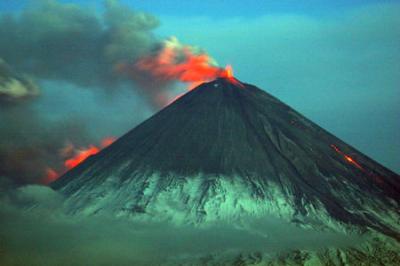




Klyuchevskoy (pronounced Kloo-shef-skoy), a stratovolcano located in the north central region of the Kamchatka Peninsula, is blasting ash up to 32,000 feet in the air, and has diverted air traffic headed toward the Far East.

This is the largest eruption to occur in the North Pacific in a decade, and is providing students at the University of Alaska Fairbanks a unique opportunity to collaborate with scientists, as well as state and federal agencies.

Klyuchevskoy’s been erupting since January, but the largest explosions in the eruption began June 28, 2007.

These explosions created a 1,360-mile-long band of ash, stretching from the Sea of Okhotsk to the Aleutian Islands, clogging well-used air routes with volcanic ash that prove deadly for aircraft.

An international working group under the direction of Wolfgang und Roswitha Wiltschko of Frankfurt University has now succeeded in demonstrating the presence of a magnetic sense of direction in domestic chickens.

40 years ago, Prof. Dr. Wolfgang Wiltschko was the first to prove that migrating robins use the Earth’s magnetic field to direct themselves during migration.

Their magnetic sensor showed them the course of the field lines of the Earth’s magnetic field. This produces an inclination compass that reacts to the inclination of the Earth’s magnetic field to the surface of the Earth, thus distinguishing between “pole-wards” (the side on which the field lines incline downwards) and “equator-wards” (the side on which they incline upwards).

Geodesists from the University of Bonn have remeasured the size of the Earth in a long lasting international cooperation project.

The blue planet is accordingly some millimeters smaller than up to now assumed. The results are important, for example, to be able to demonstrate a climate contingent rise in sea level.

From the deepest seafloor to the highest mountain, from the hottest region to the cold Antarctic plateau, environments labelled as extreme are numerous on Earth and they present a wide variety of features and characteristics. Investigating life processes in extreme environments not only can provide hints on how life first appeared and survived on Earth (as early earth was an extreme environment) but it can also give indication for the search for life on other planets.

Insects make up more than half of the known animal species on our planet and they can be found in all kinds of habitat and feed on all kinds of nutrients. They can even be used in evidence in court cases. So we are talking about forensic entomology.

The work of the Forensic Entomology Service in the Department of Zoology and Animal Cell Biology at the University of the Basque Country (UPV-EHU) involves drawing up a census of insect species of forensic interest.

These are basically necrophagous diptera, i.e. flies that live on dead tissue, cadavers. Such flies detect a dead body in a question of minutes and at times at a distance of several kilometres. They colonise the cadaver and lay their eggs there.

A gene that is strongly associated with a risk of developing childhood onset asthma was identified by an international team of scientists, whose findings are published today in the journal Nature.

In a genetic study of more than 2,000 children, scientists from the University of Michigan and colleagues from London, France and Germany found genetic markers that dramatically increase a child's risk for asthma. These markers are located on chromosome 17, and children with this marker had higher levels of a new gene called ORMDL3 in their blood, which occurs in higher amounts in children with asthma. The presence of the disease-associated version of ORMDL3 increases the risk of asthma by 60-70 percent, the study suggests.

A team of biomedical engineers at Virginia Tech and the University of California at Berkeley has developed a new minimally invasive method of treating cancer, and they anticipate clinical trials on individuals with prostate cancer will begin soon.

The process, called irreversible electroporation (IRE), was invented by two engineers, Rafael V. Davalos, a faculty member of the Virginia Tech–Wake Forest University School of Biomedical Engineering and Science (SBES), and Boris Rubinsky, a bioengineering professor at the University of California, Berkeley.

Seriously.

You buy more salad dressing from Paul Newman under his own label than you would if he were in commercials for someone else, research says.

Endorsements by the rich and famous have long been a staple of the advertising industry. They can give otherwise mundane products, like razors or carpet cleaners, new cachet. Market research has shown repeatedly that celebrities can "instantly" add personality and appeal to even unknown products and make or break recognized brands.

Eating about 30 calories a day of dark chocolate was associated with a lowering of blood pressure, without weight gain or other adverse effects, according to a study in the July 4 issue of JAMA.

Previous research has indicated that consumption of high amounts of cocoa-containing foods can lower blood pressure (BP), believed to be due to the action of the cocoa polyphenols (a group of chemical substances found in plants, some of which, such as the flavanols, are believed to be beneficial to health).

“A particular concern is that the potential BP reduction contributed by the flavanols could be offset by the high sugar, fat and calorie intake with the cocoa products,” the authors write. The effect of low cocoa intake on BP is unclear.

