


Biologists at the universities of York and Exeter have published new research which shows that an ancient symbiosis is founded entirely on exploitation, not mutual benefit.

The researchers concluded that a single-celled protozoa called Paramecium bursaria benefits from exploiting a green algae which lives inside it, providing its host with sugar and oxygen from photosynthesis.

Scientists have been debating for decades whether symbioses, like the Paramecium-Chlorella association, are based on mutual benefit or exploitation.

The common belief among academics was that both the protozoa and algae benefit.

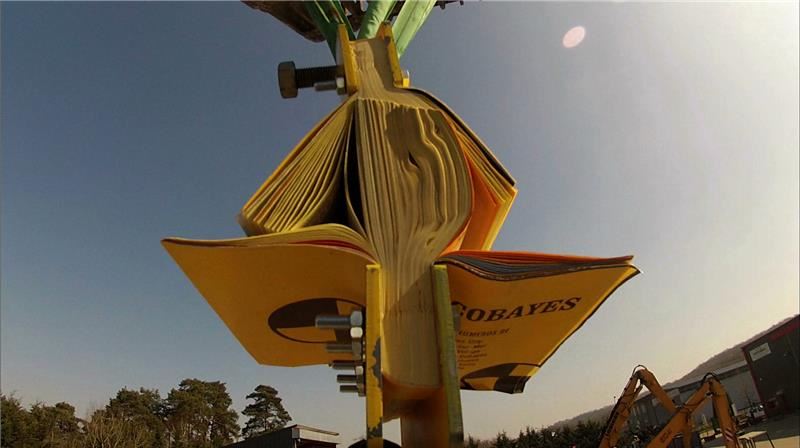
No matter how much force is applied (within reason, no hammer of Thor stuff) you can't separate two interleaved phone books by pulling on their spines.

A new experiment shows it is even possible to suspend a car from them.

Using a model that reproduces the traction and friction forces involved, researchers at the Laboratoire de Physique des Solides (CNRS/Université Paris-Sud), Laboratoire Gulliver (CNRS/ESPCI ParisTech), Laboratoire de Génie des Procédés Papetiers (CNRS/Grenoble INP) and McMaster University in Canada have shown that when the spines of the interleaved phonebooks are pulled on vertically, part of the vertical force is converted into a horizontal force that presses on the sheets. The pages then remain stuck together due to friction. 
Wikipedia may be wildly inaccurate but at least it isn't dangerous. For really dangerous advice, the assumption has been to go on Internet health forums. 

Faint praise, but a new analysis suggests that medical advice given on Internet health forums may be of better quality than people tend to assume. They focused on three popular online discussion forum websites - reddit, mumsnet and Patient.
As a follow-up of yesterday's post on the very opportune Pomeranchuk prize given to Stan Brodsky, I would like to report here on a funny anecdote Stan related to me today. The anecdote is interesting to all of us who believe the world of physics research is fully trans-national - well, it is, but there is apparently some more work to do to improve the situation further.
I was quite happy to hear today that Stan Brodsky, a professor of particle physics and astrophysics at Stanford University, has received together with Victor Fadin the 2015 Pomeranchuk Prize from the Russian Institute for Theoretical and Experimental Physics (ITEP) of Moscow. Stan is a great guy and his contributions to QCD  are of wide range. 

COLLEGE STATION - Two Texas A&M University scientists highlighted the conservation benefits of ecotourism worldwide and said a recent research review citing the dangers of ecotourism to wildlife is premature and problematic.

Dr. Lee Fitzgerald, a conservation biologist, and Dr. Amanda Stronza, an anthropologist, published a critique of a recent review in the scientific journal Trends in Ecology and Evolution that proposed tourism may increase the vulnerability of wildlife to predators.

"There have been some claims that have drawn media attention, saying that nature tourism and ecotourism can hurt wildlife and can even make wildlife more vulnerable to predators and poaching," Fitzgerald said.

In the rush to solve mainstream media stories about airline passengers sitting on the place on the tarmac for hours and hours, the U.S. Department of Transportation's 2010 Tarmac Delay Rule glossed over concerns that it would lead to more delays and cancellations - exactly what has happened.

As a result, it takes most air passengers far more time to reach their destination for all pasangers than ever occurred for a few during lengthy tarmac delays, according to a study in Transportation Research Part A: Policy and Practice.

Following a heart attack or other heart trauma, the heart is unable to replace its dead cells. Patients are often left with little option other than heart transplants, which are rarely available, or more recently cell therapies that transplant heart cells into the patient's heart. In far too many cases, however, the transplanted heart cells do not engraft well, resulting in poor recovery.

Trophy hunting shouldn't be banned but instead it should be better regulated to ensure funds generated from permits are invested back into local conservation efforts, according to a new paper co-authored by a leading University of Adelaide conservation ecologist.

Professor Corey Bradshaw, from the University of Adelaide's Environment Institute, along with Enrico Di Minin from the University of Helsinki and Nigel Leader-Williams from the University of Cambridge, argue that banning trophy hunting would do more harm than good in African countries that have little money to invest in critical conservation initiatives.

We age because the cells in our bodies begin to malfunction over the years. This is the general view that scientists hold of the ageing process. For example, in older people the cells' internal quality control breaks down. This control function usually eliminates proteins that have become unstable and lost their normal three-dimensional structure. These deformed proteins accumulate in the cells in a number of diseases, such as Parkinson's and Alzheimer's.


