




Article I, Section 8, Clause 8 of the U.S. Constitution (1787) "[T]he Congress shall have power . . . to promote the progress of science and useful arts, by securing for limited times to authors and inventors the exclusive right to their respective writings and discoveries."

If you're going to break the law, you might as well do it in style. Why bother speeding, shoplifting, or stealing cable service, when the sky's the limit? Aim high.
Facebook traffic and news items tell us a lot of Americans of northern European extraction are anxious and even fearful about the prospect that White Americans will soon be a minority. A subset seems further offended by court decisions bestowing civil rights on gay people. Another subset is inflamed over removals of the Confederate battle flag from public spaces. Then there are environmental regulations that seem to snatch job opportunities from an already embattled middle class – and other kinds of federal regulation that have set some Whites on anti-government, secessionist, or survivalist paths.

Hundreds of millions of times every year many of us turn to online symptom checkers to try to self-diagnose our symptoms and to get advice on whether we should seek further medical care or just rest at home until we feel better.

But how good is the information we receive?

The first wide-scale study of the accuracy of general-purpose symptom checkers found that while the online programs are often wrong, they are roughly equivalent to telephone triage lines commonly used at primary care practices--and they are better than general Internet-search self-diagnosis and triage. The study, led by researchers at Harvard Medical School, is published in the BMJ.

Outcomes following the arthroscopic repair of rotator cuff tears in older athletes appears to be successful a majority of the time, according to research presented today at the American Orthopaedic Society for Sports Medicine's (AOSSM) Annual Meeting in Orlando, Florida.

"Seventy-seven percent of our patients who had an arthroscopic repair of a full thickness rotator cuff tear, were able to return to their sport at a similar level of intensity," said lead author, Peter Millett, MD, MSc, from the Steadman Philippon Research Institute in Vail, Colorado.

Snacking is the new American pastime, acccording to the recent survey by Mintel which found that nearly all Americans (94 percent) report snacking at least once a day and 50 percent of adults snack two to three times per day.

Random-access memory, or RAM, is where computers like to store the data they're working on because a processor can retrieve data from RAM tens of thousands of times faster than from the computer's disk drive.

The Community Preventive Services Task Force (Task Force) recommends the use of combined diet and physical activity promotion programs to provide counsel and support to patients at increased risk for type 2 diabetes. A systematic review of 53 studies describing 66 programs found strong evidence that such programs are effective for reducing new onset diabetes. A separate review of economic evidence (28 studies) found these interventions to be cost-effective. The recommendation statement and evidence reviews are published in Annals of Internal Medicine.

Protein trumps carbohydrate and fat as the regulated parameter driving human food consumption:

Kevin Hall and Carson Chow published their estimation (in 2010) that the rise of obesity prevalence in the U.S. since the 1970s can be attributed to an increase in consumption of just seven calories per day per person. This is calculated by taking the average increase of energy stored in the heavier adult bodies of the present day, divided by the very long time frame it took for the change to occur.

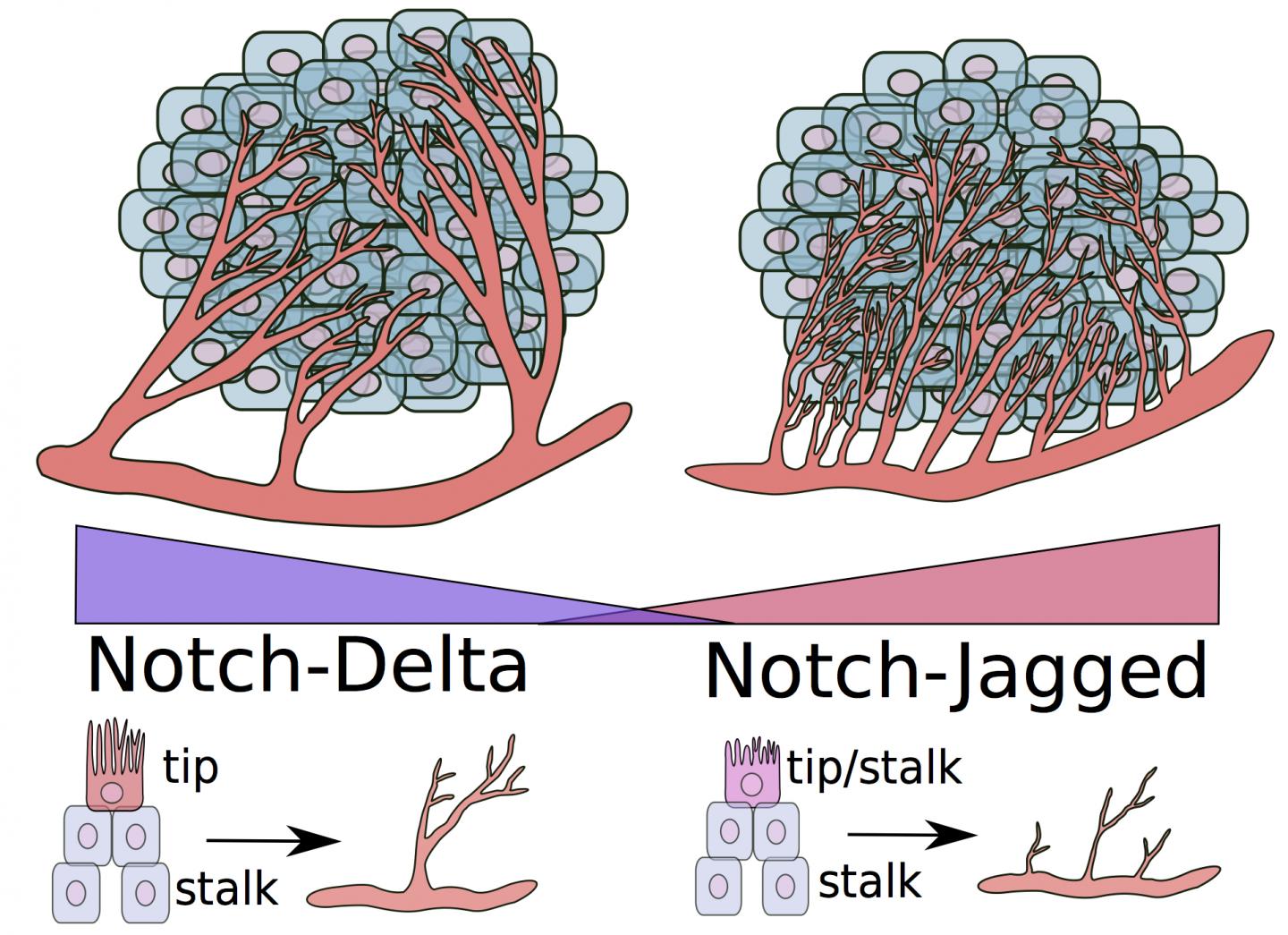
Researchers have built a simulation to show how cancerous tumors manipulate blood-vessel growth for their own benefit.

Like all cells, those in tumors need access to the body's fine network of blood vessels to bring them oxygen and carry away waste. Tumors have learned to game the process called angiogenesis in which new vessels sprout from existing ones, like branches from a tree.

But some details have been hidden until now.

New research at Rice University shows how tumors create chaos in the development of neighboring blood vessels, causing them to grow too quickly and not form properly. Credit: Marcelo Boareto/Rice University

The reported observation of a resonant state of a J/psi meson and a proton in the decay of the Lambda_b baryon by the LHCb collaboration, broadcast by CERN today, is a very intriguing new piece of the puzzle of hadron spectroscopy - a topic on which many brilliant minds have spent their life in the course of the last half century.

