





A recent study showed that a virtual reality cognitive training game could be a screening tool for patients with mild cognitive impairment (MCI) among a sample of older adults. Mild cognitive impairment  is a condition that often predates Alzheimer's disease and is characterized by memory loss and inability to execute complex activities such as financial planning. 

The CMS Collaboration at the LHC collider has recently measured a non-negligible rate for the fraction of Higgs boson decays into muon-tau pairs, as I reported in this article last summer. The observation is not statistically significant enough to cause an earthquake in the world of high-energy physics, and sceptics like myself just raised a gram of eyebrows at the announcement - oh yeah, just another 2-sigma effect. However, the matter becomes more interesting if there is a theoretical model which allows for the observed effect, AND if the model is not entirely crazy.
By Marsha Lewis, Inside Science

(Inside Science TV) – Everything from food, to air to water runs the risk of becoming contaminated. Now, chemists at the Lawrence Livermore National Laboratory in California have developed a technology that can detect and track dangerous particles in food and in the air.

“The DNA in the material can be used to identify those particles," said George Farquar, a chemist at Lawrence Livermore National Laboratory.

With the technology, called DNA Trax, researchers create tiny sugar-based particles and label them with a unique DNA signature. The particles can be sprayed onto food or released into the air to track the source of contaminants.

Donate data like blood and we can look for answers in the patterns we find. nomadFra/Shutterstock

By Anya Skatova,University of Nottingham and James Goulding, University of Nottingham


Dearcmhara shawcrossi, Scottish dino-fish. Todd Marshall

By Stephen Brusatte, University of Edinburgh

Today my colleagues and I had the great privilege to announce a remarkable new discovery: a dolphin-like reptile that prowled the Middle Jurassic waters 170 million years ago.

Many cancer survivors face physical and mental challenges, such as sexual dysfunction or anxiety about getting cancer again or financial hardships, even decades after the treatment is ended.  

Finding ways to help will become increasingly important because more cancer patients are living many years after treatment. The number of U.S. survivors is expected to top 19 million by 2024. While most survivors do well after treatment, some experience continuing problems that can significantly impair their quality of life well beyond the 5-year survival milestone. The problems and challenges can vary by the type of cancer patients had and the treatments they received. 


Why do discussions of creative genius so often happen about white male writers such as Jonathan Franzen? AAP Image/Harper Collins

By Natalie Kon-yu, Victoria University

Recent results of a study finds that that sensor changes have significantly biased temperature observations from the Snowpack Telemetry (SNOTEL) station network.
More than 700 SNOTEL sites monitor temperature and snowpack across the mountainous western U.S. SNOTEL provides critical data for water supply forecasts. Researchers often use SNOTEL data to study mountain climate trends and impacts to mountain hydrology and ecology. 

University of Montana and Montana Climate Office researcher Jared Oyler and colleagues applied statistical techniques to account for biases introduced when equipment was switched at SNOTEL sites in the mid-1990s to mid-2000s.

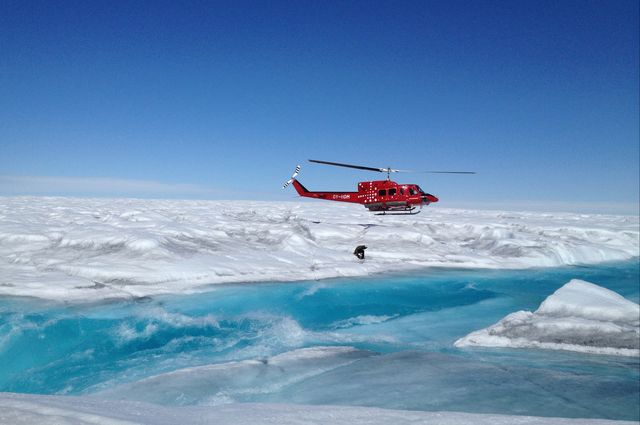
The massive ice sheet that covers about 80 percent of Greenland is the largest single chunk of melting snow and ice in the world
and for that reason it is considered the biggest potential contributor to rising sea levels due to glacial meltwater in a warming world.

What gets the most media, and therefore a lot of research, attention is the ice sheet's aquamarine lakes -- bodies of meltwater that tend to abruptly drain -- and monster chunks of ice that slide into the ocean to become icebergs.

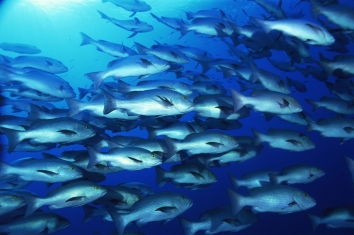
A team of scientists has identified how a "sixth sense" in fish allows them to detect flows of water, which helps resolve a long-standing mystery about how these aquatic creatures respond to their environment. The work in Physical Review Letters illustrates how sensory systems evolve in accordance with physical principles while also offering a framework for understanding how sensory networks are structured.

