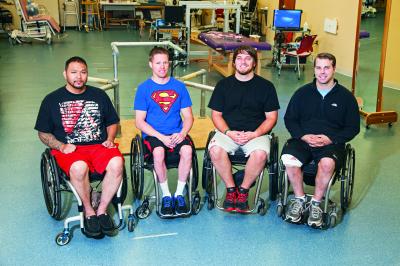
Four young men who have been paralyzed for years achieved groundbreaking progress — moving their legs.
Writing in the journal Brain, the researchers from the University of Louisville, UCLA and the Pavlov Institute of Physiology say the breakthrough is a result of epidural electrical stimulation of the spinal cord. All four participants were classified as suffering from chronic, motor complete spinal cord injuries and were unable to move their lower extremities prior to the implantation of an epidural stimulator. The stimulator delivers a continuous electrical current to the participants' lower spinal cords, mimicking signals the brain normally transmits to initiate movement.
Researchers have developed a system allowing neurophysiologists to share raw data with each other, something they hope will generate new discoveries in the field.
The first type of data they collected and standardized are recordings of so called ‘retinal waves’. During early development, retinal neurons generate signals that rapidly spread across from one cell to another, much like a Mexican wave in a football stadium. These patterns of activity are thought to help forge the neural connections from the eye to the brain.
We can identify an athletic body by analysis of their skeletons because bones show remarkably rapid adaptation to both the intensity and direction of strains. Put under stress through physical exertion – such as long-distance walking or running – they gain in strength as the fibers are added or redistributed according to where strains are highest.
Can you put a price on ecological restoration? Of course you can. In fact, you must, or the discourse will be taken over by activists for whom price is no object. In the real world, an evidence-based price on clean water and soil fertility helps the United Nations set ecological restoration targets for degraded and deforested land.
Forests provide essential ecosystem services for people, including timber, food and water. For those struggling with the after-effects of deforestation, the main hope lies in rebuilding forest resources through ecological restoration.
Researchers at Bournemouth University have shown that placing a monetary value on ecosystem services provides a mechanism for evaluating the costs and benefits of reforestation activity.
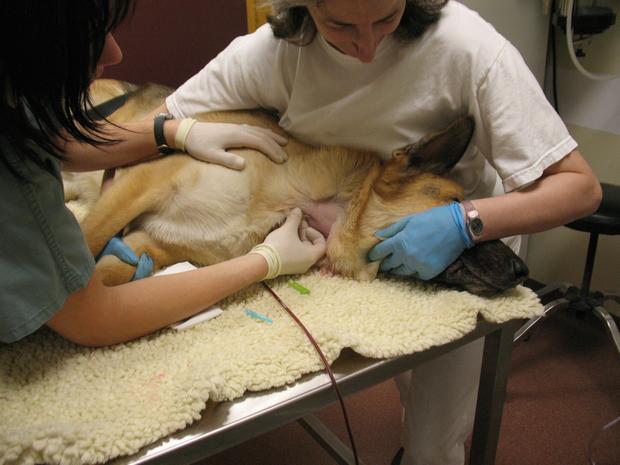
What makes a good blood donor? A willingness to welcome anyone who enters the room, it seems, and names like Don Juan, Napoleon, Gucci, Azur, and Marissa don't hurt either.
“I chose them for their hematological characteristics, but also for their good disposition. We didn’t want cats that would be stressed when handled or that needed excessive sedation,” said Dr. Marie-Claude Blais, Professor at the University of Montreal’s Faculty of Veterinary Medicine.
Previous expansions in Medicaid eligibility by states were not associated with an erosion of perceived access to care or an increase in emergency department use - so why are so many now complaining that no doctors will take Medicaid?
The problem is compounded by the fact that low-income uninsured adults in states that opted not to expand Medicaid eligibility as part of the Patient Protection and Affordable Care Act appear to have more health-related issues than those uninsured adults living in states that expanded public insurance coverage.
Rapid eye movements, known as saccades, have been a source of a nature versus nurture debate.
One hypothesis has been that this neurological behaviour is a product of culture in people of Chinese origin. A new study casts doubt on that.
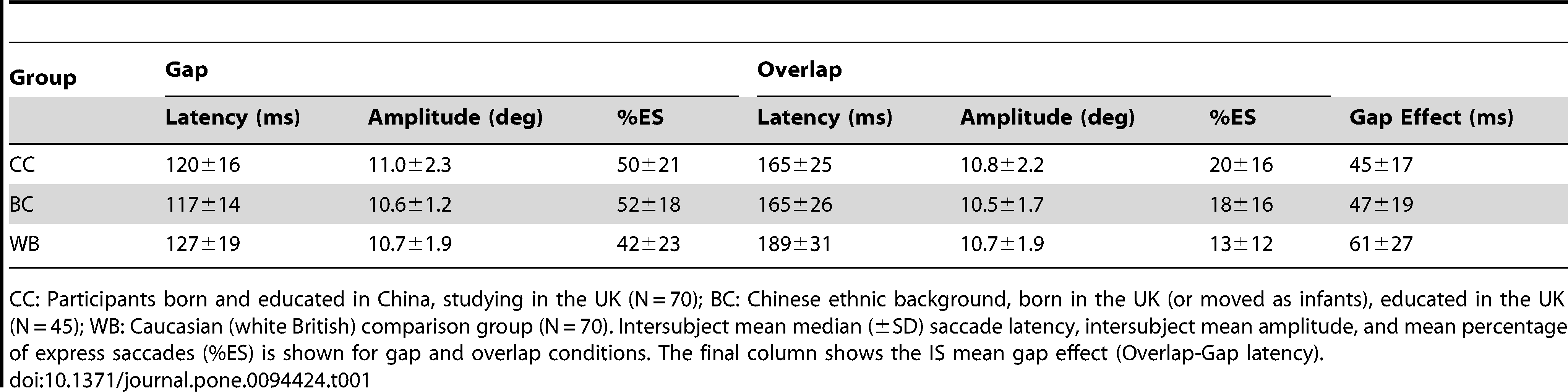
Scientists tested three groups – students from mainland China, British people with Chinese parents and white British people – to see how quickly their eyes reacted to dots appearing in the periphery of their vision.
These express saccades – particularly fast responses which begin a tenth of a second after a target appears - were similar in British and mainland Chinese while white British participants made far fewer.
Conventional wisdom and sociological arguments have claimed that societies with more men than women, such as China, will become more violent, but a new study has found that a male-biased sex ratio does not lead to more crime.
Rates of rape, sexual assault and homicide are actually lower in societies with more men than women, the study found, and evolutionary theories predicting that when males outnumber females, males will compete more vigorously for the limited number of mates don’t hold up either.
“Here, we untangle the logic behind the widely held notion that in human societies where men outnumber women, there will be more violence,” said anthropology professor Monique Borgerhoff Mulder of U.C. Davis, co-author of the study.
Vapor losses to the walls of laboratory chambers haven't been properly factored in, according to a new PNAS paper, and that has caused researchers to underestimate the formation of secondary organic aerosol in the atmosphere. It also brings up a lot of questions about what other simplistic mistakes have led to all kinds of air quality claims.
Vapor losses can suppress the formation of secondary organic aerosol, which in turn has contributed to the under-prediction of secondary organic aerosol
(SOA) in climate and air quality models. Secondary organic aerosols are formed primarily through chemistry that occurs in the gas phase.
The Baryon Oscillation Spectroscopic Survey - BOSS - is the largest component of the third Sloan Digital Sky Survey (SDSS-III) and pioneered the use of quasars to map density variations in intergalactic gas at high redshifts, tracing the structure of the young universe.
BOSS charts the history of the universe's expansion and new measures of large-scale structure have yielded the most precise measurement of expansion since galaxies first formed.