



You've heard or read the scenarios - rapidly escalating levels of CO2 could cause rapidly escalating temperatures, even as much as 18 degrees Fahrenheit.    The problem is that they are just scenarios based on a growing, yet incomplete, understanding of how climate works.

During some periods in the past, there has been 10 times the CO2 present today with little change in temperature.  At other times, temperatures have spiked rapidly but it had little to do with CO2.

Climate change is very complex, and, consequentially, models predicting it need to take into account many different aspects, from wind patterns to plant and algal growth. One of the expected consequences of the changing climate is that some regions will be drier, while others will be subjected to higher rates of precipitation, which, up in the north, means more snow.

If you're anything more than an infrequent stumbler to Science 2.0, then you will probably have noticed - if not, read - Helen's article on geomagnetic polarity reversals, which until recently has been floating in the top articles list.

Whilst it's a gallant attempt to understand the ins and outs of an incredibly complex and poorly understood process, there are a number of misconceptions that I thought would be a good idea to clear up. It's clearly a topic of great interest, because there are over 400 comments on the article.

Before going into these misconceptions, though, let's start with...

BeautifulPeople.com, a dating and networking community which claims to be exclusively for good-looking people,  apparently has programming and security that was done by beautiful people rather than smart ones.  

30,000 ugly people recently invaded the site, bypassing the  "strict rating stage" where currently designated beautiful members decide the fate of new applicants.  The rating module was brought down last month, allowing anyone - regardless of looks(gasp!) - to be accepted. 

According to Karl Popper, there are two contexts at work when trying to understand science. One is called 'the context of discovery', the other 'context of justification'. In many ways all human cognitive activities share similar divisions; art for instance also tends to fall apart in discussions on the intrinsic qualities, the skills, and mastery of the craft on one side, and discussions on the meaning, the purpose, and the place of art in society on the other. Philosophy (of science) itself knows many discussions on the issues related to discovery (e.g.
Recently, research has been conducted to see if certain life-history traits could be correlated with DNA mutation rates. By using whole-genome sequence data for 32 species of mammal, the researchers tested the hypothesis that DNA mutation rates are influenced by species-specific life-history traits. These mutation rates were estimated by looking at the rate of substitutions of neutrally evolving DNA segments. 

This type of research could make it possible to infer life-history information of extinct species, providing that genomic data is present.

The research focused on three life-history traits.

1) Generation time
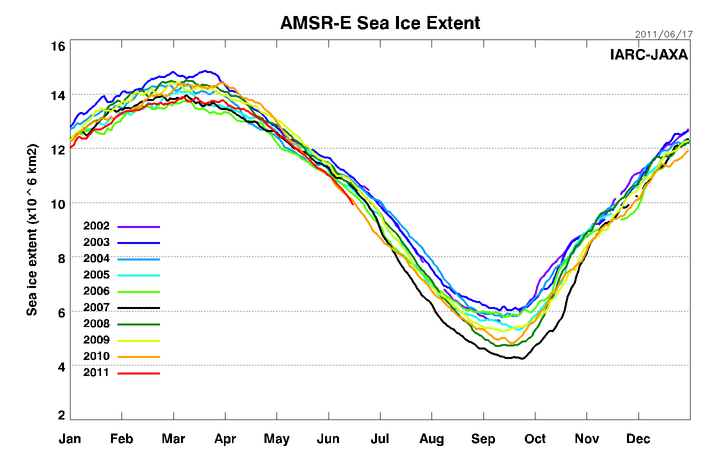
Arctic Ice June 2011


The sun is the main driver of climate and weather.  The Arctic solar year could be plotted as a graph of the angle of the sun relative to the horizon,  negative in winter and positive in summer.  The graph would be a very neat waveform which varied little in amplitude or in frequency on decadal timescales.  By way of contrast, any graph of any effect of the sun's relative angle will vary from year to year.  Although the sun will warm the air, land, sea, snow and ice, it will never do so in exactly the same way during any two years. 
When I was a teenager, my two scientific passions were astronomy and botany.  However, at my school in the early 1960s, one could either do A-levels in Mathematics - Physics - Chemistry (Science A) or Chemistry – Botany - Zoology (Science B).  I chose the former option, being very much put off by medicine which was more or less entailed with the latter.  Botany still is a scientific passion – if I were time-transported back to the Jurassic I would be eager to investigate the flora, leaving others of the party to keep a watch-out for dinosaurs.

This is the extended abstract of an article you cannot read anywhere, which ensures that one can later claim “nobody could have possibly foreseen as the relevant literature clearly shows …” (here more on why).  The article clarifies the singularity concept’s terminology and criticizes the concept itself, finishing with global suicide as the only expected annomality:


Singularity: Nothing Unusual Except For Global Suicide

I see a lot of talk on 'the future of science journalism'-- or science writing, or science funding, or science careers.  I'm guilty of contributing to it myself, but the 'future of' debates miss one point.  There isn't a single monolithic direction things are heading.  There isn't one solution.

In fact, there's not even 'one starting point' we're all moving from.


