



To ensure you have a green Christmas this season, Bluewater, the UKs leading shopping center, have devised an eco-friendly scientific formula on how to wrap a Christmas present after estimating British consumers will waste over one ton of wrapping paper this Christmas (see note 1 at the bottom).

Bluewater discovered that Brits continually overestimate the amount of paper they need to wrap their Christmas presents.

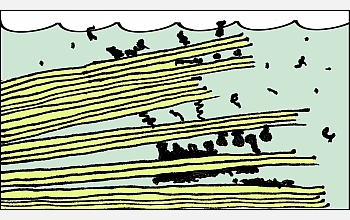
Life on Earth may have originated as the organic filling in a multilayer sandwich of mica sheets, according to Helen Hansma of the National Science Foundation and the University of California, Santa Barbara.

In a presentation at the American Society for Cell Biology’s 47th annual meeting, she proposes that the narrow, confined spaces between nonliving mica layers could have provided exactly the right conditions for the rise of the first biomolecules.

The “mica hypothesis” provides possible answers to many questions about life’s origins, according to Hansma. This layered mineral could have provided support, shelter, and an energy source for the development of precellular life, while leaving artifacts in the structure of living things today, including the periodicity of RNA.

The data are in. Divorce is bad for the environment.

A novel study that links divorce with the environment shows a global trend of soaring divorce rates has created more households with fewer people, has taken up more space and has gobbled up more energy and water. The findings of Jianguo “Jack” Liu and Eunice Yu at Michigan State University are published in this week’s online edition of the Proceedings of the National Academy of Sciences.

A statistical remedy: Fall back in love. Cohabitation means less urban sprawl and softens the environmental hit.

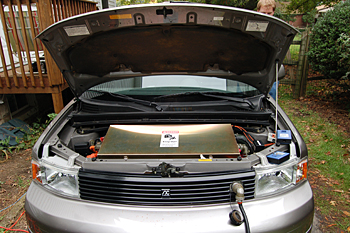
The price of oil nearly reached $100 a barrel recently, but a new University of Delaware prototype vehicle demonstrates how the cost of the black stuff could become a concern of the past.

A team of UD faculty has created a system that enables vehicles to not only run on electricity alone, but also to generate revenue by storing and providing electricity for utilities. The technology--known as V2G, for vehicle-to-grid--lets electricity flow from the car’s battery to power lines and back.

“When I get home, I’ll charge up and then switch into V2G mode,” said Willett Kempton, UD associate professor of marine policy and a V2G pioneer who began developing the technology more than a decade ago and who is now testing the new prototype vehicle.

A new data analysis undertaken by Dr.

Faint, fleeting blue flashes of radiation emitted by particles that travel faster than the speed of light through the atmosphere may help scientists solve one of the oldest mysteries in astrophysics.

For nearly a century, scientists have wondered about the origin of cosmic rays — subatomic particles of matter that stream in from outer space. “Where exactly, we don’t know,” said Scott Wakely, Assistant Professor in Physics at the University of Chicago. “They’re raining down on the atmosphere of the Earth, tens of thousands of particles per second per square meter.”

Recent results from the Pierre Auger Cosmic Ray Observatory suggest that the highest-energy cosmic rays may come from the centers of active galaxies.

MIT engineers have used ultraviolet light to sculpt three-dimensional microparticles that could have many applications in medical diagnostics and tissue engineering. For example, they could be designed to act as probes to detect certain molecules, such as DNA, or to release drugs or nutrients.

The new technique offers unprecedented control over the size, shape and texture of the particles. It also allows researchers to design particles with specific chemical properties, such as porosity (a measure of the void space in a material that can affect how fast different molecules can diffuse through the particles).

“With this method, you can rationally design particles, and precisely place chemical properties,” said Patrick Doyle, associate professor of chemical engineering.

Confused about the right planting depth for flower bulbs? You may not need to worry.

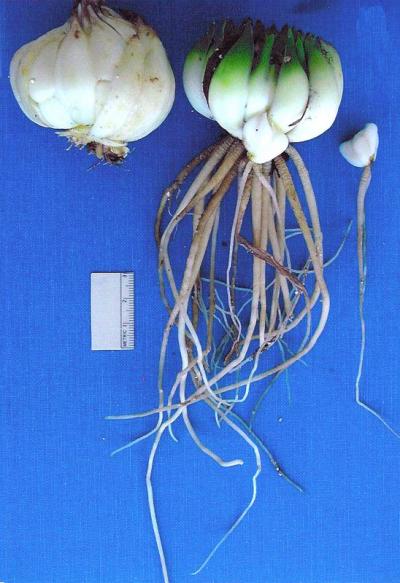
Researchers have discovered that some flower bulbs are actually "smart" enough to adjust themselves to the right planting depth. A recent study published in the Journal of the American Society for Horticultural Science proved that bulbs can adjust their planting position by moving deeper into the ground, apparently in search of moister, more conducive growing conditions.

According to Dr. A. Carl Leopold, William H. Crocker Scientist Emeritus at The Boyce Thompson Institute for Plant Research at Cornell University, when gardeners plant tulips or lilies too shallowly in their gardens, the bulbs will respond to the shallow conditions by literally "pulling" themselves down into deeper ground.

The biological pathway that powers sperm to swim long distances could be harnessed to nanotech devices, releasing drugs or performing mechanical functions inside the body, according to a presentation at the American Society for Cell Biology’s 47th Annual meeting.

The work by researchers at Cornell’s Baker Institute of Animal Health may be the first demonstration of how multistep biological pathways can be assembled and function on a human-made device.

Mammalian sperm have to delivery energy to the long, thin, whip-like tails that power their swimming. Sperm meet the challenge, in part, by onsite power generation, modifying the enzymes of glycolysis so that they can attach themselves to a solid structure running the major length of the sperm tail.

Although they look normal, people suffering from body dysmorphic disorder (BDD) perceive themselves as ugly and disfigured. New imaging research reveals that the brains of people with BDD look normal, but function abnormally when processing visual details. The report in the December Archives of General Psychiatry is the first to demonstrate a biological reason for patients’ distorted body image.

“Our discovery suggests that the BDD brain’s hardware is fine, but there’s a glitch in the operating software that prevents patients from seeing themselves as others do,” explained Dr. Jamie Feusner, assistant professor of psychiatry at UCLA’s Semel Institute.


