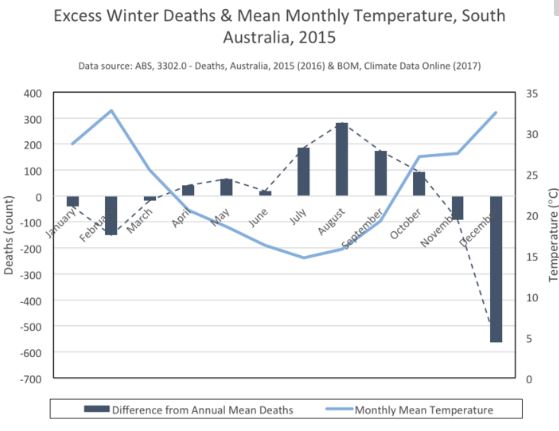






A pervasive myth in Australia is that hot weather is the greatest danger to our health. In reality, it’s more likely cold weather will kill you.

For all our concern about the dangers of heatwaves, simple analysis of mortality data suggests the cold months present a much greater health risk. Almost 7% of deaths in Australia from 1988 to 2009 were attributable to cold weather. Less than 1% of deaths were attributable to heat.

Should we ban cars because of their potential to crash? Or stop selling painkillers in case someone takes too many? If we take the logic the EU applies to regulating pesticides, then the answer should be a resounding “yes”. Thankfully, EU lawmakers have looked at the weight of evidence and concluded the risk of driving cars and taking painkillers is acceptable – no ban needed.

Pesticides get different treatment though.

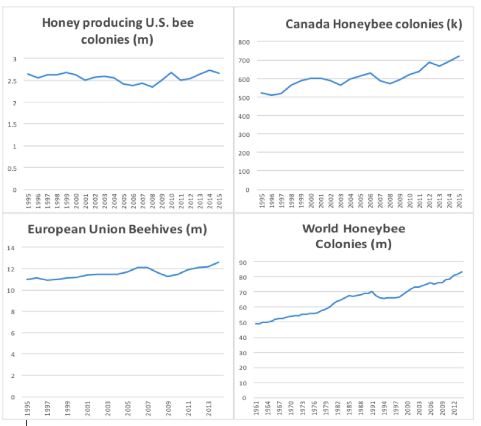
Take the class of insecticides so much in the news, neonicotinoids, that some have blamed for problems with bee health. Didn’t the European Union ban them claiming they were posing unacceptable risks to bees? Isn’t that case closed?

This is an article by the space engineer and Mars colonization enthusiast Robert Zubrin, The Planetary Protection Racket claiming that we don’t need to protect Earth from Mars microbes or Mars from Earth microbes. This is not the first time he has said controversial things like this, and they are not taken seriously by the planetary protection experts. Let’s go back to summer 2000, when he put forward similarly forceful arguments in print that there is no need to protect Earth from Mars microbes

This is what he wrote back then:

If I am alive, I probably owe it to my current very good physical shape.

That does not mean I narrowly escaped a certain death; rather, it means that if I had been slower there are good chances I would have got hit by lightning, under arduous conditions, at 4300 meters of altitude.

The heads of more than 100 of the world’s top artificial intelligence companies are very alarmed about the development of “killer robots”. In an open letter to the UN, these business leaders – including Tesla’s Elon Musk and the founders of Google’s DeepMind AI firm – warned that autonomous weapon technology could be misused by terrorists and despots or hacked to perform in undesirable ways.

The dominant Australian community would very much like to keep Indigenous communities from alcohol, but indigenous communities aren't having it. A giant black market has sprung up and such non-government alcohol sells for up to 1100 percent of the retail price.

The Centers for Disease Control and Prevention seem more scared than elated by United States smoking rates. They have migrated from a war on the world's top killer, smoking, to being in a war on a chemical, nicotine.

They needn't be concerned. Science and health have won, and it wasn't because of taxes on cigarettes or a cottage industry of anti-smoking ads built by a tobacco company settlement, it was because of peer pressure. In young people. As the American Council on Science and Health, a pro-science consumer advocacy group based in New York City, has said since the 1970s, smoking is a pediatric disease. In the past, 90 percent of smokers picked up the habit by age 18, making adolescence a critical time for smoking-prevention efforts.

Center for Science in the Public Interest, a litigation group that sues food companies, may be dusting off some of its old materials after new report which finds "good" cholesterol, also known as HDL, might not be as good as we think.

The new paper contradicts findings from the last 25 years that high levels of HDL in the blood are a good thing. They instead found that people with extremely high levels of good cholesterol have a higher mortality rate than people with normal levels. For men with extremely high levels, the mortality rate was 106 percent higher than for the normal group.

This is the fifth and final part of Chapter 3 of the book "Anomaly! Collider Physics and the Quest for New Phenomena at Fermilab". (the beginning of the chapter was omitted since it described a different story). The chapter recounts the pioneering measurement of the Z mass by the CDF detector, and the competition with SLAC during the summer of 1989.  The title of the post is the same as the one of chapter 3, and it refers to the way some SLAC physicists called their Fermilab colleagues, whose hadron collider was to their eyes obviously inferior to the electron-positron linear collider.

Researchers looked at frequency magnetic resonance imaging (fMRI) images to compare neural responses to food cues in overweight and normal weight adolescents.

They noted that food stimuli activated regions of the brain associated with reward and emotion in all groups but overweight adolescents had progressively less neural activity in circuits of the brain that support self-regulation and attention.

