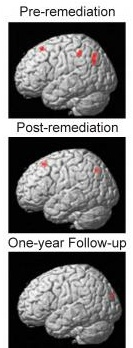






A new Carnegie Mellon University brain imaging study of dyslexic students and other poor readers shows that the brain can permanently rewire itself and overcome reading deficits, if students are given 100 hours of intensive remedial instruction.

The study, published in the August issue of the journal Neuropsychologia, shows that the remedial instruction resulted in an increase in brain activity in several cortical regions associated with reading, and that neural gains became further solidified during the year following instruction.

"This study demonstrates how remedial instruction can use the plasticity of the human brain to gain an educational improvement," said neuroscientist Marcel Just, director of Carnegie Mellon's Center for Cognitive Brain Imaging (CCBI) and senior author of the study. "Focused instruction can help underperforming brain areas to increase their proficiency."

LONDON, August 5 /PRNewswire/ --

- We Help Publishers Extend Their Reach and Circulation - We Cater for the Needs of the Millions of Publishers-Consumers, the Pubsumers!

RAPID Browser, used by more than 40 media groups and 4000 journalists, now allows for:

- One-click rich-media publishing to Web, Mobile and TV - Powerful Web-based news Playlists authoring and publishing - Super-fast and super-easy news filter creation and searching - Custom editorial and archive news types - Laying the foundations for cross-media editorial planning

Read more...

Despite concerns that the terrorist attacks of September 11, 2001 would increase intolerance toward Muslims, the opposite is true, according to new research by University of British Columbia (UBC) and Stanford University researchers published this week in Journal of Personality and Social Psychology.

Paul Davies, a professor of psychology at UBC's Okanagan campus, and co-investigators Claude Steele and Hazel Rose Markus from Stanford University created a research program to examine the relationship between foreign threats, national identity and citizens' endorsement of models for both foreign and domestic intergroup relations.

New research from The University of Western Ontario reveals how the brain processes the 'rewarding' and addictive properties of nicotine, providing a better understanding of why some people seemingly become hooked with their first smoke. The research, led by Steven Laviolette of the Department of Anatomy and Cell Biology at the Schulich School of Medicine & Dentistry could lead to new therapies to prevent nicotine dependence and to treat nicotine withdrawal when smokers try to quit.

The researchers found one brain pathway in particular uses the neurotransmitter 'dopamine' to transmit signals related to nicotine's rewarding properties. This pathway is called the 'mesolimbic' dopamine system and is involved in the addictive properties of many drugs of abuse, including cocaine, alcohol and nicotine.

HOUSTON, August 5 /PRNewswire/ --

ALTRINCHAM, England, August 5 /PRNewswire/ --

- Business Marketers Set to Enjoy Increased Return on Investment

LBM today announces the launch of a new strategic partnership and a new service that will enhance the campaign ROI for all UK B2B marketers.

The online service, developed in conjunction with the country's leading credit risk data specialist Graydon UK, will offer direct marketers the opportunity to download pre-vetted B2B mailing lists ( http://www.lbm.co.uk/news) including details of over 1.3 million businesses and decision makers across the UK. This will help firms ensure they avoid targeting prospects lacking in financial strength and likely to heighten risk exposure and increase bad debt, as the current "credit crunch" takes hold.

University of Minnesota researchers have answered a key question as to why antiretroviral therapy isn't effective in restoring immunity in HIV-infected patients.

Once a person is infected with the virus, fibrosis, or scarring, occurs in the lymph nodes – the home of T cells that fight infection. And once fibrosis occurs, T cells can't repopulate the lymph nodes when HIV therapy begins, said Timothy Schacker, M.D., professor of medicine and principal investigator on the study.

AMSTERDAM, The Netherlands, August 5 /PRNewswire/ -- Amsterdam Molecular Therapeutics (Euronext: AMT), a leader in the field of human gene therapy, today announced that it will release its financial results for the first half year of 2008 on Wednesday, August 13, 2008 at noon Central European Time (CET). To discuss these results, the company will conduct a conference call at 2:00 p.m. CET. Netherlands dial in: 0800-949-4517 (toll free); US dial in: +1-866-291-4166 (toll free); UK dial in: +44-207-107-0611. To listen to the conference call live via the internet, visit the investor relations portion of the AMT website at http://www.amtbiopharma.com. Please go to the website 15 minutes prior to the call to register, download and install the necessary audio software.

SYDNEY, Australia, August 5 /PRNewswire/ --

- Assessment Based on Customer Ratings, Regional Presence and Investment in Innovation

Verizon Business received a "Strong Positive" rating from Gartner, Inc. in its inaugural "MarketScope for Managed Security Services in the Asia Pacific Region" report.(1)

To be rated Strong Positive, companies must demonstrate their continued investments in innovation and facilities in multiple countries in the Asia-Pacific region. This is in addition to receiving either a "Good" or "Excellent" rating from participants of the research -- all of whom are customers of managed security services providers.

Globular star clusters, dense bunches of hundreds of thousands of stars, contain some of the oldest surviving stars in the Universe. A new international study of globular clusters outside our Milky Way Galaxy has found evidence that these hardy pioneers are more likely to form in dense areas, where star birth occurs at a rapid rate, instead of uniformly from galaxy to galaxy.

Astronomers used the NASA/ESA Hubble Space Telescope to identify over 11 000 globular clusters in the Virgo cluster of galaxies, most of which are more than 5 billion years old. Comprised of over 2 000 galaxies, the Virgo cluster is located about 54 million light-years away and is the nearest large galaxy cluster to Earth. Along with Virgo, the sharp vision of Hubble's Advanced Camera for Surveys (ACS) resolved the star clusters in 100 galaxies of various sizes, shapes, and brightness – even in faint, dwarf galaxies.


