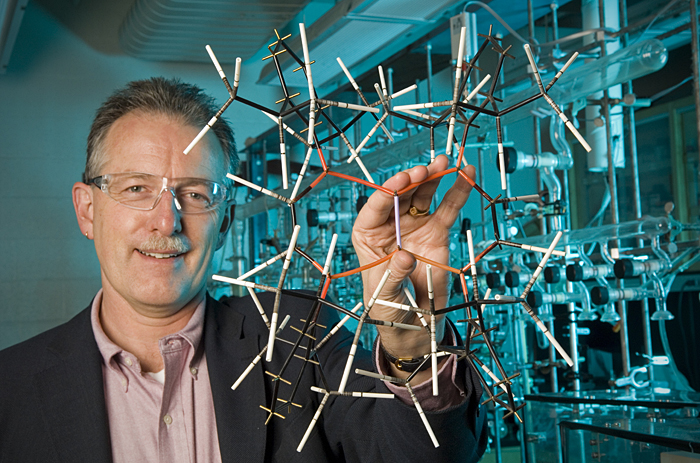






Chemists from the University of Delaware, in collaboration with a colleague at the University of Wisconsin, have set a new world record for the shortest chemical bond ever recorded between two metals, in this case, two atoms of chromium.

The distance? A minuscule 1.803 Angstroms, which is on the order of a billionth of the thickness of a human hair.

The chemists weren't driven by the Guinness Book of World Records or even a friendly bet. As is often the case in science, they discovered the molecule, which has a quintuple (i.e., fivefold) bond, quite by accident.


Klaus Theopold, professor and chairperson of the University of Delaware Department of Chemistry and Biochemistry. Photo: Kathy F.

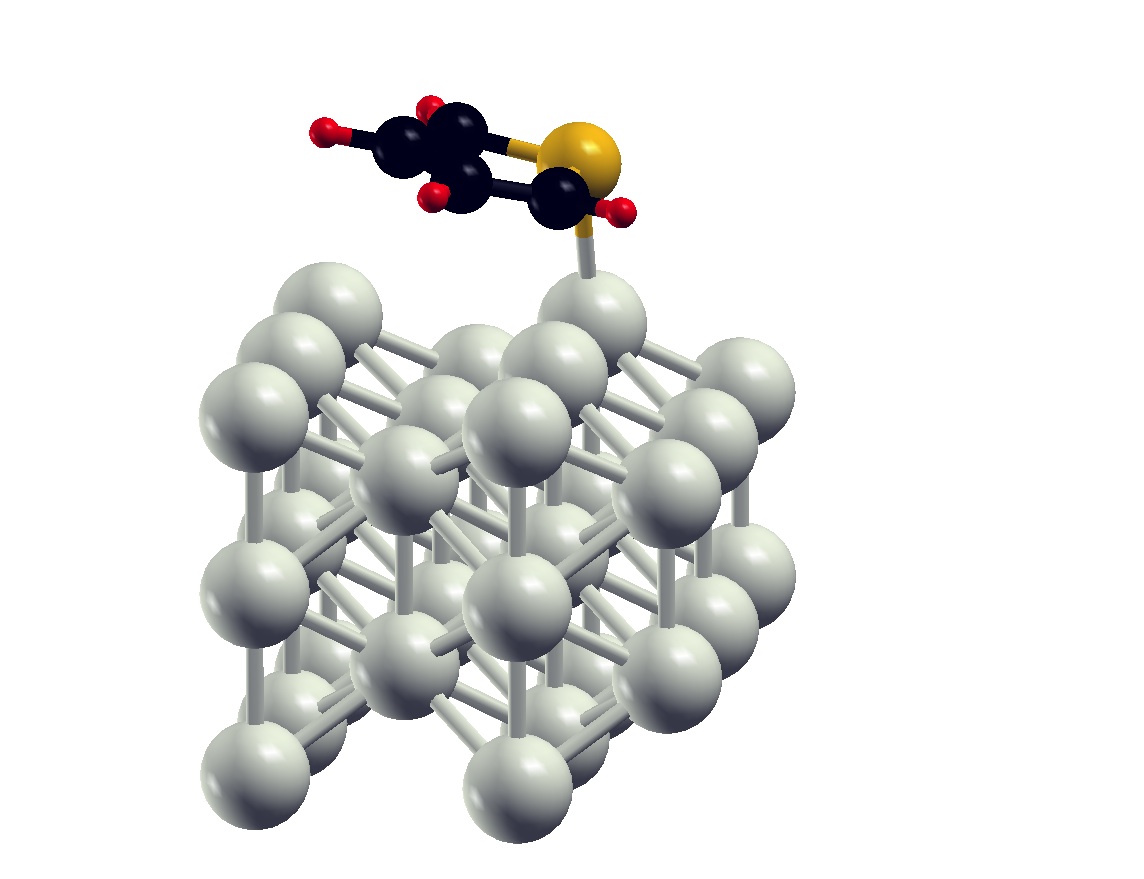
The van der Waals force, a weak attractive force, is solely responsible for binding certain organic molecules to metallic surfaces. In a model for organic devices, it is this force alone that binds an organic film to a metallic substrate. This data, recently published in Physical Review Letters, represents the latest findings from a National Research Network (NRN) supported by the Austrian Science Fund FWF. These findings mean that numerous calculation models for the physical interactions between thin films and their carrier materials will need to be revised.

Although they fulfil complex functions when used, for example, as computer chips, inorganic semiconductors have a simple construction that greatly limits their application.

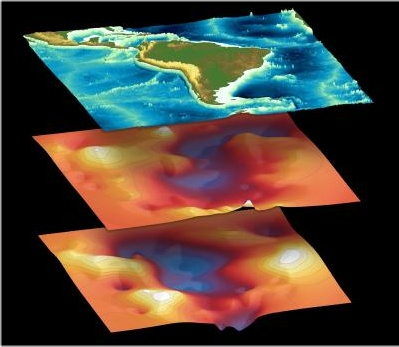
For more than a decade geoscientists have detected what amount to ultra-slow-motion earthquakes under Western Washington and British Columbia on a regular basis, about every 14 months. Such episodic tremor-and-slip events typically last two to three weeks and can release as much energy as a large earthquake, though they are not felt and cause no damage.

Now University of Washington researchers have found evidence that these slow-slip events are actually affected by the rise and fall of ocean tides.

"There has been some previous evidence of the tidal effect, but the detail is not as great as what we have found," said Justin Rubinstein, a UW postdoctoral researcher in Earth and space sciences.

STANFORD, Calif. - Researchers at the Stanford University School of Medicine have taken a small but significant step, in mouse studies, toward the goal of transplanting adult stem cells to create a new immune system for people with autoimmune or genetic blood diseases.

The researchers found a way to transplant new blood-forming stem cells into the bone marrow of mice, effectively replacing their immune systems. Many aspects of the technique would need to be adapted before it can be tested in humans, said Irving Weissman, MD, a co-senior author of the study and director of the Stanford Institute for Stem Cell Biology and Regenerative Medicine. The work was done on a particular group of mice that are a poor mimic for the human immune system.

Brain scanning experiment shows how much we take others' earnings as a measure of our success.

The feelings an individual has on receiving his paycheque depend critically on how much his colleague earns. Hard evidence for this comes from an experiment conducted by economists and brain scientists at the University of Bonn. They tested male subjects in pairs, asking them to perform a simple task and promising payment for success. Using magnetic resonance tomographs, the researchers examined the volunteers' brain activity throughout the activities. Participants who got more money than their co-players showed much stronger activation in the brain's "reward centre" than occurred when both players received the same amount.

In our first exciting episode of Who’s Smarter: Chimps, Baboons or Bacteria? The Power of Group IQ ( Part I ) we showed how small-brained baboons can outsmart big-brained chimpanzees and how bacteria can out-innovate chimps, baboons, and you and me. We also visited an evolutionary mystery in the world of a bacterial buddy that's with you every day, the E. coli found in your gut.

In Part II we discussed how E.

MIT researchers have found that the children of mothers whose water supplies were contaminated with arsenic during their pregnancies harbored gene expression changes that may lead to cancer and other diseases later in life.

In addition to establishing the potential harmful effects of these prenatal exposures, the new study also provides a possible method for screening populations to detect signs of arsenic contamination.

This is the first time evidence of such genome-wide changes resulting from prenatal exposure has ever been documented from an environmental contaminant. It suggests that even when water supplies are cleaned up and the children do not experience any direct exposure to the pollutant, they may still suffer lasting damage.

It was not the isolation of the Ice Age that determined the genetic distribution of bears, as has long been thought, according to an international research team writing in the latest issue of Molecular Ecology. One possible interpretation is that the hunting of bears by humans and human land use have been crucial factors.

Twenty thousand years ago Europe was covered by ice down to Germany, and the climate in the rest of Europe was such that several species were confined to the southern regions, like the Iberian Peninsula and Italy.

These regions were refuges, areas where species could survive during cold periods and then re-colonize central and northern Europe when it got warmer.

Newly launched nerve cells in a growing embryo must chart their course to distant destinations, and many of the means they use to navigate have yet to surface. In a study published in the current issue of the journal Neuron, scientists at the Salk Institute for Biological Studies have recovered a key signal that guides motor neurons – the nascent cells that extend from the spinal cord and must find their way down the length of limbs such as arms, wings and legs.

The Salk study, led by Samuel Pfaff, Ph.D, a professor in the Gene Expression Laboratory, identifies a mutation they christened Magellan, after the Portuguese mariner whose ship Victoria was first to circumnavigate the globe.

Writing in Atoms for Peace, Energy consultant David Wood suggests that Iran's demands for nuclear power in economic and technical terms are a justified response to rapid growth in domestic energy demands and an increased dependence on oil exports for revenue.

Despite its vast oil and gas reserves, years of under-investment in Iran has limited access to technology and stifled its production capacity. Indeed, Iran now relies on imports for certain refined petroleum products and natural gas. Wood argues that the development of this situation has forced Iran to consider alternative future energy solutions.

