




Social media is both faster and more accurate, according to a recent analysis. Newly unemployed people are often motivated to find new jobs so to see if social media posts about unemployment can predict jobless data faster, a team developed a large language model (LLM, colloquially called AI) that identifies unemployment disclosures on social media.
The inputs were 31.5 million Twitter (now X) users posting between 2020 and 2022. Those data "trained" a transformer-based classifier called JoblessBERT to detect unemployment-related posts, even those that featured slang or misspellings, such as “I needa job!”.
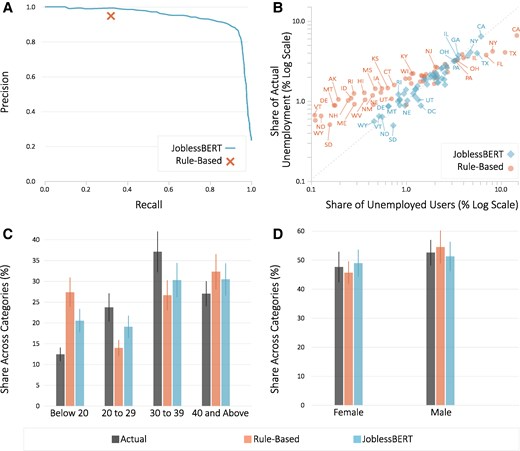
Social media users are a tiny subset of the population so they made demographic adjustments to account for Twitter's non-representative user base, then forecast US unemployment insurance claims at national, state, and city levels.
They say their model captured nearly three times more unemployment disclosures than previous rule-based approaches and reduced forecasting errors by 54.3% compared to industry consensus forecasts. It was able to see the massive surge in unemployment claims in March 2020, before official statistics were released. They believe social media data models can be faster than traditional economic reporting statistics and provide real-time insights for policymaking, especially during economic crises.
Citation: Do Lee, Manuel Tonneau, Boris Sobol, Nir Grinberg, Samuel P Fraiberger, Can social media reliably estimate unemployment?, PNAS Nexus, Volume 4, Issue 12, December 2025, pgaf309, https://academic.oup.com/pnasnexus/article/4/12/pgaf309/8405883



Comments