






Make way for the real nanopod and make room in the Guinness World Records. A team of researchers with Lawrence Berkeley National Laboratory and the University of California at Berkeley have created the first fully functional radio from a single carbon nanotube, which makes it by several orders of magnitude the smallest radio ever made.

“A single carbon nanotube molecule serves simultaneously as all essential components of a radio -- antenna, tunable band-pass filter, amplifier, and demodulator,” said physicist Alex Zettl, who led the invention of the nanotube radio.

A University of Florida scientist has grown a living "brain" that can fly a simulated plane, giving scientists a novel way to observe how brain cells function as a network.

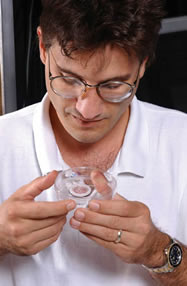
The "brain" -- a collection of 25,000 living neurons, or nerve cells, taken from a rat's brain and cultured inside a glass dish -- gives scientists a unique real-time window into the brain at the cellular level.

By watching the brain cells interact, scientists hope to understand what causes neural disorders such as epilepsy and to determine noninvasive ways to intervene. As living computers, they may someday be used to fly small unmanned airplanes or handle tasks that are dangerous for humans, such as search-and-rescue missions or bomb damage assessments.

A potent clot-busting substance originally extracted from the saliva of vampire bats may be used up to three times longer than the current stroke treatment window – without increasing the risk for additional brain damage, according to research reported in Stroke: Journal of the American Heart Association.

The vampire bat saliva-derived clot buster is called Desmodus rotundus salivary plasminogen activator (DSPA) or desmoteplase. DSPA targets and destroys fibrin, the structural scaffold of blood clots, says senior author Robert Medcalf, Ph.D.

The "dark matter" that comprises a still-undetected one-quarter of the universe is not a uniform cosmic fog, says a University of California, Berkeley, astrophysicist, but instead forms dense clumps that move about like dust motes dancing in a shaft of light.

In a paper from Physical Review D, Chung-Pei Ma, an associate professor of astronomy at UC Berkeley, and Edmund Bertschinger of the Massachusetts Institute of Technology (MIT), prove that the motion of dark matter clumps can be modeled in a way similar to the Brownian motion of air-borne dust or pollen.

Their findings should provide astrophysicists with a new way to calculate the evolution of this ghost universe of dark matter and reconcile it with the observable universe, Ma said.

Does your dog know if you've had a bad day? Probably, but don't expect your cat to catch on.

Do chimpanzees understand why those who can't see them don't offer them treats?

Do vampire bats have the ability to show gratitude by returning a favor?

Some Texas A&M University researchers examining ancient Egyptian mummies may have unwrapped – literally – some of the mysteries that embalmers used to preserve bodies more than 3,000 years ago.

Mahlon "Chuck" Kennicutt II, MoonKoo Kim and Yaorong Qian of Texas A&M's College of Geosciences, along with colleagues from the University of Alexandria, have discovered that tar originating from natural oil seeps in the Middle East area was used in the preservation and mummification process by Egyptians thousands of years ago.

Examining areas near the Suez Canal, Kennicutt and the team also learned that tar fueled fires in glass factories used by the surrounding communities.

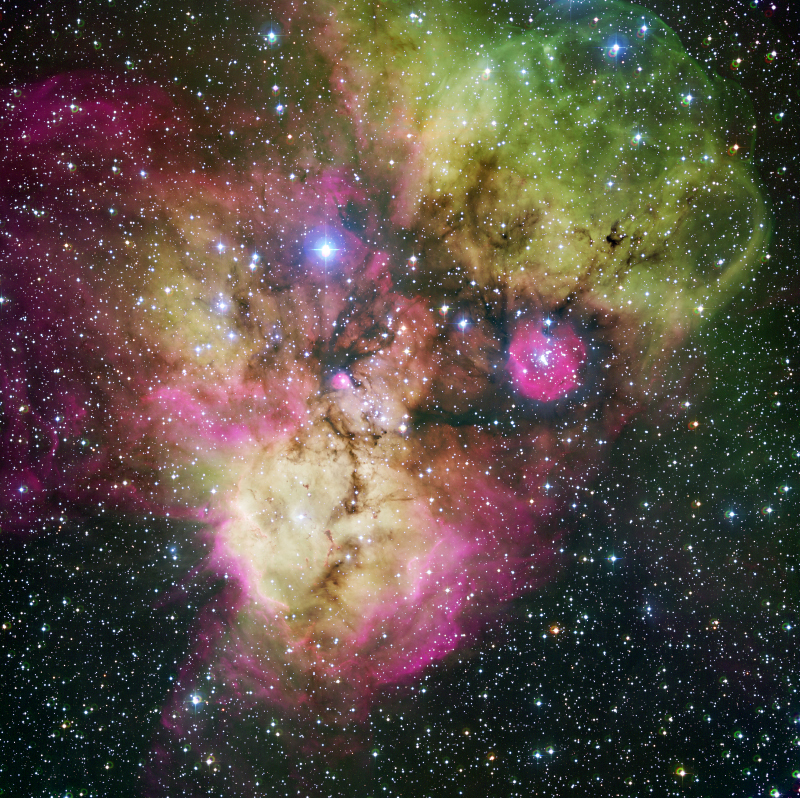
Two of ESO's telescopes captured various stages in the life of a star in a single image - a cosmic ghost.

ESO PR Photo 42a/05 shows the area surrounding the stellar cluster NGC 2467, located in the southern constellation of Puppis ("The Stern"). With an age of a few million years at most, it is a very active stellar nursery, where new stars are born continuously from large clouds of dust and gas.

The image, looking like a colorful cosmic ghost or a gigantic celestial Mandrill [1] , contains the open clusters Haffner 18 (center) and Haffner 19 (middle right: it is located inside the smaller pink region - the lower eye of the Mandrill), as well as vast areas of ionized gas.

Astronomers have found possible proofs of stellar vampirism in the globular cluster 47 Tucanae. Using ESO's Very Large Telescope, they found that some hot, bright, and apparently young stars in the cluster present less carbon and oxygen than the majority of their sisters.

A biotech company, Tensor Biosciences of Irvine, California, has developed a method to keep pieces of living brain tissue alive for weeks, which will allow research on entire neural networks rather individual cells.

"We are building stripped-down mini-brains, if you will, directly on a chip," says Miro Pastrnak, business development director of Tensor.

"Behaviour is the result of the electrical activity of billions of brain cells connected in complex circuits, not the activity of a cell or a receptor acting in isolation," says Pastrnak. Currently, drugs are only tested on individual nerve cells because larger pieces of brain tissue couldn't be kept alive for more than a few hours.

Vampire bats, the only mammals to feed exclusively on blood, including human blood, recognize their prey by the sound of its breathing. In a study published today in the open access journal BMC Biology, vampire bats of the species Desmodus rotondus could recognise recorded human breathing sounds much better than human participants could.

Vampire bats feed on the same prey over several nights and the authors of the study propose that the bats use breathing sounds to identify their prey in the same way as humans use voice to recognise each other.

