
In ancient Egypt, the heart was the key to a happy afterlife. It lived on after death, they believed, and in the Duat, the Netherworld, it revealed a truth man's words could not hide.

The 42 gathered gods would measure the heart and if it weighed more than the Feather of Truth which adorned the head of Maat, their Goddess of Justice, Order, and Truth, it was consumed by the Goddess Ammit, Devourer of the Dead, who had the body of a crocodile, a lion, and a hippopotamus, and you were gone from existence forever.

People had a lot of ways to get heavy hearts. Theft, anger, even eavesdropping added weight
In politics, one way to make your belief in alternative energy seem feasible is to make its competitors expensive. President Obama did that when he began to subsidize the domestic solar energy industry at unprecedented levels.(1) He brought in Dr. Stephen Chu, who had advocated $9-a-gallon gasoline, from inside his high-paying job in academia to be in charge of energy policy for Democrats. He was right in his agenda, solar could be feasible if its conventional energy competitors were forced to be 300% more expensive.
Once upon a time, wealthy white women virtue signaled to other wealthy white women when they spent $500 on snacks at stores they're paid to promote, like "upscale" grocery chain Erewhon, where its overpriced nonsense supposedly leads to a "radiant" lifestyle.

That time is still now. This one is especially fun, because two words after assuring us it "has literally sold out everywhere" she tells gullible viewers that you can buy it at the store she's being paid $5 to promote.

Aging is not a smooth and gradual process.

If you read environmental groups, we are closer to our doom than ever. Bees are nearly extinct, cell phones are causing cancer, and hydroelectric power is devastating the land.

None of those are true yet they all have claims found in journals and in media. So it has been with mercury emissions, where computer models so poorly designed they'd get you fired in the private sector if you tried to recommend a working prototype using them sail through peer review. 
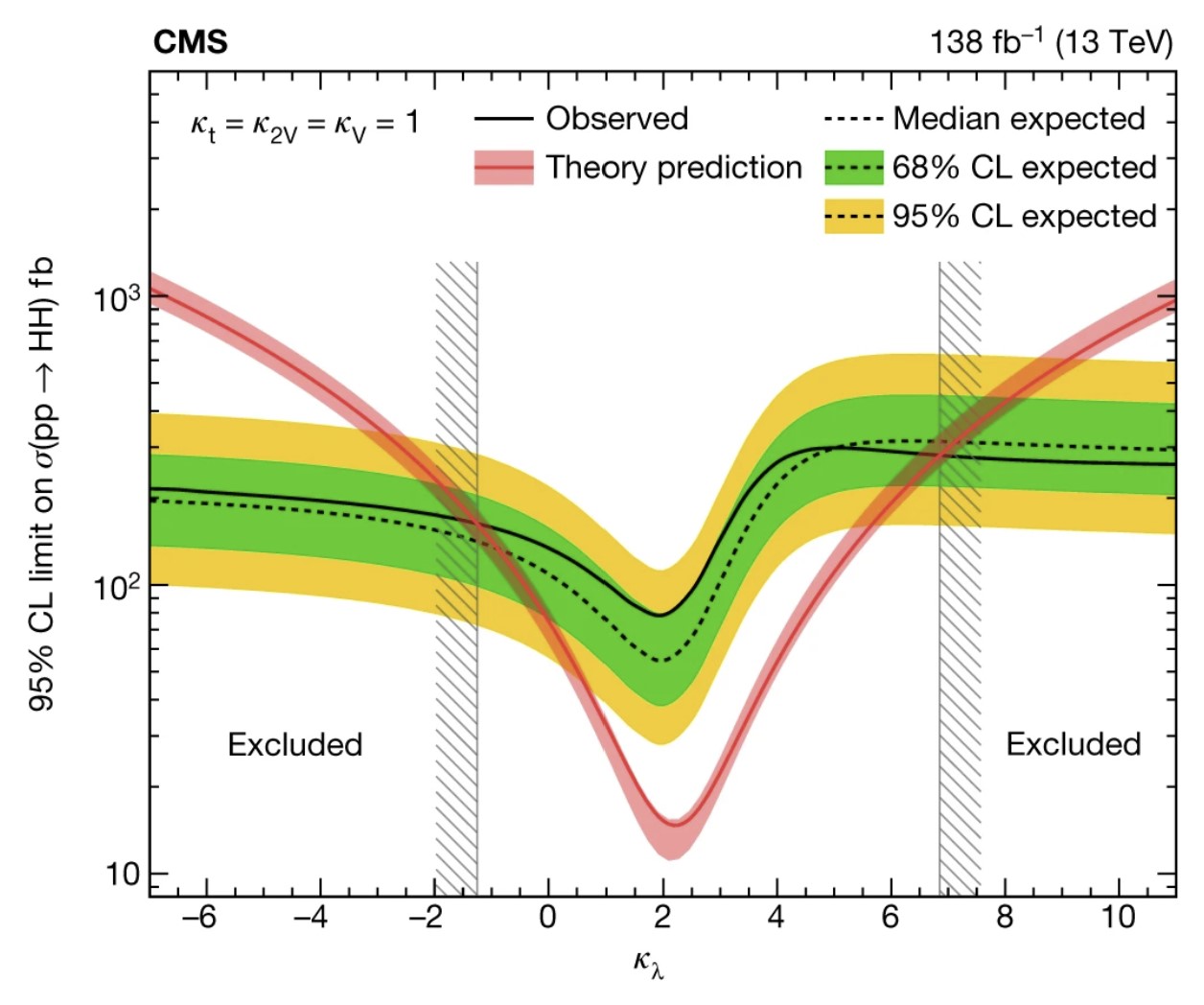
I recently got engaged in a conversation with a famous retired mathematician / cosmologist about the phenomenology of Higgs bosons in the Standard Model of particle physics, and very soon we ended up discussing a graph produced by the CMS collaboration at the CERN Large Hadron Collider, which details the result of searches of Higgs boson pairs in proton-proton collisions data. 
The conversation -and in particular the trouble I had in making sense of the graph with my interlocutor- clarified to me that the way we present those graphs, which summarize our results and should speak by themselves, is confusing to say the least. Indeed, one needs to be briefed extensively before one can fully understand what the various elements of the graphs mean.
It is easy for wealthy countries to spend $135 billion on an organic food process that uses higher quantities of older, more toxic pesticides at greater environmental strain, because it is a niche luxury item.

In countries that are poor, which often means  outside natural breadbasket climates, the organic food process means cycles of famine and starvation. Science can help with that. Like humans, plants have a natural ability to adapt to unfavorable weather conditions but nature is only about individual survival, and humans need to think about yields if we're going to keep land use limited.

These days I am in the middle of a collaborative effort to write a roadmap for the organization of infrastructures and methods for applications of Artificial Intelligence in fundamental science research. In so doing I wrote a paragraph concerning benchmarks and standards.

Do you think the 2008 financial meltdown was caused by religious evil? I don't, I think it was caused by populism in Congress that made it a potential prison sentence to deny anyone a mortgage and guaranteed mortgages for unqualified people.(1)
If you instead think it was evil, "Slaves of Satan" by Patrick R. Bell is a solid work. For the rest of us, well, maybe. It requires a certain amount of suspension of disbelief. The 20th century philosopher Bertrand Russell proposed if you create a closed system and introduce a contradiction anything can be proven. Dan Brown used this to fantastic effect in books like "The Da Vinci Code" and if you believe in evil as an external control, like demons, it can explain a lot.
Get-out-the-vote campaigns matter, which is why U.S. political parties encourage those in their tribe to vote by mail long before any controversies can change their mind. Voting is so predictable that about six percent of voters actually decide the election.

Passion motivates, and that is shown by a new survey result which claims that undecided voters are also less likely to vote at all. Either they don't care - one party brags about their stock market gains while the other claims they'll be better for the economy - or they don't believe their vote matters. Like voters in California, unless Democrats are able to overturn the Electoral College.

