







BUDAPEST, September 23 /PRNewswire/ --

- New Charging Model Allows Advanced Real-Time Rating and Charging for All Mobile Services Across all Payment Methods

Acision, the world's leading messaging company, announces the launch of Acision Charging Engine, a new visionary platform at the heart of its unified charging architecture. For the first time, operators will be able to unify the monetization of their services on one platform, bringing together prepaid, postpaid and bundle management, enabling the optimization of customer experience across the network.

After several years of detective work, philologists at the University of Stavanger in Norway have collected a unique collection of texts online and they're about to start the most comprehensive analysis of middle English ever.

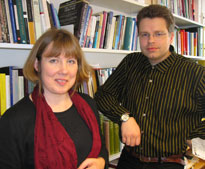
During the last few years, associate professor Merja Stenroos and post doctor Martti Mäkinen at the University of Stavanger have travelled around Britain and read original handwritten leather manuscripts from the 1300s–1500s.

"It is as natural for us in Stavanger to research Middle English as it is for English researchers. None of us have this language as our mother tongue anyway, says Merja Stenroos, who is managing the project titled MEG - Middle English Grammar.

 Merja Stenroos Martti Mäkinen  15th century Book of Hours Folio

Whether young people get drunk as a purposeful behavior or as an unintended consequence depends on what country they live in, according to new research on young people in seven countries. The research finds that young people's views on alcohol and drunkenness were influenced more by culture than by factors such as age and sex.

The research, sponsored by the International Center for Alcohol Policies (ICAP), also finds striking similarities about drinking among young people in different parts of the world including:

A nesting behavior study has detailed some previously unconsidered effects of biodiversity loss and climate change - changing seabird biodiversity is resulting in more ammonia in the atmosphere.

Ammonia emissions from seabirds have been shown to be a significant source of nitrogen in remote coastal ecosystems, contributing to nutrient enrichment (eutrophication) and acidification. While most ammonia emissions originate from domesticated animals such as poultry and pigs, seabirds are the most significant emitters of ammonia to the atmosphere in remote regions.

Emerson looked forward to the day when America would be self-reliant and not second rate in its scholarship. In science, the U.S. has fulfilled Emerson's ambition, but at what cost to religion?

Physicist Steven Weinberg muses on religion's fate in the West as science has come to dominate our culture:

Let's grant that science and religion are not incompatible—there are after all some (though not many) excellent scientists, like Charles Townes and Francis Collins, who have strong religious beliefs. Still, I think that between science and religion there is, if not an incompatibility, at least what the philosopher Susan Haack has called a tension, that has been gradually weakening serious religious belief, especially in the West, where science has been most advanced. Here I would like to trace out some of the sources of this tension, and then offer a few remarks about the very difficult question raised by the consequent decline of belief, the question of how it will be possible to live without God.

The nation’s economy is in deep trouble, which means financial woes all over the world, with millions of people affected. President Bush is hardly appearing in the news, as apparently “the Decider” has nothing to say about a disaster whose slow but sure build-up his so called administration has presided over for the last eight years. To compound disaster with disaster, the Treasury Department isn’t just trying to help by saddling the taxpayers with the sins of Wall Street; no, in perfect Bush style, Secretary Paulson is seeking to obtain from Congress -- and retain in perpetuity for his successors -- unfettered authority to intervene in the markets with essentially no oversight by the legislative branch.

Throughout all this, David Sloan Wilson and Larry Arnhart have been debating whether evolutionary theory favors government regulation or not. What on earth does evolutionary theory have to do with the global economy, one might reasonably ask?

This story caught my eye because of the 'ew' factor, so naturally I wanted to share my newfound fear of catheters (which already took up a healthy amount of time during my daily phobia-pondering) with you all. Misery loves company, so I assume that stands true for other negatively connotated emotions like disgust, fear of microbes, etc.

Imagine waking up but not being able to get out of bed. One day you are enjoying life to the fullest, but within a couple of years, you cannot walk unassisted.  You lose track of where you are and what you are doing while your muscles refuse to cooperate with your brain.

This is a likely scenario if you are one of the millions of people worldwide that suffer from Multiple Sclerosis (MS). Characterized by the destruction of insulation (myelin) around the nervous system, MS is one of the world’s most debilitating diseases.

PARIS, September 22 /PRNewswire/ --

- Recognized for Seminal Contributions to the Science and Technology of Multiple-Antenna Wireless Communications

Alcatel-Lucent (Euronext Paris and NYSE: ALU) today announced that Gerard J. Foschini, distinguished scientist and innovator at Alcatel-Lucent's Bell Labs, has been awarded the 2008 IEEE Alexander Graham Bell Medal during the IEEE Honors Ceremony in Quebec City, Canada. The Alexander Graham Bell Medal is the highest recognition bestowed by the IEEE for contributions to the advancement of communications sciences and engineering. The IEEE is the world's leading professional association for the advancement of technology.

Truls Thorstensen (EFS Consulting Vienna), Karl Grammer (Ludwig Boltzmann Institute for Urban Ethology) and other researchers at the University of Vienna say that people make lots of assumptions about sex, age, emotions, and intentions by looking at human faces - and we do it with cars as well.

They're not the first ones to come up with this idea; five year olds have been finding personalities in inanimate objects for thousands of years and my kid has been saying "Ka-chow!" ever since he saw Cars, but they are the first ones to tackle it in a systematic fashion.

How did they do it? They asked people to describe car grills anthropomorphically. Then they used geometric morphometrics to calculate the corresponding shape information, whatever that means. One-third of the respondents associated a human or animal face with over 90 percent of the cars and everyone noted eyes (headlights), a mouth (air intake/grill), and a nose in 50 percent of the cars. Yep, that means people think cars have a personality.

