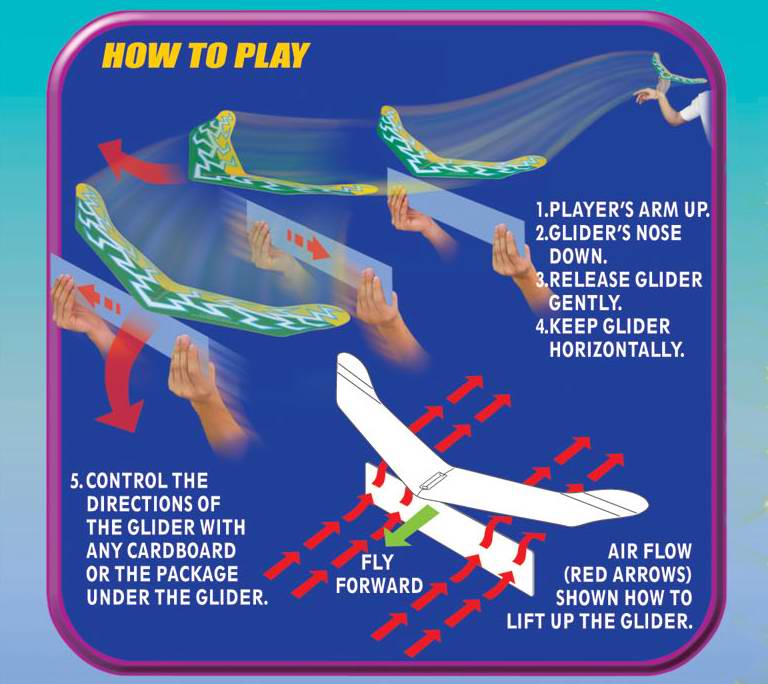
A short while ago, SciFest 2010, the International Science Festival, was held in St. Louis. Making the trip was a group from Jersey Shore, PA and they were invited because a teacher, Slater Harrison, is really good at 'air surfing'.
If you have never seen the term air surfing, it was invented in the 1970s by Dr. Tyler MacCready, a fellow who studied philosophy at Yale and then geology at the University of Wyoming and Monash before becoming famous in amateur aerodynamics for the 'walkalong glider' - which looks like magic to many a young person's eyes, at least the way Harrison and his team of students do it. First, here is a diagram of a walkalong glider. MacCready no longer makes these so you'd have to find it on Ebay or make your own:
When you were young you may have heard something about a dog like, "Fido is 10 years old, that is 70 in people years" and wondered what that meant.
It's a rule of thumb but there is a science basis to it, yet current methods of comparing patterns of aging are limited because they confound two different elements of aging – pace and shape. And it can be confusing for non-biologists.
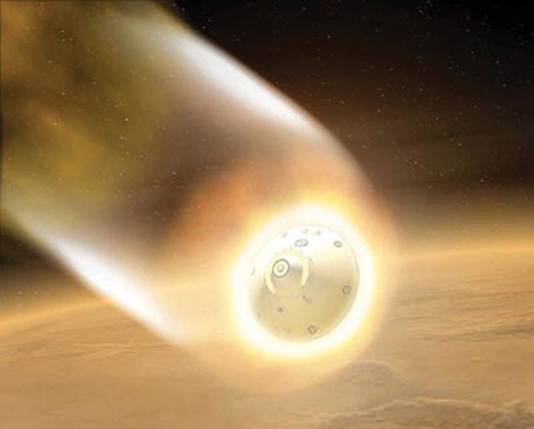
All space missions end-- some with a whimper, some with a 'fwoosh' of reentry. For longevity, it's hard to surpass the twin
Voyager probes. They have been flying steadily for almost 30 years (since 1977), have passed the heliopause's termination shock, and are still cruising on momentum and sending back messages using the power equivalent of just 3 light bulbs.
Around the pink- and red-hued madness of overpriced flowers and heart-shaped everything that is Valentine's Day, even a rocket man
1 needs a little love.
2 Unfortunately for NASA, the Stardust spacecraft beamed down an unexpected photo of its intended Valentine, the potato-shaped comet Tempel 1. (And no wonder - what girl wants to be photographed if she's told she has the figure of a potato?)
Instead of a space age love song
3, scientists received the a photo of a tiny speck:

The lure of the far-off land, the thrill of crossing the seven seas, the dream of studying in a foreign university is still the most sought after by many Indian students and scientists. Indian students who pursue their academic dreams overseas need to be mentally prepared to rough it up.
Most importantly, they need to follow a legitimate path in pursuit of money, excellence, and exercise necessary precaution to avoid getting duped, lest they have their wings clipped, their beaks bent, claws tagged, ankles radio-tagged and their flight monitored by immigration authorities.
Recently, the news of the Trivalley University hit headlines and most prominently the Indian students looking up to brighter opportunities abroad felt the heat.
Many of those involved with transhumanism desire to accelerate the development of some sort of ‘higher consciousness’. Although the topic is mostly approached with the most serious input of the persons’ specific fields, for example cutting edge fascinating neuroscience, it is nevertheless too often handled philosophically naïve.
Thinking more rationally, bigger memory, adding ultraviolet light receptors for a four dimensional color space, enabling
global workspace to contain more than about 7 items, … All this are nice enhancements, but none of these seem to be what people lust after when it comes to the mystic 'higher consciousness'.
When you were younger, you may have wondered why gas had odd prices like $1.09.9 and your parents likely told you it's because $1.09.9 looks cheaper than $1.10. Stores love prices that end in $.99 for that reason.
I don't get excited about the singularity the way some on Science 2.0 do (and certainly elsewhere) though I admire the optimism. So when I got an email from a publicity person at PBS about
NewsHour Science Correspondent Miles O’Brien’s report on the upcoming match between Jeopardy masters Brad Runner, Ken Jennings and the super computer Watson I had to wonder if this would lead to more claims about an upcoming singularity and exponential leaps in artificial intelligence.
Nothing says science like Valentine's Day and we are positively littered with articles on neuroscience, chemistry and social aspects of romance. Really, we cover it all.
Not sure who to date? Garth Sundem answers it in
The Valentine's Day Man-O-Meter. Be sure to take it as gospel because he never just makes stuff up. If you need even more help than that, here is his
Ultimate Valentine's Day Toolkit.
Have you ever found yourself wondering about the species identification of the molluscan muscle in your mouth? The answer can be as slippery as the animal.
Accurate seafood labeling is a constant problem, largely due to the length of the supply chain. Customers have to trust what the restaurant or supermarket tells them, and the buyers for those businesses in turn have to trust what their suppliers say. This game of fish telephone can go around the world, as globalization shuttles seafood between distant markets.
Among seafood, cephalopod labeling is some of the least informative. Often there's no attempt to get any more specific than "squid" or "octopus", and even those terms seem dubious when you realize how often people mix them up.