




SUNNYVALE, California, June 19 /PRNewswire/ --

- Cytori and UC lose rights to Adipose-Derived Stem Cells; business agreements and activity under other patents likely affected.

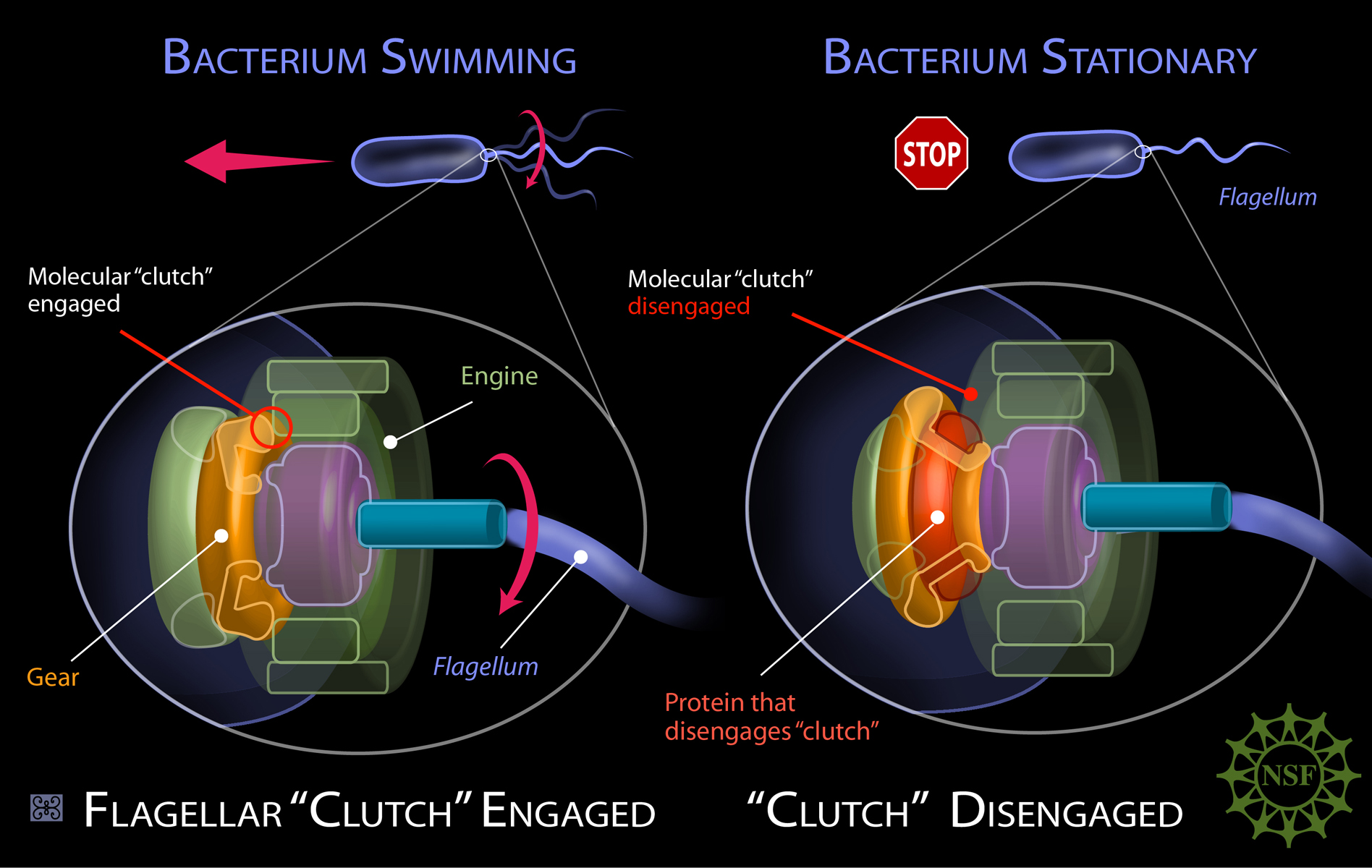
It has been long been known that bacteria swim by rotating their tail-like structure called the flagellum. The rotating motion of the flagellum is powered by a molecular engine located at the base of the flagellum. Just as engaging the clutch of a car connects its gear to its engine and delivers power to its wheels, engaging the molecular clutch of a bacterium connects its gear to its engine and delivers power to its flagellum.

Now, a paper appearing in Science describes, for the first time, how the flagellum's rotations are stopped so that bacteria stop moving.

Here's how the stopping mechanism works: while a bacterium is swimming, it releases a protein (shown in red in the stationary bacterium in the figure) that flows between its gear and engine. The presence of this protein detaches the bacterium's gear from its engine and thereby stops the delivery of power to its flagellum. This process is analogous to disengaging the clutch of a car, which detaches its gear from its engine and thereby stops the delivery of power to its wheels.

Once the delivery of power to bacterium's flagellum stops, the flagellum stops rotating, and the bacterium's swimming ends.

AMSTERDAM, Netherlands, June 19 /PRNewswire/ --

Agendia BV has announced the official opening of the company's new headquarters yesterday at Amsterdam's Science Park at Watergraafsmeer, Kruislaan 406. The Grand Opening ceremony was officiated by Dr. Rene Bernards, Chief Scientific Officer at Agendia and the Honourable Director General Mrs. R.M. Bergkamp, on behalf of the Honourable Mrs. Maria van der Hoeven, Minster of Economic Affairs for The Netherlands.

LONDON, June 19 /PRNewswire/ -- Solcara's Spotlight product has been adopted by Glasgow City Council to provide its press office with an efficient, fast, accurate and now indispensable media service.

Solcara Spotlight has been deployed in many of the UK's largest press offices, including the UK's largest Police forces, local authorities and city councils, as well as large commercial organisations that are increasingly in the media spotlight.

For those responsible for directing an organisation's communications, Solcara Spotlight allows them to connect to the information that matters, when it matters most, providing greater efficiency in the management and protection of reputation.

Chris Starrs, PR Manager for Glasgow City Council, said:

SAN FRANCISCO, June 19 /PRNewswire/ --

- Food Safety, Healthcare and Transportation 'Industry Solution Tracks' Strengthen Conference Agenda

TechInsights today announced the expansion of the RFID World 2008 conference (http://www.rfid-world.com/2008), offering demonstrable vertical market RFID solutions, discussion forums, seminars and symposia that address the increased demand from industry leaders for a RFID solutions-focused event. RFID World 2008: Beyond RFID: Global Solutions for the Auto ID Community will take place in Las Vegas at the MGM Grand September 8-10.

The slate of RFID World educational topics focuses on the hottest issues facing the RFID industry today such as:

LYNDHURST, England, June 19 /PRNewswire/ -- INEOS welcomes the statement made by Unite today confirming that INEOS has at no time stripped, removed or received any assets from the pension fund of INEOS workers at Grangemouth.

These were extremely serious allegations. INEOS is pleased that Unite has set the record straight by issuing its statement to the media and by publishing it on their website.

INEOS and Unite continue their discussion on the Grangemouth pension scheme with a view to finding a resolution to this dispute.

The Unite statement is given in full below:

In the current issue of Science, researchers from the European Molecular Biology Laboratory's European Bioinformatics Institute [EMBL-EBI] uncover systematic errors in existing methods that compare genetic sequences of different species to learn about their evolutionary relationships.

They present a new computational tool that avoids these errors and provides accurate insights into the evolution of DNA and protein sequences. The results challenge our understanding of how evolution happens and suggest that sequence turnover is much more common than assumed.

The four letter code that constitutes the DNA of all living things changes over time; for example individual or several letters can be copied incorrectly [substitution], lost [deletion] or gained [insertion]. Such changes can lead to functional and structural changes in genes and proteins and ultimately to the formation of new species. Reconstructing the history of these mutation events reveals the course of evolution.

LONDON, June 19 /PRNewswire/ -- Unite, the UK's largest trade union, reacted angrily today (Thursday) at the sudden announcement of the departure of Scarborough & North East Yorkshire NHS Trust's Chief Executive, Iain McInnes. The union called for immediate action by the Trust to alleviate the uncertainty the departure is causing patients and the workforce across the region.

His resignation is announced along with the resignations of the finance director and deputy chief executive Sandy Hogg and Jason Brine, the non-executive chairman of the trust board's audit committee.

LONDON, June 19 /PRNewswire/ -- An industrial dispute has arisen involving the INEOS Group of companies and Unite the union in relation to changes proposed to the company's pension arrangements for current and future employees at the Grangemouth Refinery Petrochemicals site in Scotland. In April 2008 industrial action took place and prior to the action commencing statements were made by both the company and the union representatives in relation to the dispute.

Yesterday I was facilitating a philosophy discussion at the New York Society for Ethical Culture when I found myself all of a sudden defending philosophy from the accusation that it’s all made up stuff. Two of the participants raised the objection from different perspectives, both representing persistent misconceptions concerning how philosophers go about doing their business.

The first criticism is that philosophy can never settle anything because, unlike science, it does not rely on experimental evidence. Granted, philosophers don’t do experiments (other than the very inexpensive thought variety), but then again philosophy isn’t science, so it seems odd to accuse philosophers of not doing what scientists do. (Then again, check out the experimental philosophy web site!)

Philosophers have other ways of settling disputes and advancing their discipline, and these ways make use of the rules of rational discourse and logic. For instance, just like no self-respecting scientist would be caught dead conducting an experiment with a statistically flawed design (say, the lack of a control), so no professional philosopher wants to be found engaging in a logical fallacy. And logical fallacies are even more clearly defined and understood than most experimental protocols.


