A new study suggests watermelon can be an effective natural weapon against prehypertension, a precursor to cardiovascular disease. It still won't hurt to exercise, of course.
Estimates are that up to 60 percent of U.S. adults are prehypertensive or hypertensive. Prehypertension is characterized by systolic blood pressure readings of 120-139 millimeters of mercury (mm Hg) over diastolic pressure of 80-89 mm Hg. "Systolic" refers to the blood pressure when the heart is contracting. "Diastolic" reflects the blood pressure when the heart is in a period of relaxation and expansion.
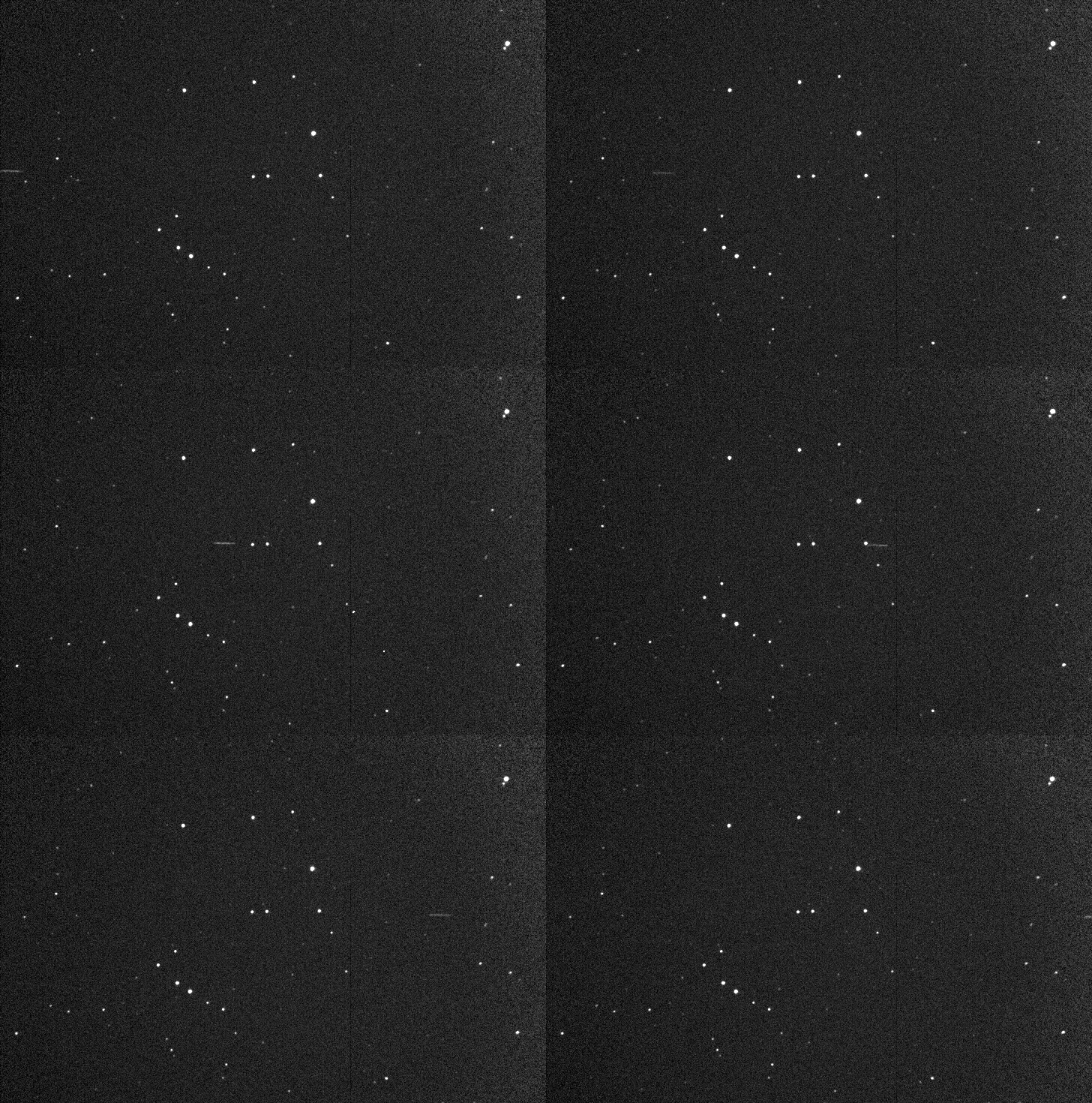
What's 7 billion light years away, equivalent in weight to 800,000,000,000,000 of our Suns and holds hundreds of galaxies? It's the most galaxy cluster ever discovered, that's what.
Astronomers using the South Pole Telescope discovered the behemoth and designated it the rather unspectacular SPT-CL J0546-5345.
Redshift measures how light from a distant object has been stretched by the universe's expansion. Located in the southern constellation Pictor (the Painter), the cluster has a redshift of z=1.07. This puts it at a distance of about 7 billion light-years, meaning we see it as it appeared 7 billion years ago, when the universe was half as old as now and our solar system didn't exist yet.
Well! The last day of the squid fertilization workshop was just as exciting, in its own way, as Sunday's fishing excusion.
The workshop's dozen participants hail from Mexico, Peru, Brazil, USA, Germany, Russia, and Spain. But our passion for cephalopod reproduction is as pure as our backgrounds are diverse. That's right, we are all obsessed with squid sex. So obsessed that we will make ourselves late for lunch with concerns about the chemistry of egg masses, and debate ommastrephid paralarval nutrition well into the night.
Yesterday morning we showed each other videos of egg masses and baby squid. We cooed over Susana's paralarvae and applauded Sakurai's shockingly spherical egg masses.
The smallest entity of life is the single cell, which exists not only as single cell organisms, but as evolution proceeds, as members of a bigger and more complex living organism. During the progression of life, an organism encounters many experiences, and encodes these experiences as memories or knowledge.
A 32-foot asteroid flew between the Earth and the Moon this morning. It was spotted in advance. It did not hit the Earth, but passed about 28,000 miles up. If it had hit the Earth, it would not have done damage. One of this size tends to hit the Earth's atmosphere every 2 years, on average. And, as NASA notes, we get a flyby of this size in the 'tween-Earth-Moon space about once every day.
This particular one passed much closer to Earth than the Moon's distance, and in fact almost to the spacing of our Earth-launched geosynchronos satellites. While the Moon is a hefty 236,000 miles away, geosync is only 26,000 miles away.