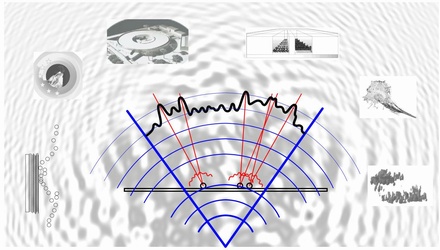



Richard F. Heck, Ei-ichi Negishi and Akira Suzuki have won 2010 Nobel Prize in Chemistry for  developing new, more efficient ways of linking carbon atoms together to build the complex molecules that are improving our everyday lives - palladium-catalyzed cross couplings in organic synthesis.

Basically, it allows researchers to make chemicals easier.   Carbon-based (you called it 'organic' in college) chemistry is the basis of life and has allowed man to explain parts of the world using natural laws but also provided  a stable foundation for functional molecules, which led to revolutionary materials like plastics.
Obviously some things about the Sun's relationship to Earth are known - if we get too close or too far away all life disappears.  But other aspects, like the activity of the Sun related to heating and cooling, are less clear.

It has long been known that the Sun's activity waxes and wanes over an 11-year cycle and that as its activity wanes, the overall amount of radiation reaching the Earth decreases. A new study looked at the Sun's activity over the years 2004-2007, when it was in a declining part of its 11-year activity cycle.
Is a 52% chance of winning a prediction?   Well, yes and no.

Today begins the Major League Baseball Division Series and New Jersey Institute of Technology associate math professor Bruce Bukiet is back again, performing his analysis of the probability of each team advancing to the League Championship Series.
Evolutionary detectives have used century-old bits of DNA from museum specimens to find a place for the extinct passenger pigeon, Ectopistes migratorius, in the family tree of pigeons and doves, identifying for the first time this unique bird's closest living avian relatives. 
New research is challenging the belief that the planet Neptune knocked a collection of planetoids known as the Cold Classical Kuiper Belt to its current location at the edge of the solar system.

The Kuiper Belt is of special interest to astrophysicists because it is a fossil remnant of the primordial debris that formed the planets.  University of Victoria Ph.D. student Alex Parker presented his results at today's meeting of the Division of Planetary Sciences in Pasadena, California.
The Chinese Chang'e series is taking over the moon.  For lunch, NASA people in Florida are heading to bread lines, while meanwhile the Chinese are microwaving the entire moon for their own consumption.  Okay, I'll ditch the mixed jingoistic metaphors now and get to what really makes me hungry-- space exploration successes.

With 1 down, 1 flying, and several more coming, the Chang'e program is starting off with strong successes.  The Chang'E-1 mission mapped the entire moon in microwaves, with data presented at the European Planetary Sciences Congress conference last month (September 2010).
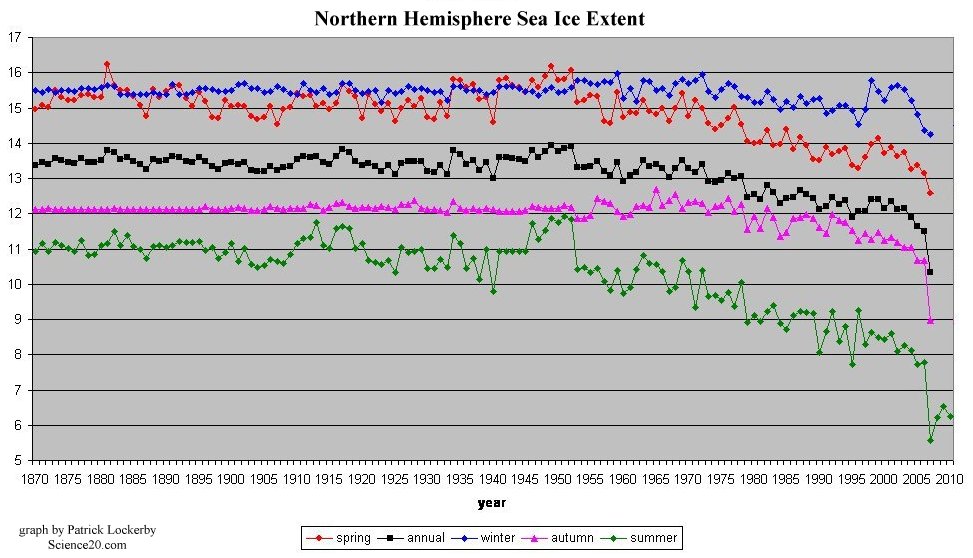
Arctic Ice October 2010

... the land being very high and full of mightie mountaines all covered with snowe, no viewe of wood, grasse or earth to be seene, and the shore two leages of into the sea so full of yce as that no shipping cold by any meanes come neere the same. The lothsome viewe of the shore, and irksome noyse of the yce was such as that it bred strange conceipts among us, so that we supposed the place to be wast and voyd of any sencible or vegitable creatures, whereupon I called the same Desolation.

John_Davis, 1587
I am on a diet, to the delight of my impossibly chic wife, who has no problem at all eating cake and pasta in front of me while I consume bland chicken.

I had assumed that my increasing weight was due to eating too much and no exercise but a new Université de Montréal study says it is my job doing it to me.  Whew.  I dodged a bullet there.

Regardless, in two weeks I will be back where I want and if it is true that workplace related obesity is real, my job took four years to make me a weight I did not want so four weeks is not so bad to suffer.

