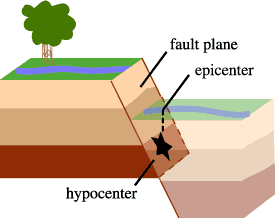
The earth has four major layers: the inner core, outer core, mantle and crust. The crust is what we need to think about here and the earth's crust is divided into 'plates' that are like puzzle pieces but are up to 50 miles thick and they are in constant motion in the earth's interior. These puzzle pieces are tectonic plates and the edges of the plates are called the plate boundaries. The plate boundaries are made up of many faults, and most of the earthquakes around the world occur on these faults. Most earthquakes are due to pressure that builds up over time and that pressure causes the ground to 'slip' along a geological fault plane on or near a plate boundary.
For me, parenting a child with autism sometimes feels like taking high school physics.
I was never a science-minded kid. I was a writer. I did theater. I was all about the liberal arts. But, science and me? We never really hit it off.
Despite that, I enrolled in AP Physics in my senior year. At the time, I was swayed by the certainty of a classmate who told me that without physics I would never make it through college – never mind through life. She’s probably a nuclear physicist now – I never thought to ask her about her plans for the future. Instead, I just took her advice and signed up for the toughest physics class my high school offered.
Researchers have discovered more about the mechanisms underlying female sexual arousal using a novel prototype drug called UK-414,495, according to findings published this week in the British Journal of Pharmacology.
Researchers found that electrically stimulating the pelvic nerve increases blood flow to the genitalia, and that this effect was enhanced if they also gave the prototype drug. They believe that UK-414,495 acts by blocking the breakdown of an internal chemical messenger that plays a key role in increasing blood flow during sexual arousal.
a new review published in the April issue of The Cochrane Library suggests that restrictions on smoking in public reduce secondhand smoke exposure, heart attacks, and improve a number health indicators.
Researchers searched for studies of situations where a legislative ban had been introduced, or restrictions on smoking had been applied to populations. They considered data from 50 studies that monitored at least the first six months after a policy change had been implemented.
"Taken together, the benefits for workers and the reduction of hospital-related morbidity are impressive," says Professor Cecily Kelleher, School of Public Health, Physiotherapy and Population Science at University College Dublin, Ireland.
New satellite data indicate that March 2010 was the third warmest month since December 1978, compared to seasonal norms, according to researchers at the Earth System Science Center (ESSC) at The University of Alabama in Huntsville.
Powered by the most intense El Nino Pacific Ocean warming event since 1997-1998, the first three months of 2010 have all landed among the six warmest months in the satellite temperature record, which starts in December 1978.
Anthropologists writing in the Journal of Social Archaeology say they have found evidence indicating that Mayan citizens recorded their family history by burying it within their homes.
Maya in the Classic period (A.D. 250-900) regularly "terminated" their homes, razing the walls, burning the floors and placing artifacts and (sometimes) human remains on top before burning them again.
Evidence suggests these rituals occurred every 40 or 50 years and likely marked important dates in the Maya calendar. After termination, the family built a new home on the old foundation, using broken and whole vessels, colorful fragments, animal bones and rocks to mark important areas and to provide ballast for a new plaster floor.
Researchers have identified the brain circuit that underlies our ability to resist instant gratification in order to earn a better payoff.
The effort provides insight, scientists say, into the capacity for "mental time travel," also known as episodic future thought, that enables humans to make choices with high long-term benefits. Results of the research are published in Neuron.
Several models have been proposed to explain the neural basis of assigning relative value to multiple rewards at different points in time (also known as "intertemporal decision making") in humans. Until now, however, many questions remained unanswered, and the brain regions and mechanisms involved in this process were unclear.
Exclusive licenses to gene patents are supposed to spur development of new technologies for gauging disease risk but actually do more to block competition in the gene testing market, say researchers from the Duke Institute for Genome Sciences and Policy (IGSP).
As single-gene tests give way to multi-gene or even whole-genome scans, exclusive patent rights could slow promising new technologies and business models for genetic testing even further, the Duke researchers say.
The findings emerge from a series of case studies that examined genetic risk testing for 10 clinical conditions, including breast and colon cancer, cystic fibrosis, and hearing loss. The studies appear April 14 in a special issue of Genetics in Medicine.
The Animal That Amplifies Itself
Amplify: to make a thing bigger or more powerful.
The characteristic that most distinguishes humans from our animal cousins is not the use of tools. Nor is it the use of language. Many animals use twigs or stones as tools. Many animals have the ability to communicate alarm, distress, food sources and other matters.
The only thing, I suggest, that clearly separates humans from all other living things is that we are the only species which can amplify its behaviors. Whatever biological faculty we wish to use we have a machine to amplify that faculty. We invented machines to enhance our chances of survival.