Scientist with the European Space Agency (ESA) and NASA say that Venus is still geologically active. The Visible and Infrared Thermal Imaging Spectrometer (VIRTIS) aboard the ESA's Venus Express spacecraft has identified relatively young lava flows that suggests the planet remains capable of volcanic eruptions.
ESA researchers were able to determine the relative age of the flows based on how they react with Venus' atmosphere. On Earth, lava flows react rapidly with oxygen and other elements in the atmosphere, changing their composition. On Venus, the process should be similar, though more intense because of the hotter, denser atmosphere, chiefly of carbon dioxide.
The surging number of autism diagnoses is driven in part by social interaction between parents, according to a study published in the American Journal of Sociology.
The study found that children living near a child who has been previously diagnosed with autism have a much higher chance of being diagnosed themselves in the following year, mainly because of parents learning about autism from other parents who have a child diagnosed with the disorder.
The Hubble space telescope has snapped a spectacular image of Messier 66, the largest "player" of the Leo Triplet, and a galaxy with an unusual anatomy: it displays asymmetric spiral arms and an apparently displaced core. The peculiar anatomy is most likely caused by the gravitational pull of the other two members of the trio.
The unusual spiral galaxy, Messier 66, is located at a distance of about 35 million light-years in the constellation of Leo. Together with Messier 65 and NGC 3628, Messier 66 is one third of the Leo Triplet, a trio of interacting spiral galaxies, part of the larger Messier 66 group. Messier 66 wins out in size over its fellow triplets — it is about 100 000 light-years across.
Researchers have drastically increased the toughness of a T-shirt by combining the carbon in the shirt’s cotton with boron – the third hardest material on earth. The result is a lightweight shirt reinforced with boron carbide, the same material used to protect tanks.
Scientists dipped plain, white T-shirts that were cut into thin strips into a boron solution. The strips were later removed from the solution and heated in an oven. The heat changed the cotton fibers into carbon fibers, which reacted with the boron solution and produced boron carbide.
Europe's first mission dedicated to studying the Earth's ice, CryoSat-2, was launched today from Kazakhstan. From its polar orbit, the satellite will send back data leading to new insights into how ice is responding to climate change and the role it plays in our 'Earth system'.
CryoSat-2 replaces the original CryoSat satellite that was lost in 2005 owing to a launch failure. The mission objectives, however, remain the same: to measure changes in the thickness of the vast ice sheets that overlie Antarctica and Greenland, as well as variations in the thickness of the relatively thin ice floating in the polar oceans.
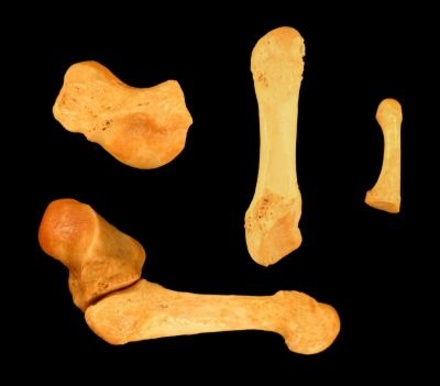
The new species of hominid discovered 40 kilometers outside of Johannesburg, South Africa,
the first missing link of 2010, has been dubbed
Australopithecus sediba by its discoverers
. Researchers believe the new species might be the link between the southern African ape-man
Australopithecus africanus and either Homo habilis or a direct ancestor of
Homo erectus. The research is detailed in this week's issue of
Science.
A comprehensive review of national opinion polls taken before and after Congressional voting and when President Obama signed into law a major healthcare reform bill last month has found that the law's signing did not change Americans' opinions of the legislation.
The analysis of 33 independent opinion polls revealed that partisan disagreements over the reforms are stark. These political differences have implications for the implementation of the legislation and for the 2010 Congressional elections as many potential voters want the law to be scaled back while many others want the law changed to expand government's future role.
The analysis appears in this week's New England Journal of Medicine.
There is no link between a lack of musical ability and dyslexia, and attempts to treat dyslexia with music therapy are unwarranted, according to a study in the International Journal of Arts and Technology.
Research into dyslexia has pointed to a problem with how the brain processes sounds and how dyslexic readers manipulate the sounds from which words are composed, the phonemes, consciously and intentionally.
For many researchers, it was a relatively short step between the notion that dyslexia is an issue of phonological processing and how this might also be associated with poor musical skills – amusia – that has led to approaches to treating the condition using therapy to improve a dyslexic reader's musical skills.