


Researchers say they have uncovered a clue that may help to explain why the earliest evidence of complex multicellular animal life appears around 550 million years ago, after atmospheric oxygen levels on Earth dramatically rose, from 3% to the modern day level of 21%.

The group says humans share a method of sensing oxygen with the world's simplest known living animal, Trichoplax adhaerens, suggesting the method has been around since the first animals emerged around 550 million years ago and helps us understand how humans sense oxygen and how oxygen levels drove the very earliest stages of animal evolution.
If you're in one of the areas of the world blanketed by snow, it probably feels like winter is already here - the cold weather has NPR pundits in such a panic they are claiming the snow is worse than global warming because it means (to them) that the climate is already 'unstable'.

But December 21st is officially winter and it is bringing with it a lunar eclipse.   Last time that happened?   1554 A.D., according to NASA.
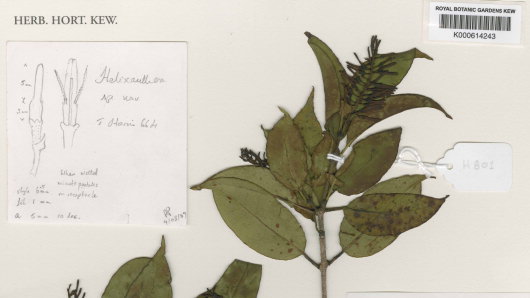
A  parasitic, tropical mistletoe has been discovered near the summit of Mount Mabu in northern Mozambique and, just in time for Christmas, this new wild mistletoe has been named Helixanthera schizocalyx.

It was spotted by Royal Botanic Gardens, Kew East African butterfly specialist, Colin Congdon, while the team were trekking up the mountain, on a path that took them from the moist montane forest up to where the broad granite peaks break through the dense foliage. Congdon says he quickly realized this species was different from anything he had seen on the mountains in neighboring Malawi and Tanzania, and on closer inspection back at Kew it was confirmed as a new species.
What's on people's mind? Who or what is impacting us most? That is easy to decide: go to Google, put in the search field the n-gram (the sequence of n words) that describes the item you want to check,* and watch the number of hits. 

So the bigram "John Lennon" (25 million hits) is apparently more talked about than "Elvis Presley" (20 million hits). But both get beaten by "Paris Hilton" (32 million hits), who in turn is dwarfed by "Michael Jackson" (98 million). And of course, "Lady Gaga" (140 mln) is the biggest.

That's pretty clear, right?
In all of the excitement about 'renewable' energy that can replace fossil fuels, we look to the future - algae, seaweed, switchgrass, we have articles on practically every new idea - but forget to look to the past, like in wood.

Unlike 50 years ago, we now know how to make wood truly renewable (the Christmas tree industry was a wonderfully efficient proof of concept) and, say researchers at Fraunhofer Institute for Environmental, Safety and Energy Technology UMSICHT in Oberhausen, Germany, with modern techniques wood is comparable to natural gas in efficiency of heat supply.
In the month of December (and October, November, and January), PA systems in malls around the country play holiday music. And when we hear the telltale pa-rum-pum-pum-pum we want to strangle the nearest elf. Maybe kick a reindeer.

Sigh. I was going to write with lyric beauty about a dream I had last night, in which I was finally, finally successful in feeding baby squid. I watched them stuffing copepods into their mouths with deep satisfaction. But that will have to wait, because guess what?

CC attribution-noncommercial

In this case, it's an article called Santa loves Calamari. Well-intentioned, but wrong. The premise of the piece is that "squid is the new sustainable holiday seafood" based on information like:

