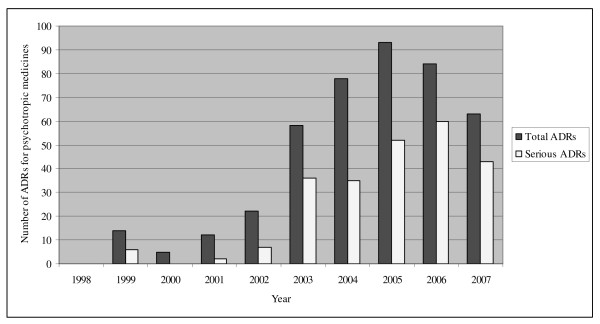
Psychotropic medications - psychostimulants like Ritalin, antidepressants like Prozac and antipsychotics like Haldol - during pregnancy increase the probability of birth defects, according to a University of Copenhagen study.
In Denmark, psychotropic medications were associated with 429 adverse drug reactions in Danish children between 1998 and 2007 - more than half of the 429 cases were serious and several involved birth defects, such as birth deformities and severe withdrawal syndromes.
While proponents of organic farming insist it can meet population projections and is better for wildlife, scientists at the Universities of Leeds and York say instead a balanced approach is superior. At least for butterflies.
Their study found that organic farms have more butterflies than conventional farms but that a conventional farm plus an area specifically managed for wildlife could support more butterflies and produce the same amount of food from the same area of land. Drawback: the wildlife area would have to be similar in quality to a nature reserve rather than similar to an uncultivated field margin, which boosts costs even more.
The Greenland and West Antarctic ice caps are melting at half the speed previously predicted, shows a team from the Jet Propulsion Laboratory, Delft University of Technology (TU Delft, The Netherlands) and SRON Netherlands Institute for Space Research in Nature Geoscience.
The melting of the ice caps has been charted since 2002 using the measurements produced by the two GRACE satellites. From space they detect small changes in the Earth's gravitational field and these changes are related to the exact distribution of mass on Earth, including ice and water. When ice melts and lands in the sea, this therefore has an effect on the gravitational field.
A research team says they have discovered one of the key drivers of human evolution and diversity, accounting for changes that occur between different generations of people.
Professor Alec Jeffreys, who discovered DNA fingerprinting at the University of Leicester in 1984, and has spent the decades since investigating what he describes as "pretty bizarre bits of DNA" - highly variable repeated parts of DNA called 'minisatellites' - found in the human genome. Jeffreys observed that these seemed to be changing and "picking up mutations at an extraordinary rate" when compared to other DNA.