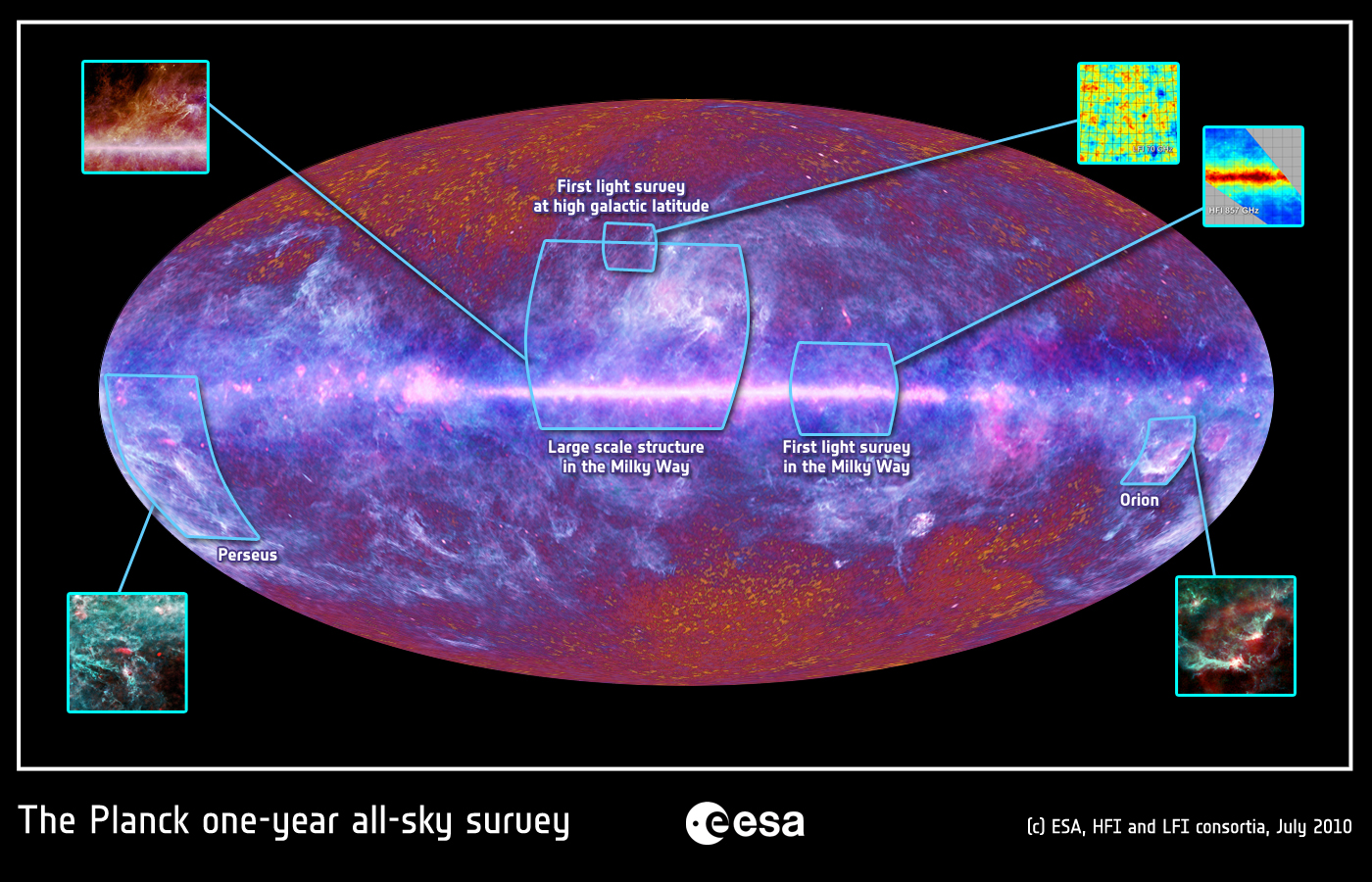
ESA’s Planck mission is a 'time machine' to study the relic radiation from the Big Bang, and it has delivered its first all-sky image, one of four all-sky scans it will complete by the end of its mission in 2012.
Planck is designed to map tiny irregularities in fossil radiation left over from the very first light in the Universe, emitted shortly after the Big Bang, and has enough sensitivity to reach the experimental limits of what can be observed, allowing researchers to peer into the early Universe and study its constituents, perhaps even the hypothetical dark matter and dark energy that continue to be a debate among the science community worldwide.
Brain stem cells remain dormant until needed to make more neurons but little is known about the molecular guards that keep them quiet - or 'wake' them up.
Scientists from the Salk Institute for Biological Studies say they have identified the signal that prevents stem cells from doing too much proliferating, a move that protects the brain against too much cell division and ensuring a pool of neural stem cells that lasts a lifetime.
Researchers have shown a new ability to control the behaviors of individual electrons within simple atoms and molecules by stripping them away, one by one, and in some cases creating 'hollow atoms'.
The results describe how the Linac Coherent Light Source's intense pulses of X-ray light change the very atoms and molecules they are designed to image. Controlling those changes will be critical to achieving the atomic-scale images of biological molecules and movies of chemical processes that the LCLS is designed to produce.