



The long supposed connection between mind and music has been further demonstrated by an international collaboration of physicists led by Simone Bianco and Paolo Grigolini at the Center for Nonlinear Science at the University of North Texas. A statistical analysis reveals a remarkable similarity between the distributions produced by music compositions and brain activity.

The consumption of sweetened soft drinks by children has more than doubled between 1965 and 1996 but few studies have been able to investigate the link between diet and the body’s energy balance control systems in early life. Now scientists at Aberdeen’s Rowett Research Institute have been able to model how the young body responds to overeating.

Biologists at the University of California, Riverside have identified the genes, and determined the DNA sequences, for two key proteins in the "dragline silk" of the black widow spider - an advance that may lead to a variety of new materials for industrial, medical and military uses.

Researchers at the University of Pennsylvania have created the first three-dimensional optical images of human breast cancer in patients based on tissue fluorescence.

Fluorescence diffuse optical tomography, or FDOT, relies on the presence of fluorophore molecules in tissue that re-radiate fluorescent light after illumination by excitation light of a different color.

The reconstructed images demonstrated significant tumor contrast compared to typical endogenous optical contrast in breast. Tumor-to-normal tissue contrast based on FDOT with the fluorophore Indocyanine Green, or ICG, was two-to-four-fold higher than contrast based on endogenous contrasts such as hemoglobin and scattering parameters obtained with traditional diffuse optical tomography, or DOT.

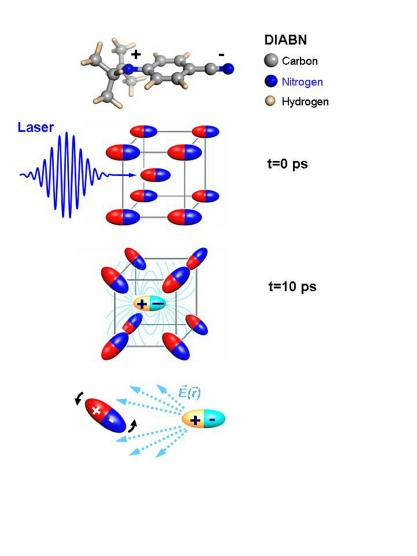
Ultrafast intramolecular electronic charge separation during photo-chemical reactions cause up to tenthousand surrounding molecules to perform aligning pirouettes. Researchers observed for the first time such light induced reorientations in an organic molecular crystal.

In their study they initiated a separation of positive and negative electronic charge in a small number of particular molecules with extremely short light pulses. In turn the surrounding molecules responded by aligning their respective dipole axes along the photoinduced electric fields. The researchers observed this fundamental process for the first time by means of femtosecond x-ray diffraction with high spatial precision and in real time.

Physicists of the DZero experiment at the Department of Energy's Fermi National Accelerator Laboratory have discovered a new heavy particle, the Îb(pronounced "zigh sub b") baryon, with a mass of 5.774±0.019 GeV/c2, approximately six times the proton mass.

The newly discovered electrically charged Îb baryon, also known as the "cascade b," is made of a down, a strange and a bottom quark. It is the first observed baryon formed of quarks from all three families of matter.

A protein found primarily in the lens of the eye could be the critical "tipping point" in the spiral of inflammation and damage that occurs in multiple sclerosis, researchers at the Stanford University School of Medicine report.

This protein - alphaB-crystallin - is not normally found in the brain, but develops in response to the injuries inflicted on nerve cells by multiple sclerosis. The nerve-cell injuries can cause people to suffer loss of motor control and even paralysis.

A major study of the organization and regulation of the human genome published today changes our concept of how our genome works. The integrated study is an exhaustive analysis of 1% of the genome that, for the first time, gives an extensive view of genetic activity alongside the cellular machinery that allows DNA to be read and replicated.

The lead report from the ENCyclopedia Of DNA Elements (ENCODE) Consortium, published in Nature, together with 28 companion papers published in Genome Research, defined in detail which regions of the genome are actively copied in the cell, revealed the location and studied evolution of elements that control gene activity, and defined the relationship between DNA-associated proteins and gene activity and DNA replication.

Genome-wide association studies (GWAs) have received a lot of media attention in the last several months as various research groups have released over a half-dozen such studies, all focused on some of the most widespread Western diseases, including heart disease, type II diabetes, and breast cancer.

A method for increasing plants’ tolerance to salt stress and thus preventing stunted growth and even plant death has been developed. The method has significant consequences for dealing with soil salinization, which is an acute problem for a wide range of crops in many regions of the world.


Magnified photo at left shows the invasion of heavy oxidation (green bubbles) in the membrane of a wild, stressed, salt-sensitive plant. At right, following genetic manipulation, the bubbles are broken up and "caged" into tiny vesicles, thus preventing interference with the flow of vital nutrients in the plant. Credit: Illustration courtesy the Hebrew University

