





Nobody questions that the color of our eyes is encoded in our genes. When it comes to behavior the concept of "DNA as fate" quickly breaks down -- it's been long accepted that both genes and the environment shape human behavior. But just how much sway the environment holds over our genetic destiny has been difficult to untangle.

Scientists at the Salk Institute for Biological Studies have found a clever way to sort one from the other: They compared the social behavior of children with Williams syndrome -- known for their innate drive to interact with people -- across cultures with differing social mores. Their study, published in a forthcoming issue of Developmental Science, demonstrates the extent of culture's stamp on social behavior.

A team led by biochemists at the University of California, San Diego has found what could be a long-elusive mechanism through which inflammation can promote cancer. The findings may provide a new approach for developing cancer therapies.

The study, published in the January 26 issue of the journal Cell, shows that what scientists thought were two distinct processes in cells—the cells’ normal development and the cells’ response to dangers such as invading organisms—are actually linked.

New research has identified the first genetic evidence of Africans having lived amongst "indigenous" British people for centuries. Their descendants, living across the UK today, were unaware of their black ancestry.

The University of Leicester study, funded by the Wellcome Trust and published today in the journal European Journal of Human Genetics, found that one third of men with a rare Yorkshire surname carry a rare Y chromosome type previously found only amongst people of West African origin.

The researchers, led by Professor Mark Jobling, of the Department of Genetics at the University of Leicester, first spotted the rare Y chromosome type, known as hgA1, in one individual, Mr. X. This happened whilst PhD student Ms.

Homer's Cyclops might be myth, but a disorder that can cause babies to be born with only one eye is very real. Scientists from Cleveland, Ohio, and Paris, France, reached an important milestone in understanding one of the molecular causes of a rare, but serious birth defect, Holoprosencephaly.

In a study to appear in the February issue of The FASEB Journal, researchers describe findings that help explain why and how some fetal brains fail to develop two lobes, as well as why and how the related skull and facial defects occur. Using the information from this study, researchers will be able to pursue better approaches toward detecting, preventing, and treating this serious disorder.

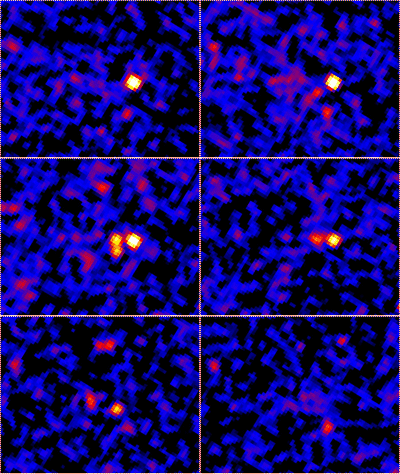
The European Space Agency's gamma ray observatory Integral has caught the centre of our galaxy in a moment of rare quiet. A handful of the most energetic high-energy sources surrounding the black hole at the centre of the Galaxy had all faded into a temporary silence when Integral looked.

  Integral Galactic Centre


This unusual event is allowing astronomers to probe for even fainter objects and may give them a glimpse of matter disappearing into the massive black hole at the centre of our galaxy. The Galactic centre is one of the most dynamic places in our Galaxy.

A research team, led by UC Riverside’s Ludwig Bartels, is the first to design a molecule that can move in a straight line on a flat surface. It achieves this by closely mimicking human walking. The “nano-walker” offers a new approach for storing large amounts of information on a tiny chip and demonstrates that concepts from the world we live in can be duplicated at the nanometer scale – the scale of atoms and molecules,


An illustration from the lab of Ludwig Bartels of the walking molecule as it carries molecular packages. (Image courtesy of University of California - Riverside)

