




Susskind and other usual suspects try hard to convince the world that they are the ones who finally understood 'Many Worlds' and that such is a success of string theory and all that. A media spectacle is going on right now, see here at the New Scientist’s “Ultimate Guide to the Multiverse”, Brian Greene chipping in with the Multiverse episode of the “Fabric of the Cosmos” series on PBS, and many others.

Today's squid news comprises four journalistic angles on the same story. See if you can figure out what it is:
The controversy over whether or not violent video games are potentially harmful to players has been debated for many years, even making it to the Supreme Court in 2010. There has been little scientific evidence demonstrating that the games have a prolonged negative neurological effect but sustained changes in the region of the brain associated with cognitive function and emotional control were found in young adult men after one week of playing violent video games, according to study results presented at the annual meeting of the Radiological Society of North America.

The debate over the actual benefit of antioxidants may be ongoing but the studies keep coming in. Regardless of cardiovascular disease medical history, Swedish women who ate an antioxidant-rich diet had fewer strokes, shows the results of a new survey.

Oxidative stress is an imbalance between the production of cell-damaging free radicals and the body's ability to neutralize them. It leads to inflammation, blood vessel damage and stiffening.

Antioxidants such as vitamins C and E, carotenoids and flavonoids can inhibit oxidative stress and inflammation by scavenging the free radicals. Antioxidants, especially flavonoids, may also help improve endothelial function and reduce blood clotting, blood pressure and inflammation.

Researchers using the Ozone Monitoring Instrument (OMI) on NASA's Aura satellite have confirmed major reductions in the levels of sulfur dioxide, a key pollutant generated by coal power plants which contributes to the formation of acid rain, in the eastern United States. 

The text below was graciously written for this blog by Alejandro Rivero (below),  a friend who has contributed to this blog other times in the past. His theoretical ideas are off the mainstream, but in a way which makes them interesting to me. I hope some of you will appreciate reading about the whole thing in summary here - Alejandro has a few papers out which you may want to read if you are specifically interested in the matter.

For most of human history, technology changed very little during a person’s lifetime. Certainty, their life was not constant with the hard agricultural life being interrupted by war, disease, and famine. However, very few new technologies would come into their life. In contrast, my grandparents saw tremendous change throughout the 20th century as planes, cars, electricity, radio, and computers enter during their lives. Politically, the U.S. grew from a minor player to a world leader. Socially, many rights were obtained. In my life, I have also experienced rapid change, but it seems a bit different than my grandparents’.

For example, the biggest change is the way computers have grown to dominate many products and processes. But why do I have a computer now?

By the time Dr. Maciej Zwieniecki returned to the blackboard, I’d gotten sufficiently lost in the intricacies of fluid dynamics that I wasn’t sure how much more I could absorb from his lecture on vertical water transport in trees.  Still, I could objectively admire his off-the-cuff artwork as he brushed away a cross-section of a tree and quickly outlined a perfectly recognizable…fighter jet?

The audience watched, bemused. Maciej chuckled, then explained how mechanisms borrowed from tree physiology might one day be used to efficiently transfer heat from jet wings to the cockpit.  At least, that’s what the Department of Defense, which funded his basic research on tree mechanics, hoped.

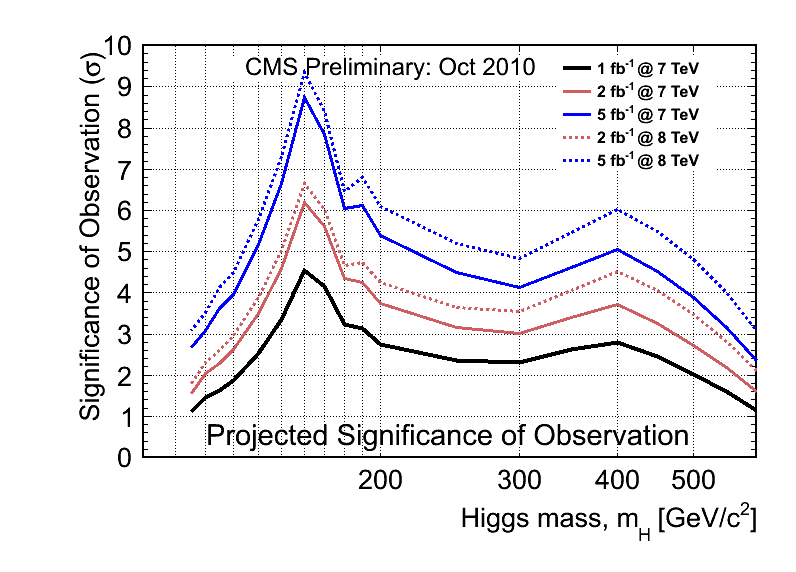
Update: I am keeping out of this, but you may well be interested in reading what Gibbs, Woit, and Motl have to say about recent leaks on the ATLAS and CMS results. So I hope I won't be crucified for three general links now!

Update 2: And it is now public that a seminar at CERN will be given by ATLAS and CMS on December 13th. So the wait is almost over, officially...

I have not written in a while - a full week. This is uncharacteristic enough that I owe you some sort of explanation.

I don’t understand, sometimes, how people put together their web pages. Who really thinks that, say, pink text on a red background looks good? Seventeen different typefaces on one page? A background image that makes people’s eyes cross?

