



It's always a little surreal to see a new comment in the email on an old article. The older the article is, the stranger it is, especially when the comment itself is bizarre.
252 million years ago there was a watershed moment in the history of life on Earth - namely that there was almost no life left on Earth. As much as 90 percent of ocean organisms were extinguished, ushering in a new order of marine species, some of which we still see today and land dwellers also sustained major losses.

A new paper in Proceedings of the Royal Society B undertook an exhaustive specimen-by-specimen analysis  of surviving land-based vertebrates. The survivors, a handful of genera labeled "disaster taxa," were free to roam more or less unimpeded, with few competitors in their respective ecological niches.

An underwater ridge may be the only thing holding back the retreat of Antarctica's fast-flowing Thwaites Glacier, which drains into west Antarctica's Amundsen Sea, and it could speed up within 20 years, says a new study in Geophysical Research Letters.

Thwaites Glacier is being closely watched for its potential to raise global sea levels as the planet warms but neighboring glaciers in the Amundsen region are also thinning rapidly, including Pine Island Glacier and the much larger Getz Ice Shelf. The study highlights the importance of seafloor topography in predicting how these glaciers will behave in the near future.

Quick, have you heard of Professor Curie?  How about Marie Curie?

If you're reading this article, you may have known who I meant with the first one, but how many of you instinctively thought of Pierre Curie, co-discoverer of Polonium and Radium, when I used the term 'professor'?  You all knew the name Marie Curie but to the bulk of the world, one of the most iconic scientists of the 20th century is known instead as "Madame Curie".
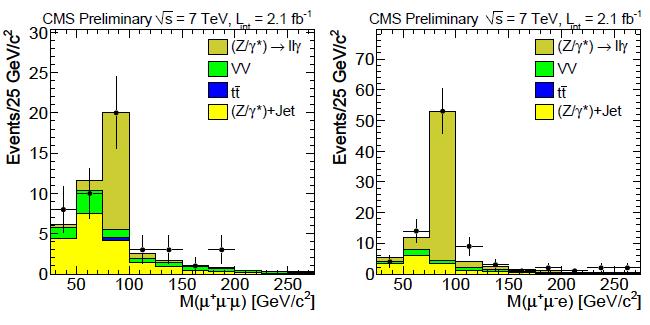
A process which caught some of the LHC Higgs analysts by surprise in the recent run of analyses for summer 2011 conferences is the production of multiple-lepton events by a process called "internal photon conversion in Z events". What is it, and how can we size it up ?

The conversion of a real, energetic photon into a fermion-antifermion pair readily occurs when the particle traverses a medium: the process is also known as "pair production", and is the leading form of energy loss of energetic photons in matter. It is thanks to it (and to the related process called "bremsstrahlung" of energetic electrons) that our electromagnetic calorimeters can measure electrons and photons!
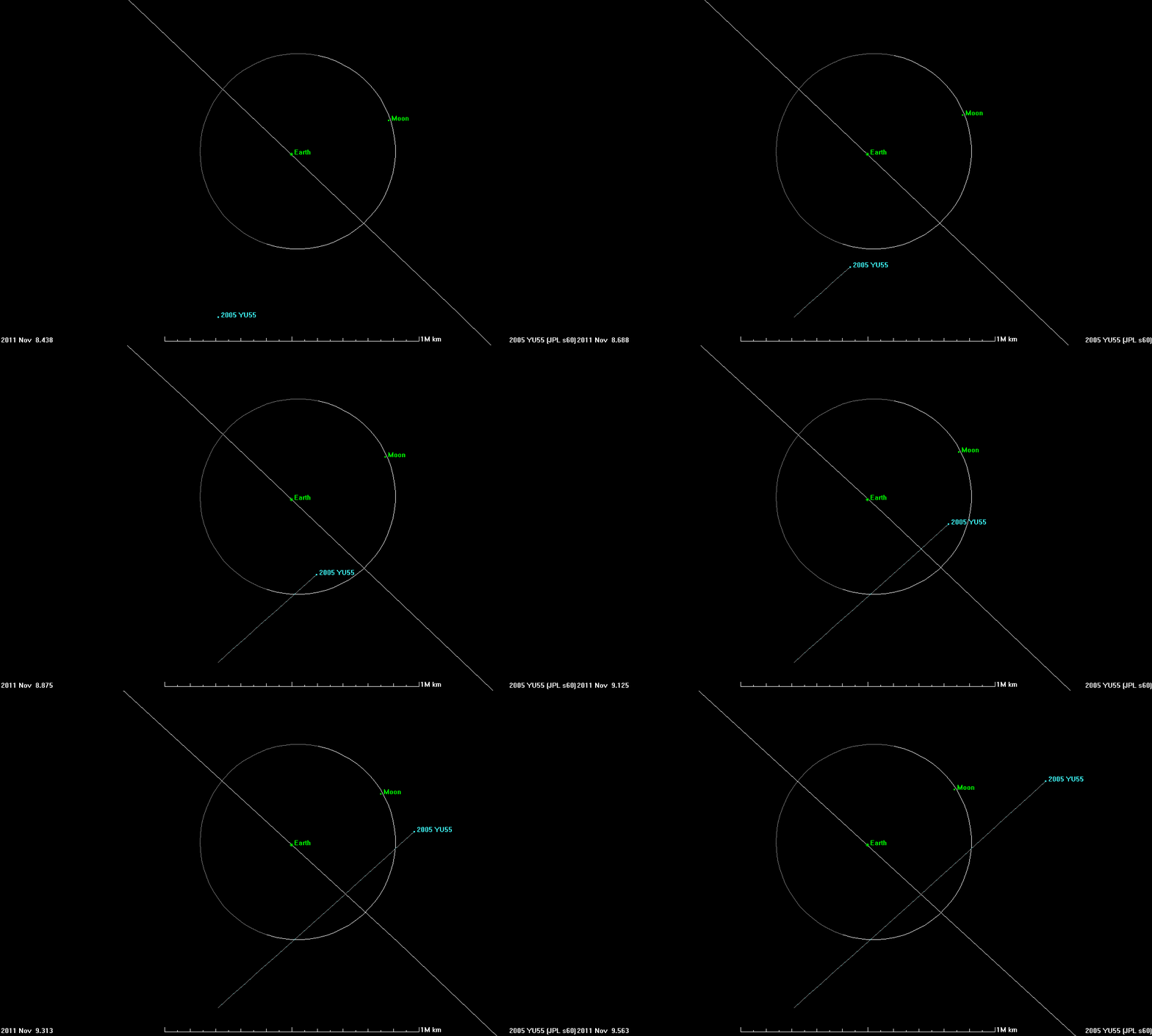
 A 400 meter, C-type asteroid will pass within 0.85 lunar distances from the Earth on November 8, 2011.  The attached animated illustration shows the Earth and moon flyby geometry for November 8th and 9th when the object will reach a visual brightness of 11th magnitude and should be easily visible to observers in the northern and southern hemispheres. The closest approach to Earth and the Moon will be respectively 0.00217 AU and 0.00160 AU on 2011 November 8 at 23:28 and November 9 at 07:13 UT.

'Lucid' dreamers are people who claim they are aware that they are dreaming and can deliberately control their actions in dreams. When people dream that they are performing a particular action, a portion of the brain involved in the planning and execution of movement lights up with activity. 

This learned skill presents an opportunity for researchers who are studying the neural underpinnings of our dreams and their findings in Current Biology, made by scanning the brains of lucid dreamers while they slept, give us a glimpse into non-waking consciousness and perhaps create a waypoint toward true "dream reading." 

Higher levels of testosterone have been associated with reduced lean muscle mass loss in older men, especially in those who were losing weight. In thoese men, higher testosterone levels were also associated with less loss of lower body strength.

Loss of muscle mass and strength contribute to frailty and are associated with falls, mobility limitations and fractures. Men also lose more muscle mass and strength than women as they age, suggesting that sex steroids, and testosterone in particular, may contribute to body composition and physical function changes.

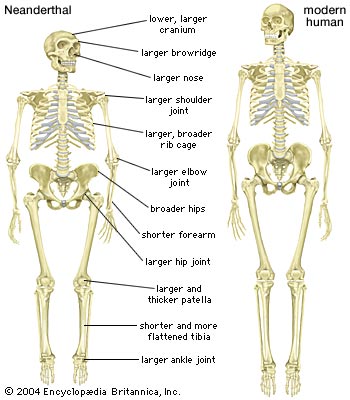
Neanderthals had shorter legs than their Homo sapiens contemporaries, leading many to believe that the locomotion of the former was less efficient (basically, they have to take more steps to traverse a certain distance). But a new study, performed by researchers at the John Hopkins School of Medicine, questions this notion.

What’s new in this study is that it takes the terrain into account. Whereas previous studies looked only at flat land, this one considered sloped, mountainous terrain more like the environment in which Neanderthals could be found. The colder climate they were exposed to, led to a ‘compaction’ of the Neanderthal body (less surface area, thus less loss of body heat) (see figure 1).


Experiments have recently supported a longstanding hypothesis that explains how males can survive with only one copy of the X chromosome, a hotly debated topic in science.

Women have two X chromosomes, while men have one X and one Y. The lack of a 'back up' copy of the X chromosome in males contributes to many disorders that have long been observed to occur more often in males, such as hemophilia, Duchene muscular dystrophy and certain types of color blindness. Having only one copy of X and two copies of every other chromosome also creates a more fundamental problem; with any other chromosome, the gene number imbalance resulting from having only one copy would be lethal.

How can males survive with only one X?

