


Rhythmic activity of nerve cells supports spatial navigation, say a group of researchers who recently showed that cells in the entorhinal cortex, important for spatial navigation, oscillate with individual frequencies. These frequencies depend on the position of the cells within the entorhinal cortex.
Rotten oranges can be detected manually in dark rooms with the help of ultraviolet light that illuminates the essential oils in damaged rind through fluorescence but that type of light poses some risk on fruit quality, like a reduction in vitamin C.

Scientists at the Valencian Institute of Agrarian Research (IVIA, Spain) have created prototypes for machines that not only detect and automatically separate rotten oranges, but can also detect mandarin segments according to quality and helps citrus fruit pickers out in the field. All the prototypes use computer vision to automatically inspect the fruits.
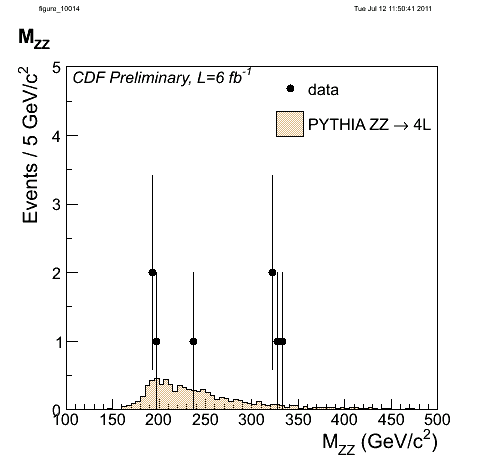
Higgs boson hunters often catch themselves dreaming of the boson having a mass high enough to give rise to the spectacular decay into two Z bosons, and then four charged leptons in the final state. At a hadron collider -let's talk of the LHC to be specific- such a signature is the only one providing events which, once properly selected, are more likely signal than background.

The situation of observing an event display being able to tell for sure what it represents, among the infinite possibilities and the intrinsic indetermination of quantum processes, is reassuring and gives a physicist a feeling of power. God did not play dice this time: those two are 100% Z bosons, and their combined mass is exactly the one of the Higgs.
There may be a sexual upside to an economic downside; more sex.  Maybe 'stimulus plan' means different things to different people.

Omri Gillath at the University of Kansas says men are likely to pursue short-term mating strategies when faced with a threatening environment, according to sexual selection theory based on evolutionary psychology.  How did he determine that?  He and colleagues told men to think about their own deaths, which mimics conditions of 'low survivability' and they found that men responded more vigorously to sexual pictures and had increased heart rates when viewing them, compared to when they thought about dental pain.

While people are busy with their own knee-jerk reactions trying to stifle my criticizing the scientific community, the Wall Street Journal did what was predicted by that very criticism, namely turning the way that the scientific community deals with the faster than light neutrino results into an asset for global warming denial:


Robert Bryce in “Five Truths About Climate Change”:

Particulate organic carbon (or POC) is an important factor in the ocean’s carbon cycle. When these tiny particles hit the water, they sink and attract bacteria. These bacteria can feed on the particles, releasing carbon into shallow waters and the atmosphere.

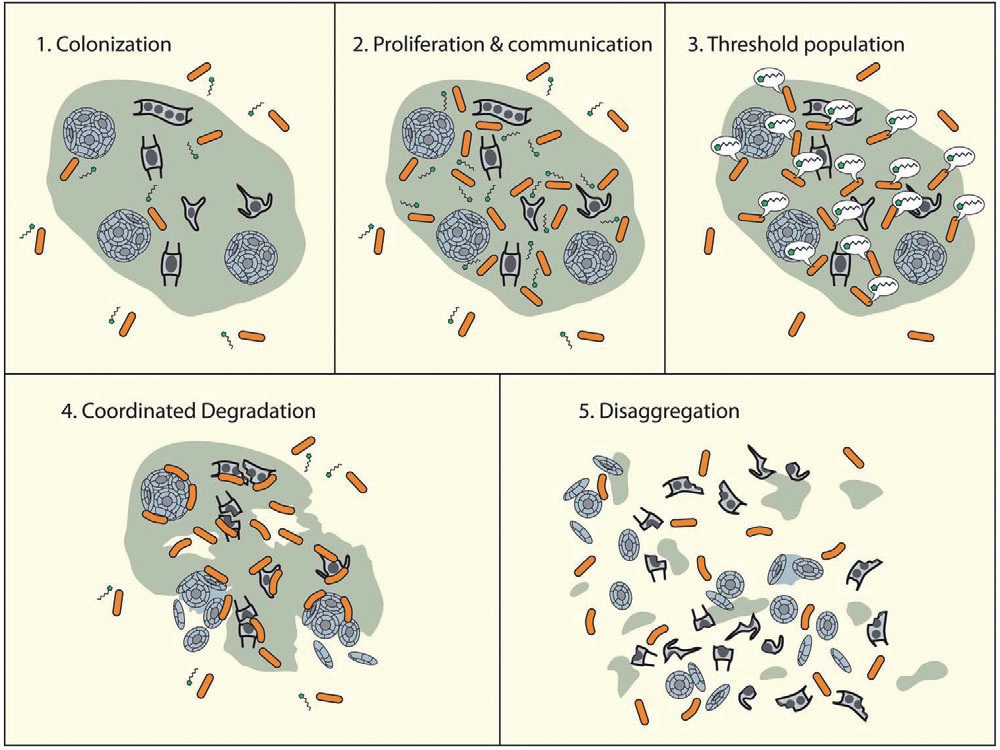
A new study has found that bacteria communicate about whether or not to begin feeding on the particles through quorum sensing (QS), simply put, a process where bacteria release signaling molecules, which, in turn can influence the activity of other bacteria. Or, in the authors’ words:

Number crunchers have never been much of nature lovers. Most venture capitalists, as it were, would rather be content, mulling over their wins and losses in the vagaries of business transactions of a life sciences company, than showering encomiums on the potential benefits of a technology that could potentially double up as a silver bullet for debilitating diseases such as diabetes, cancer or AIDS.

The Wisdom of Crowds: Why the Many Are Smarter Than the Few and How Collective Wisdom Shapes Business, Economies, Societies and Nations”, published in 2004, is a book by James Surowiecki. It discusses, often using anecdotes, that under certain conditions, crowds of people make better decisions than experts. In how far can we (mis)construe this as further proving the democratic doctrine?

Today's post in honor of the 2011 Cephalopod Awareness Days. October 12th is Fossil Day.

I must confess, I'm glad today is the last of the Cephalopod Days. This heady pace is almost more than I can handle! The final day of ICAD is for celebrating fossil cephalopods, timed to coincide with National Fossil Day, which is totally a real thing. (Not that the other Cephalopod Days aren't a real thing, they're just differently real.)

In gene therapy, one or more desired genes are introduced into an adenovirus, a virus that causes the common cold, which is then administered to the patient. Once in the body, the virus enters targeted cells and delivers the desired genes. In heart disease patients, for example, the virus delivers genes that trigger the growth of new blood vessels in damaged heart muscle.


