




In Doomsday Comet Elenin Goes Out With A Whimper we dismissed concerns from prophets of doom that a tiny comet 22 million miles away would make any difference in our lives - but we never said anything at all about a sunspot and what it might due to your wireless PS3 connection at a crucial moment in "Gears of War".

Behemoth sunspot 1302 unleashed another strong flare on Saturday morning, an X1.9-category blast at 5:40 am EDT. NASA's Solar Dynamics Observatory (SDO) recorded the extreme ultraviolet flash.
While concern about water is always real, scare tactics like virtual water do more harm than good for rational policy making. Objective analyses show we don't have a food issue looming that science and technology can't address.

A new study in Nature shows that genetic parasites invaded the mammalian genome more than 100 million years ago and dramatically changed the way mammals reproduce.

The molecular changes allowed mammals to carry their developing young within the womb rather than laying them in nests or carrying them around in pouches - the uterus was transformed. 

The findings published online Sept. 25 in the journal Nature Genetics describe in unprecedented detail the molecular changes that allowed mammals to carry their developing young within the safety of the womb rather than laying them in nests or carrying them around in pouches.

I don't want to sound alarmist, but glow-in-the-dark animals are real-- and it's not just cute kitty-cats.  As reported earlier here at Science 2.0, scientists did this and that to genetics to make AIDS-resistant cats.  Part of the process includes splicing in jellyfish DNA so the cats glow in the dark.

Yes, not 'they glow because of the medical reason', they glow for the fun of it.  They glow because the scientists wanted to track the progress of the other stuff, the real medical stuff they were doing.
People concerned about climate change recently can look no farther than the world's rainforests to see the diversity that arises from different ecological conditions.  History and geology, not current ecology, are likely what has made tropical forests so variable from site to site, according to a new study published in Science.

Measurements of variation in biodiversity from place to place, called beta diversity, are actually very similar as you move from the tropics to the poles when you account for the number of species present in the first place.  And forests in Canada and Europe may have much more in common with tropical rainforests than previously believed. 
Laws of Nature and Natural Justice


What are the 'laws of nature', the natural laws which underly the thing which we perceive as natural justice?

Aristotle discussed natural justice in terms of what 'ought to be'.  His view was that if particular rules of procedure are followed then the outcome of a procedure will be just.  There is a great deal of circularity in this form of argument.  Circular arguments and arguments about what 'ought' to be are not scientific arguments.

Research examined 19,349 twins between the ages of 12 and 41 yrs of age and had participants complete  a questionnaire at the start and end of the study to compare alcohol intake with the risk of developing asthma over 8 yrs. The results showed that the lowest risk of asthma was seen in the group which had a moderate intake of alcohol, as less than 4% of those who drank 1-6 units per week developed asthma.

Drinking alcohol in moderate quantities can reduce the risk of asthma, the researchers concluded. Drinking 1-6 units of alcohol a week could reduce the risk of developing the condition. 

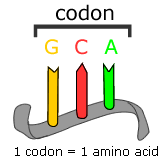
In a protein coding sequence of DNA, three subsequent nucleotides form codons (see figure 1), which, in turn, form amino acids that will eventually give rise to a protein. Some of these codons, however, are synonymous, meaning that one amino acid can be encoded by several different codons. When an amino acid is preferentially encoded by one of several potential synonymous codons, it is called codon bias.


Figure 1: Example of a codon. (GCA codes for alanine, which is also encoded by the synonymous codons GCT, GCT and GCG.)

(Source: Georgia Southern University, Department of Biology.)


Just about two days ago I warned that there will be a lot of nonsense about relativity coming out these days, and promptly there are already three articles here on Science2.0 alone that are exactly what I feared: Physicists with only basic knowledge about relativity claiming that particles cannot possibly go faster than light and portraying anybody who holds otherwise as a moron (not literally, but that seems to be the gist). Wake up guys – it is 2011 – modern physics has come a looooong way since Albert.

To be specific, the Humboldt squid are back in California. Their opening act was a mass stranding on Black's Beach in San Diego last Saturday. A lifeguard had the most poetic commentary on the matter:
"Of course, as you might imagine, there were some odors associated with that," he said. "The only thing left on the beach right now is the scent of dead squid and seagull footprints."
As usual, everyone seems to be afflicted with amnesia regarding the regularity of such strandings over the past decade.

