



Sometimes the precautionary principle can run amok.   Anti-science people who don't accept climate science use it to prevent meaningful policy actions related to the environment while anti-science people who don't accept biology block efforts to improve food sources so crops can grow in areas where the world's poorest live, or improve yields to feed more people, and use silly labels like "Frankenfood."

Imagine going through customs with everything in order. Passport’s okay, and all seems fine. But when your fingerprints are scanned, the customs agents are looking surprised. Apparently, you have no fingerprints. Sounds weird, right? And yet, it is exactly what happened to a Swiss woman in 2007 when she tried to enter the United States.

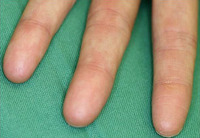
As it turned out, the woman had a very rare condition known as adermatoglyphia, leading to a lack of fingerprints (see figure 1), and a lower production of hand sweat than the average person. Very little is known about the condition, and so far, only four families carrying the mutation have ever been documented.


This afternoon we had the first formal meeting for product planning of the Science 2.0 television pilot.  

As you can imagine, there was talk of technical details, how the creative guys will set up the shot lists and storyboard the segments, what segments we will use, and then some of the philosophical stuff.

Like, what will make Science 2.0 a science show for the next century?

I told the agency and the producer what a fond recollection U.S. scientists of today have for shows like "Nova" and Carl Sagan's "Cosmos" - but noted that at the time, those were not regarded as stodgy, traditional ways of doing science on television, they were cutting edge.
Proofiness, slightly different than Stephen Colbert's truthiness, is basically finding statistics you want to believe to enhance your confirmation bias.  It was coined by Charles Seife, a long-time science writer who teaches journalism at New York University, because he was outraged at skewed representation on both sides of the aisle, like Al Gore for cherry-picking data about global warming and George Bush for cherry-picking data about how tax refunds would save poor people money.   He wrote a book on it called "Proofiness: The Dark Arts of Mathematical Deception" to clobber everyone he found doing it.
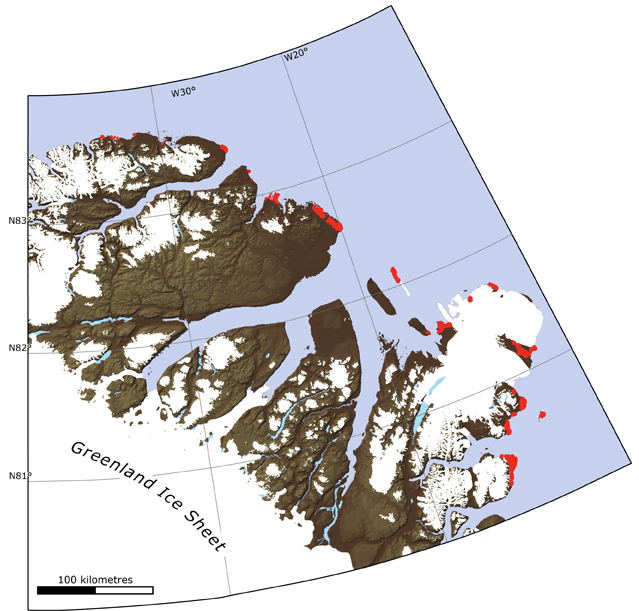
If you are worried about big changes in Arctic sea ice, you are not alone - but it is hard to know how much is worth worrying about.  If you are worried, there is some slightly good news - even if we lose half, it will not be a 'point of no return' according to a new study.

Sea ice comes and goes without leaving a record so our knowledge about variations and extent was limited before we had satellite surveillance and observations from airplanes and ships.  Not any more.  Researchers at The Centre for Geogenetics at the Natural History Museum of Denmark, University of Copenhagen say have developed a method by which it is possible to measure the variations in the ice several millennia back in time.
Psychology does not usually lend itself to live experimentation but the The American Psychological Association intends to change that perception.    They are featuring three public demonstrations of psychological science applications at their annual convention this week.

The goal: to show practical uses of psychological research and how it can be of great service to individuals and society as a whole.
As a teaching assistant for the pilot section of Bio 44Y, I spend Wednesday afternoons accompanying 10 students of field ecology to Jasper Ridge Biological Preserve. Only five miles from the main quad, we’ve battled rattlesnakes and squeezed past poison oak — but the nearest I’ve come to disaster was almost letting a wasp fly into our class van.

When we’re worried about being stung (knock on wood, I’ve so far evaded the experience), we tend to see bees and wasps as the flying enemy, rather than as pollinators, critical to the reproductive life of most of the world’s flowering plants. Of course, the value of pollination isn’t lost on farmers or beekeepers: the former pay the latter to haul hivefuls of bees from crop field to orchard every spring.

As Tiger Woods returns to action this weekend at the WGC-Bridgestone Invitational, mortal golfers wonder what's inside his head that makes him so much better than us. Well, chances are his brain actually has more gray matter than the average weekend duffer.

Researchers at the University of Zurich have found that expert golfers have a higher volume of the gray-colored, closely packed neuron cell bodies that are known to be involved with muscle control. The good news is that, like Tiger, golfers who start young and commit to years of practice can also grow their brains while their handicaps shrink.

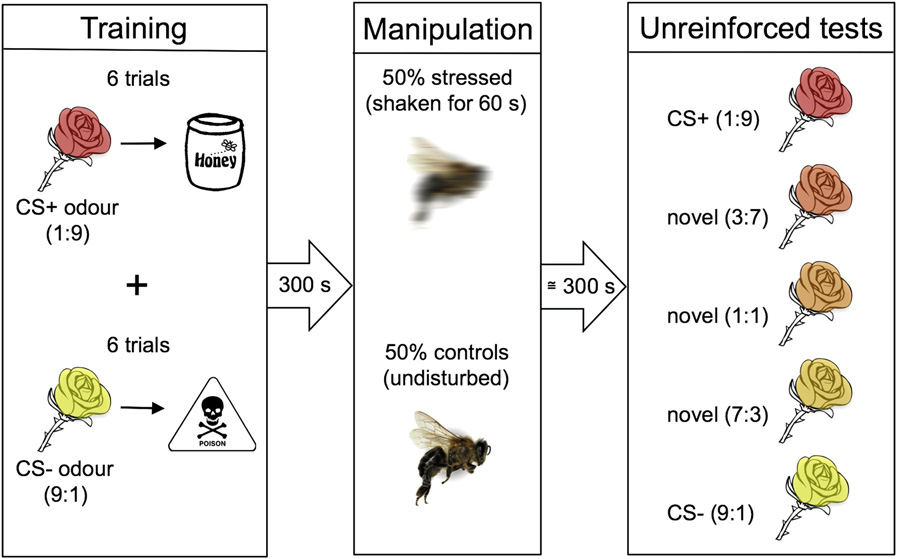
Most of us don’t have a problem attributing emotions to primates, dogs, horses and other vertebrates. But what about invertebrates? That seems less obvious. They have smaller, less complex brains, but is that enough to boldly claim they have no emotions? Of course, studying animal emotions is a precarious business. Studying human emotions has already proven difficult enough, and in animals it is bound to be a lot harder.

One way to go about it, is to take a look at so-called cognitive biases, biases in the processing of information that are typical of negative affective states. An example of this is the pessimistic bias, an increased expectation of punishment, greater attention to potential threats and a tendency to interpret ambiguous stimuli as if they were threats.

The quality of TED talks is in free fall and has gotten only worse since the last time I mentioned this. So it is worth to point to a rare good presentation whenever one comes along.


Geoffrey West’s The Surprising Math Of Cities And Corporations shows nicely how other than biological systems, namely cities and corporations, undergo similar evolutionary shaping by natural selection, even though they do not necessarily die or go through generations. Therefore, they can be described - and their development predicted - with simple scaling laws, which physicists like yours truly always find endearing (since that is all we ever really do).

