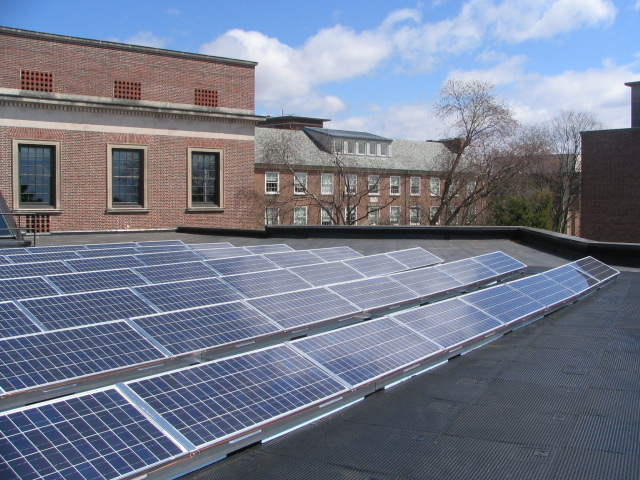
As worldwide demand for cleaner energy grows, scientists are working frantically in every area to improve the amount of energy we are able to generate from various renewable sources. Many existing technologies, such as wind and solar power, are advancing slowly in efficiency as research continues, while others such as wave power are merely prototypes awaiting verification. Solar panel technology has undergone numerous upgrades over the years, many of which have increased efficiency by altering the materials and coatings applied to the panels. And now, two new nanotechnologies may provide a large increase in solar panel efficiency, driving solar panels down to costs manageable for homeowners and small businesses.
Across the University of Colorado at Boulder campus students are sharing answers, checking their responses to questions against those of their neighbors and making adjustments to those answers in hopes of earning a better grade.
Not surprisingly, the students are getting more answers right. But what may be startling is that professors are encouraging the whole thing.
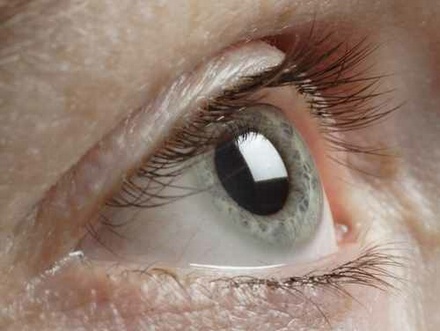
A team of Johns Hopkins neuroscientists has worked out how some newly discovered light sensors in the eye detect light and communicate with the brain. The report appears online this week in Nature.
These light sensors are a small number of nerve cells in the retina that contain melanopsin molecules. Unlike conventional light-sensing cells in the retina—rods and cones—melanopsin-containing cells are not used for seeing images; instead, they monitor light levels to adjust the body's clock and control constriction of the pupils in the eye, among other functions.
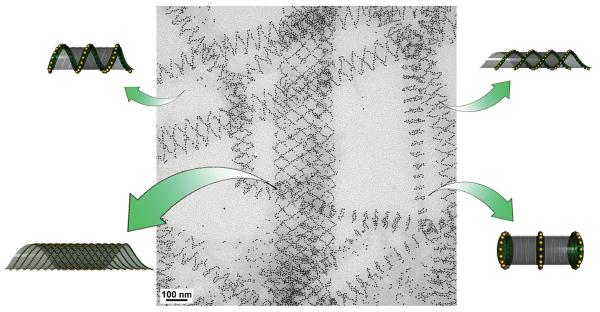
The future of the nanotechnology field depends on our ability to reliably and reproducibly assemble nanoparticles into 3D structures we can use to develop new technologies. According to Hao Yan and Yan Liu at Arizona State University, the greatest challenges in this burgeoning field include control over nanoscale 3D structure and imaging these tiny materials.
"The ability to build predicted structures and provide experimental feedback to current theories is critical to the nanotechnology field," said Yan.
One approach to production of nanoscale architecture is creation of nanoparticles that assemble themselves into the desired structure. DNA molecules are an elegant biological example of small particles that self-assemble to form higher order 3D structures.
Abundant tiny particles of diamond dust exist in sediments dating to 12,900 years ago at six North American sites, adding strong evidence for Earth’s impact with a rare swarm of carbon-and-water-rich comets or carbonaceous chondrites, reports a nine-member scientific team.
These nanodiamonds, which are produced under high-temperature, high-pressure conditions created by cosmic impacts and have been found in meteorites, are concentrated in similarly aged sediments at Murray Springs, Ariz., Bull Creek, Okla., Gainey, Mich., and Topper, S.C., as well as Lake Hind, Manitoba, and Chobot, Alberta, in Canada. Nanodiamonds can be produced on Earth, but only through high-explosive detonations or chemical vaporization.
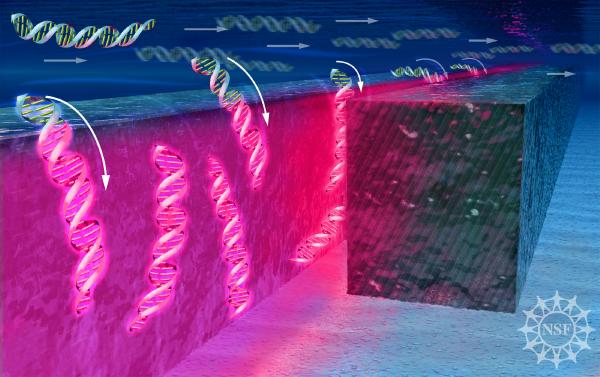
Using a beam of light shunted through a tiny silicon channel, researchers have created a nanoscale trap that can stop free floating DNA molecules and nanoparticles in their tracks. By holding the nanoscale material steady while the fluid around it flows freely, the trap may allow researchers to boost the accuracy of biological sensors and create a range of new 'lab on a chip' diagnostic tools.
Light has been used to manipulate cells and even nanoscale objects before, but the new technique allows researchers to manipulate the particles more precisely and over longer distances.
Did you make a resolution? Most people do, consciously or not. The end of one year and the beginning of a new one is a built-in time for reflection. You may resolve to go to the gym or learn a musical instrument but often something will come up that interrupts the routine, progress is lost and the resolution loses its ... resolve.
John O’Neill, LCSW, LCDC, CSAT, director of Addiction Services for The Menninger Clinic in Houston, says all is not lost if you plan your resolution, including planning for setbacks. And his 5-step program is not just for New Years, you can resolve to make positive changes at any time.
GRONINGEN, The Netherlands, December 31 /PRNewswire/ -- Results from a landmark trial published today in the New England Journal of Medicine, show that in transplanted kidneys preserved and transported in a specially designed machine (LifePort Kidney Transporter) the odds for experiencing a delay in recovery of kidney function are 43% lower, and that these kidneys are 48% less likely to fail within a year compared to those stored in the traditional box of ice (cold storage)(1). The study was the first randomised, prospective trial to compare these two methods of preservation.
To view the Multimedia News Release, please click: http://www.prnewswire.com/mnr/thessc/36486/
CHICAGO, Illinois, December 31 /PRNewswire/ -- A landmark study published today in the New England Journal of Medicine (NEJM) demonstrates that use of a specially designed machine to store kidneys for transplantation offers significant benefits in kidney survival and function when compared to those stored in a traditional ice box, or cold storage. Unlike the icebox, the LifePort Kidney Transporter monitors the temperature and vascular performance of the organ in real time, while preserving it by pumping the kidney continuously with a cold solution, even while the organ is being transported to its intended recipient.
There was a big development in science this year, yet most people missed it. It wasn't
induced pluripotent stem cells or
global warming or Barack Obama securing 99% of the scientist vote despite his belief that vaccines cause autism, which caused even heterosexual scientists to disregard
Jenny McCarthy. No, it was an alarming decrease in available clichés to describe what scientists think about new discoveries.