


Show Me The Science Month Day 19


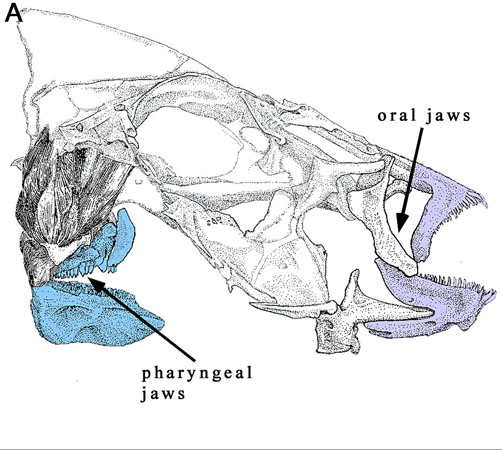
Some fish have two sets of teeth: oral teeth, set towards the front of the mouth (like ours), and so-called pharyngeal teeth, set far back in in the throat in a strange, second set of jaws. Based on what we learn from the fossils of ancient jawless fish, it appears that teeth first appeared on these deep pharyngeal jaws. So how did most vertebrates come to have the more common set of oral teeth? A group of scientists based in Georgia and Tennessee used paleontology and modern genetics to show that tweaks to an ancient gene regulatory network enabled the evolution of  oral cavity teeth possessed by most vertebrates.

pharyngeal jaw pharngula evolution teeth

Figure 1 from Fraser, et al.

Someone on this site recently posed the following thought experiment questioning the postulate of special relativity that no object can travel faster than the speed of light - c.  Imagine a one dimensional problem in which two travelers, move close to the speed of light, but in opposite directions - one moving close the speed of light in the positive direction and the other traveler moving close to the speed of light in the negative direction.  

Wouldn't these observers perceive the relative velocity of the respective other as exceeding the speed of light (i.e., approx. 2c)? 


Special relativity posits the following:
Last night, I watched on BBC Television Natural World, 2008-2009 - 14. A Farm for the Future in which

Wildlife film maker Rebecca Hosking investigates how to transform her family’s farm in Devon into a low energy farm for the future, and discovers that nature holds the key.


Show Me The Science Month Day 19

Merriam-Webster's dictionary says the word 'evolution' originated in 1622 and derives from the Latin evolutio, "unrolling, from", as in a parchment, and this is actually the perfect way to think of both Darwin and Evolution in their context.
Maybe you just want to wait until you can control television with your thoughts or even have it beamed directly into your brain but if you don't mind interim steps, and won't feel vaguely silly with two hands pointed at a screen, the iPoint 3D may be just what you want next.

The iPoint 3D allows people to communicate with a 3-D display through simple gestures – without touching it and without 3-D glasses or a data glove. What until now has only been seen in science fiction will be presented at CeBIT from March 3-8 by experts from the Fraunhofer Institute for Telecommunications, Heinrich-Hertz-Institut, HHI (Hall 9, Stand B36).
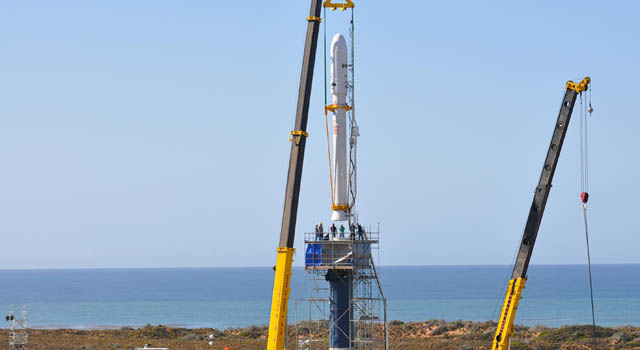
Here are some quick facts about the Earth-orbiting satellite, scheduled to launch on Feb. 24, 2009. 

-- It will study carbon dioxide sources (where it comes from) and sinks (where it is pulled out of the atmosphere and stored). Carbon dioxide is a major contributor to global warming. The new data will help scientists more accurately forecast global climate change. 

-- Data collected by the OCO mission may help policymakers and leaders make more informed decisions to ensure climate stability and retain our quality of life. 

Chuckanut Drive, in northwestern Washington provides a visual feast from sea to sky.  An amazing array of plants and animals call this coastline home.

For the fossil enthusiast, it is a chance to slip back in time and have a bird’s eye view to a more tropical time. Snug up against the Pacific Ocean, this 6000 m thick exposure yields a vast number of tropical and flowering plants that you might see in Mexico today. Easily accessible by car, this rich natural playground makes for an enjoyable daytrip just one hour south of the Canada/US Border.

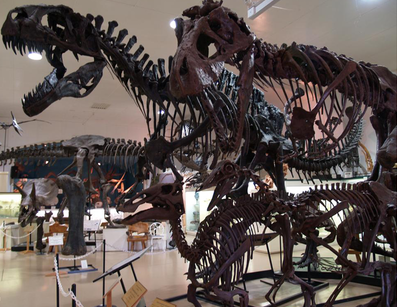
A team of biomechanical and paleontological researchers at University of Manchester are exploring a question that teenaged dinosaur girls have wondered for years: how thin should a dinosaur model be?

Karl Bates and his team built their supermodels using a framework reconstructed from museum-installed skeletons, using an infrared laser scanning technique called LiDAR.

Show Me The Science Month Day 18


The transition from one-celled microbes to multicellularity was a huge step in the evolution of life on this planet, but as daunting as this evolutionary step seems, it didn't happen just once. Today's plants, fungi, animals, and various types of algae are all descendants of separate transitions to multicellular life.

All of these transitions from a single-cell lifestyle to multicellularity occurred in the very distant past, so how can we learn anything about them? It turns out that it is not hard to find living, modern examples that closely parallel the momentous evolutionary transitions that led to animals, plants, and fungi. Right now on earth there are primitive multicellular organisms that, in many ways, resemble the first multicellular creatures that existed a billion years ago. Researchers are using these organisms to understand what kinds of genetic changes are needed to turn a single-celled organism into a multicellular one.
The floodgates have opened, and through it rushes advances in stem cell research. It seems that every day, another effort makes a push forward for medical stem cell therapy.

Earlier this week, a team of research scientists published a study evaluating long term clinical results of treating patients with Parkinson’s disease with autologous neural stem cells. The results of the study demonstrated that stem cells from cerebral tissue could form differentiated neurons and could produce dopamine and reverse symptoms of Parkinson’s.  Restored GABA and dopamine signals can restore and provide long term motor improvement.

