Public confidence in the honesty of scientists is being harmed by a small minority of researchers who behave badly, heard attendees of a meeting in Madrid on 17-18 November that was organized by the newly formed Research Integrity Forum of the European Science Foundation (ESF) in collaboration with the Spanish National Research Council (CSIC). The European research organizations agreed to work more closely to tackle the problem of fraud and other misconduct in science.
Fraud in science includes inventing data (fabrication), manipulating data to produce an unjustified result (falsification) or presenting the work of other researchers as one's own (plagiarism).
It is widely accepted that Upper Paleolithic early modern humans spread westward across Europe about 42,000 years ago, variably displacing and absorbing Neandertal (alt. spelling Neanderthal) populations in the process. However, Middle Paleolithic assemblages persisted for another 8,000 years in Iberia, presumably made by Neandertals. It has been unclear whether these late Middle Paleolithic Iberian assemblages were made by Neandertals, and what the nature of those humans might have been.
New research, published Dec. 8 in the Proceedings of the National Academy of Sciences, is now shedding some light on what were probably the last Neandertals.
A preliminary study suggests that economic incentives appear to be effective for achieving short-term weight loss, according to a report in the December 10 issue of JAMA.
New research at the Faculty of Life Sciences (LIFE) at the University of Copenhagen – shows that dark chocolate is far more filling than milk chocolate, lessening our craving for sweet, salty and fatty foods. In other words, eating dark chocolate may be an efficient way to keep your weight down over Christmas.
We have known for a long time that it is healthier to eat dark chocolate, but now scientists at the Department of Human Nutrition at LIFE, University of Copenhagen, have found that dark chocolate also gives more of a feeling of satiety than milk chocolate.
Chocolate experiment
Two common diabetes drugs — rosiglitazone and pioglitazone — are linked to higher fracture rates in women, according to a meta-analysis in CMAJ by a team of researchers from the University of East Anglia in the United Kingdom and Wake Forest University in the United States.
The drugs, called
thiazolidinediones, help improve glycemic control and decrease insulin resistance in patients with diabetes.
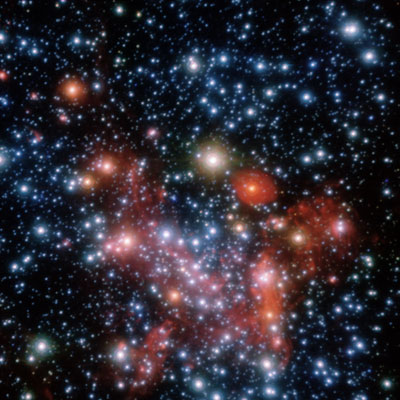
By watching the motions of 28 stars orbiting the Milky Way's most central region with admirable patience and amazing precision, astronomers have been able to study the supermassive black hole lurking there. It is known as
Sagittarius A* (pronounced "Sagittarius A star"). The new research marks the first time that the orbits of so many of these central stars have been calculated precisely and reveals information about the enigmatic formation of these stars — and about the black hole to which they are bound.
As we watch TV, listen to the radio or flip through the pages of a magazine, most of us ignore the relentless onslaught of advertising. But are we in fact being persuaded and influenced by the glossy pages of that magazine or that 30 second commercial? The prevalence of advertising on consumer preference has long been debated by communication and psychology professors alike, none of whom can agree to the meanings of their research, which have all yielded vague and inconclusive results. A new area of study has suggested that human response to advertising is based on our cognitive efficiency instead of marketing manipulation.
Lockheed Martin has just delivered the most recent upgrade of the military's cargo backbone, the C-5M Super Galaxy, to the U.S. Air Force at Warner Robins Air Logistics Center, Robins AFB, Georgia. The aircraft contains a host of upgrades and modernizations intended to help its keep its status as the dominant cargo plane of the U.S. Military.
Everyone knows mountaineering can be dangerous and climbing Mt. Everest more dangerous than most. Counterintuitively, most deaths occur during the descent, in the so-called 'Death Zone' just above 8,000 meters. But why deaths happen hadn't really been explored until now.
An international research team has conducted the first detailed analysis of deaths during expeditions to the summit of Mt. Everest. They identified factors that appear to be associated with a greater risk of death, particularly symptoms of high-altitude cerebral edema and published their results in the British Medical Journal.
Measures imposed to reduce exposure to nuts are often based on irrational fears of nut allergies and are becoming increasingly sensationalist, according to Professor Nicolas Christakis from Harvard Medical School on bmj.com today.
A peanut on the floor of a school bus leading to evacuation and decontamination for fear that it might be eaten by the 10 year old passengers, and schools declaring themselves "nut free" by banning nuts, peanut butter, homebaked goods and any foods without ingredient labels, are just some examples cited in the article. According to Christaki, there is no evidence that any of these extreme restrictions work better than more circumscribed policies or that they are worth the money and disruptions they create.