Molecular biologists have long operated on the principle that knowing the structure of a biological entity is critical for understanding how it works. Most famously, this was the premise behind one of biology's most iconic discoveries, Watson and Crick's model of the structure of DNA. Structure-function studies have been the foundation of much of molecular biology ever since.

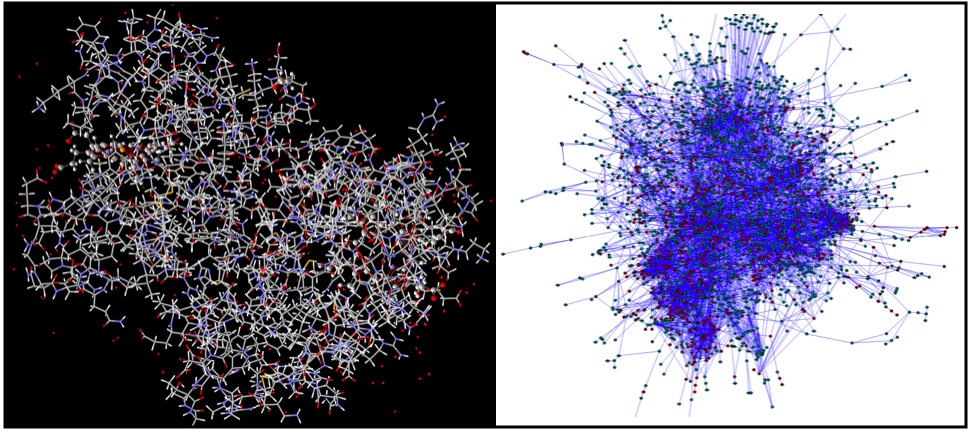
Although the structure of DNA yielded almost immediate insight into an important biological problem, solving structures hasn't always resulted in a eureka moment. The same year Watson and Crick received their Nobel Prize, two other scientists, John Kendrew and Max Perutz, were also awarded the Nobel for determining the structure of a biological molecule. Unfortunatly for Kendrew and Perutz, instead of a flash of insight the result was incomprehension. They had determined the structure of two related proteins, myoglobin and hemoglobin, and these structures at first glance looked like just an irregular mass of thousands of atoms.

Happily, the befuddlement didn't last long. Scientists quickly learned how protein structures explain their function, and today we have amazing structural snapshots of proteins in action. These studies of structure have helped biologists understand the gritty details of key biological processes, such as how membrane-embedded ion pumps enable our nerves to conduct electrical signals. Using a protein's structure to understand its function has now become routine.

But today biologists are facing another moment of incomprehension. We're staring at structures of a different type of biological entity: a network, not an irregular mass of atoms, but one of connections. We know that biological networks give cells their ability to make sense of the world, to process information, to sense the environment or the cells' own internal state, and to take appropriate action. Scientists have been mapping these networks in great detail for years now, but the result is frequently just a giant, molecular hairball (or 'ridiculogram', as a friend calls it).

In other words, scientists are facing yet another giant structure-function problem. How do the strucures of biological networks result in something functional?


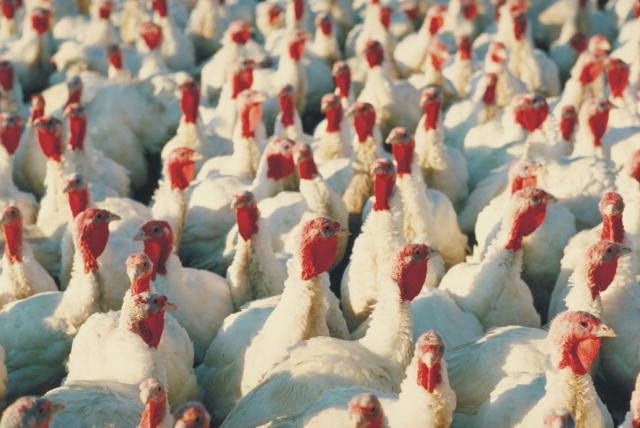
'Tis the season for the local supermarkets to feature delicately balanced displays of gravy, stuffing mix, and cranberry sauce. Thanksgiving is almost upon us, and the centerpiece of the upcoming meal for 95% of families will be the traditional roast turkey.

Americans gobble up a lot of turkey: 267 million­ turkeys are sold in the United States each year. Considering all those turkeys, it may surprise you to hear that there's one that dominates the competition at the supermarket: the broad-breasted white turkey. Most of us have never eaten anything else.
The first time I experienced migraine with aura, I was shopping. I remember looking up at the fluorescent lighting overhead and wondering where that weird triangle rainbow was coming from. An hour later, I was in tears and curled up in my bed with all the lights out--I have a low threshold for pain.

After that, Excedrin became my constant companion, along with nausea and a nagging pain pushing down on my skull. I started a headache diary in an effort to avoid "triggers" that might cause my migraines: bacon, poor sleep habits, strong odors. I kept a cold pack in the freezer just in case.
Heartbreak is more than just an emotional defeat; to some the pain is very real. At one point or another, everyone must experience this mind numbing feeling (unless you confine yourself to a house and never interact with even a pet) but that's not the norm and you're probably not reading this article if you've had that kind of sheltered life.
An article published electronically in the scientific journal Acta Paediatrica describes how heart rate and sleep in boys are affected by violent video games. Researchers from Stockholm University, Uppsala University and Karolinska Institutet in Sweden have worked together with this study.
A recently discovered female pelvis is changing minds about the head size of an ancient human ancestor, Homo erectus, and consequently revising notions about how smart they may have been. The Pleistocene adult female Homo erectus pelvis was from the Busidima Formation of Gona, Afar, Ethiopia., not far from the site that yielded the 3.2 million year old remains of the famed Australopithecus afarensi "Lucy," and the pelvis indicates that Homo erectus, which lived in Africa roughly 2 million years ago, had a larger birth canal than originally suspected and could have given birth to babies with bigger brains.
An unusual microorganism discovered in the open ocean may force scientists to rethink their understanding of how carbon and nitrogen cycle through ocean ecosystems.

A research team led by Jonathan Zehr, a marine scientist at the University of California, Santa Cruz, characterized the new microbe by analyzing its genetic material, even though researchers have not been able to grow it in the laboratory.  Zehr said the newly described organism seems to be an atypical member of the cyanobacteria, a group of photosynthetic bacteria formerly known as blue-green algae.
We are now in the transition from the Information Age to the Shift Age. In recent columns I have positioned the recent financial melt down and global economic collapse as the beginning of a painful transitional restructuring between ages. Just as the 1970s with all its stagflation and unprecedented turmoil was the transitional period between the Industrial Age and the Information Age, so is this time a transitional period between the Information Age and the Shift Age.
Autoimmune diseases are some of the most confounding diseases that affect the human body. Viruses, bacteria and parasites are all simple compared to the complexities and complications that arise when faced with treating an autoimmune disease. Researchers and physicians alike are unsure of the root of most autoimmune diseases and can only guess as to what specifically triggers our immune system to turn on itself. Treatment for most autoimmune diseases is brutal, consisting of high doses of steroids which suppress immune system function.
When I write in that title, a 'new Ice Age beast', I'm talking about the Coelodonta Tologoijensis. of course! That's Woolly Rhinoceros for us non-palaeontologists. After 460,000 years of being in the great Mammoth's shadow, this giant rhino is finally receiving it's place in the spotlight.