






Surgeries related to overuse elbow injuries, i.e. Tommy John Surgery, are more common among youth athletes than previously believed, according to research presented last week at the American Orthopaedic Society for Sports Medicine's (AOSSM) Annual Meeting in Orlando.

"Our results showed that 15-19 year-olds accounted for 56.7 percent of the Ulnar Collateral Ligament Reconstruction (UCLR) or Tommy John surgeries performed in the U.S. between 2007-2011. This is a significant increase over time with an average increase of 9.12 percent per year," said lead author, Brandon Erickson, MD of Rush University Medical Center in Chicago, Illinois.

By Charles Choi, Inside Science -- Bloodcurdling screams in horror movies often send tingles down people's spines, even though they know such shrieks are fake. Now scientists have discovered the key ingredient of screams that activates the brain's fear circuitry. Inventors may have unknowingly copied this hair-raising acoustic feature into alarms found in cars and houses.

A humble soil additive used by millions of amateur and professional gardeners alike is set to slash the cost of the most effective form of insulation for buildings.

Brunel University London academic Dr. Harjit Singh has proved in the laboratory that vacuum insulation panels can be made with a core of perlite - the volcanic ore “popcorn” used in horticulture to improve drainage and water retention.

This dramatically reduces the cost of the panels which are normally made by surrounding a core of fumed silica with metallised PET envelope. Initial cost savings are estimated to be at least 30 per cent.
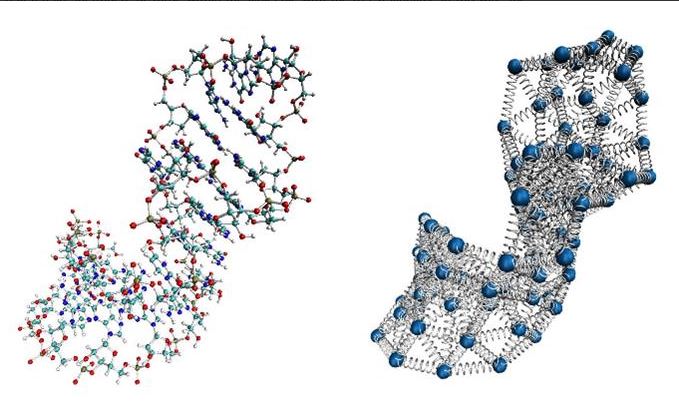
A group of scientists at SISSA have proposed a quick alternative for predicting the internal dynamics of RNA molecules (how the different parts move in relation to each other). Their simple solution, which uses beads and springs, provides similar results to other, more complex and expensive techniques for analyzing molecules that are currently in use. 

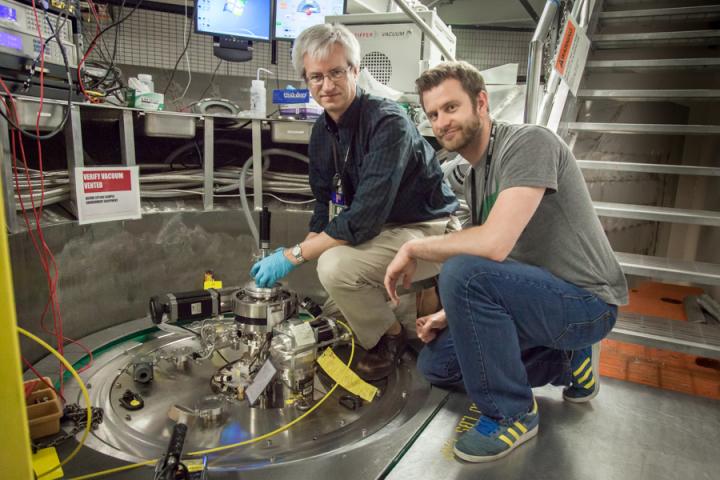
New research has confirmed plutonium's magnetism, which scientists have long theorized but have never been able to experimentally observe. 

Plutonium was first produced in 1940 and its unstable nucleus allows it to undergo fission, making it useful for nuclear fuels as well as for nuclear weapons. Much less known, however, is that the electronic cloud surrounding the plutonium nucleus is equally unstable and makes plutonium the most electronically complex element in the periodic table, with intriguingly intricate properties for a simple elemental metal.

A lot of attention has been given to city dwellers and the health risks of sitting in front of a computer screen, but almost 50 of the world spends 75 percent of their time on their feet.

Prolonged standing is associated with short-term adverse health issues, including reports of fatigue, leg cramps, and backaches, which can affect job performance and cause significant discomfort. A new study published in Human Factors suggests that, over time, this type of sustained muscle fatigue can result in serious health consequences. 

Researchers have developed an inhalable vaccine that protects primates against Ebola. 

Previous studies with primates suggest that aerosols of most biothreat agents, which are particles dispersed in the air, are infectious. Recent studies show that contact with the Ebola virus through the mucus membranes that line the respiratory tract results in infection, suggesting that airway linings may be important portals of entry for the virus. Aerosolized delivery has never before been tested for an Ebola vaccine or any other viral hemorrhagic fever vaccine.

On April 20, 2010, BP's Deepwater Horizon (DWH) drilling rig experienced a failure resulting in the discharge of gas and light sweet crude oil from a depth of approximately 5,000 feet.

Discharge continued for 87 days until July 15, 2010, five years ago this week, when the well was capped and the leak was contained.

From trilobites to tyrannosaurs, most fossils are of creatures with hard shells or bones. These materials don’t easily biodegrade and sediment has time to build up around them and turn them into a record of the creature that is still with us millions of years after it has died. Soft-bodied organisms like worms, on the other hand, decay rapidly and their fossil record is decidedly patchy.

In exceptional circumstances, however, their remains are preserved and sometimes in the most unusual places. With the right detective skills, palaeontologists can use such discoveries to open up whole new windows on the history of life on Earth. A recent discovery found in 50-million-year-old rocks from Antarctica has yielded a particularly incredible example: fossilised worm sperm.

From the frozen forests of Russia to the scorching sands of the Kalahari Desert, leopards are the most widely distributed large cat on earth. Their iconic spotted coat has been admired and coveted by humans for millennia.

But in one part in their vast range - the Malay Peninsula - leopards are almost entirely black in color.

Yes it turns out those have spots also. By modifying the infrared flash on automatic camera traps and forcing them into ‘night mode’ a team of wildlife experts has revealed the black leopard’s spots. Using infrared flash, the seemingly ‘black’ leopards suddenly showed complex patterns of spotting.

