






The authors of a new book, "Natural Security: A Darwinian Approach to a Dangerous World", say lessons learned from Mother Nature help protect us from terror threats -- if governments are willing to think outside the box.

“Biological organisms have figured out millions of ways, over three and a half billion years of evolution, to keep themselves safe from a vast array of threats,” said Raphael Sagarin, a Duke University ecologist who co-edited the book with Terence Taylor, an international security expert.

“Arms races among invertebrates, intelligence gathering by the immune system and alarm calls by marmots are just a few of nature’s successful security strategies that have been tested and modified over time in response to changing threats and situations,” Sagarin said. “In our book, we look at these strategies and ask how we could apply them to our own safety.”

A unique transmissible and rapidly spreading cancer threatens the very existence of Tasmanian devils. To combat this particularly aggressive disease, a Cold Spring Harbor Laboratory research team, in collaboration with 454 Lifesciences, is committing resources to sequence parts of the devil’s genome in an effort to increase the odds of saving them from extinction.

In 1996 scientists first discovered the facial tumors on Tasmanian devils. Subsequent research revealed that the cancer is transmitted from one devil to another when tumor cells are transplanted through fighting, biting, and other physical contact.

Once afflicted with the cancer, aggressive tumors begin to appear on the face and neck of the devils, restricting their ability to eat. Within approximately three months, the devils succumb to the disease and often die of starvation. The disease has decimated the devil population by nearly 90 percent in certain geographical areas of Tasmania, and officials project that within twenty years the entire species could become extinct.

NEW YORK, January 28 /PRNewswire/ --

QTRAX (www.QTRAX.com), the world's first free and legal peer-to-peer music service announced that at today's V.2 Beta launch, its ground-breaking service had approximately 61,000 unique users per hour (between 7am and 1pm EST). This translates to approximately 1,464,000 unique users per day. QTRAX believes that a significant percentage of users were unable to access the site due to this massive demand and has now dramatically increased its download capacity.

Cosmologists at the University of Illinois say ancient light absorbed by neutral hydrogen atoms could be used to test certain predictions of string theory - but they'll need a gigantic array of radio telescopes to do it, somewhere in the neighborhood of 1,000 square kilometers.

String theory is commonly considered (and one of our Ph.D.s will likely point out the flaws in this simplified explanation) a theory in which the fundamental building blocks are tiny one-dimensional filaments. One of its many flavors is usually the leading contender for a 'theory of everything' that unifies all four fundamental forces of nature - the strong and weak nuclear forces, electromagnetism, and gravity. It's not an easy thing to test.

Now these cosmologists say absorption features in the 21-centimeter spectrum of neutral hydrogen atoms could be used for such a test.

First results from a new NASA-funded scientific instrument at the W. M. Keck Observatory in Hawaii are helping scientists overturn long-standing assumptions about powerful explosions called novae and have produced the first unified model for a nearby nova called RS Ophiuchi.

"We were getting ready for a routine engineering run when all of a sudden the nova went off. It was very bright and easy to observe, so we took this opportunity and turned it into gold," says team member Marc Kuchner of NASA’s Goddard Space Flight Center in Greenbelt, Md.

In The Big Bang and the Birth of Culture, we talked about the beginning of culture long before what anthropologists had previously assumed and discussed why space travel is not only becoming important for ecological reasons, it's part of a universal mandate.

Now we're going to talk about some aspects of galactic order. Infinite monkeys in a random universe? No, more like a railroad train with a lot of ways to get from point A to point B - but it has rails and the universe can never leave them.

***

In the aftermath of the Big Bang, particles collided and shifted with terrific force - yet protons came out of these crashes intact. This identity retention was a primitive form of memory and it was the foundation of culture.

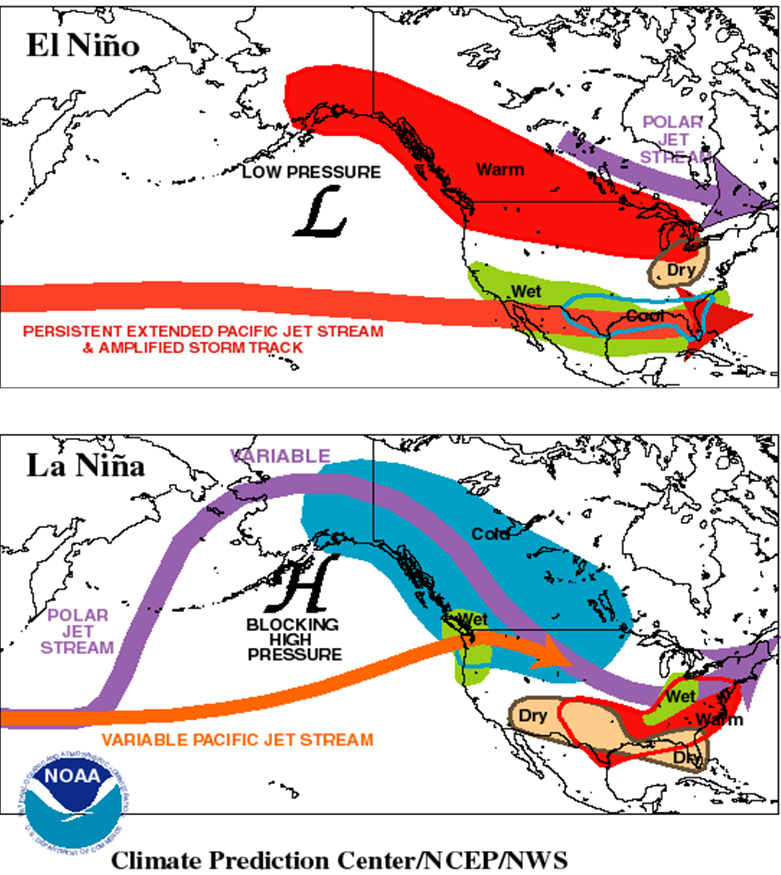
It used to be that El Nino was a predictable phenomenon that explained odd weather changes but recent global warming studies minimized its impact - everything was global warming instead. Now, it seems, El Nino is back in atmospheric fashion.

Scientists have known about El Niño weather fluctuations over a large portion of the world since the early 1950s. They occur in cycles every three to seven years, changing rain patterns that can trigger flooding as well as drought.

Siegfried Schubert of NASA's Goddard Space Flight Center in Greenbelt, Md., and his colleagues studied the impact that El Niño-Southern Oscillation (ENSO) events have on the most intense U.S.

Communist dictatorships don't get credit for much but one thing about them made anti-smoking advocates happy; a lack of cigarettes meant fewer people puffed. Yes, according to a new study in an anti-smoking journal, capitalism is to blame.

Contrary to health wisdom in the west, the number of Russian women who smoke has more than doubled since the collapse of the Soviet Union, say authors of a study published in the journal Tobacco Control.

In 1992, seven per cent of women smoked, compared to almost 15 per cent by 2003. In the same period, the number of men who smoke has risen from 57 per cent to 63 per cent.

Since the term "black hole" was coined by John Wheeler in 1967, they have been used to resolve a lot of science-fiction plot inconsistencies.

Sometimes they resolve real-life ones too, especially if there is no other explanation.

HE 0437-5439, is an early-type star and one of ten so-called hypervelocity stars that are speeding away from the Milky Way galaxy - because of its young age, astronomers stated it could not have come from our galaxy. Carnegie astronomers Alceste Bonanos and Mercedes López-Morales, and collaborators Ian Hunter and Robert Ryans from Queen’s University Belfast examined its velocity, light intensity and, for the first time, its elemental composition and have proposed an answer - another black hole.

Think it's laws or governments that keep people honest? Not according to a new study in Psychological Science. Two psychologists examined the psychological impact of genetic determinism, free will, and ethical behavior and found that people who felt like they were in control of their destiny acted more ethically than people who felt like they were not.

It is well established that changing people’s sense of responsibility can change their behavior. But what would happen if people came to believe that their behavior was the inevitable product of a causal chain beyond their control – a predetermined fate beyond the reach of free will?

