






When you turn on the Oscars, what are you really watching? Most people admit it's a good excuse for a fashion show. And it seems an obvious choice between Keira Knightley’s elegant, wine-colored Vera Wang and Gwyneth’s 2003 gothic horror show. But then why, if it’s that obvious, do stars continue to mistake the Oscars for that other dress-up day on the 31st of October? With a cadre of stylists, trainers and designers, and without needing to fit the dress inside a small pocketbook, wouldn’t you think they could get it right every time?

Now they can.

 Will Her Oscar Dress Be A Hit?


Dress Score Equation

Science doesn’t always happen at a lab bench. For University of Toronto Mississauga physicist Kent Moore, it happens while strapped into a four-point harness, flying head-on into hurricane-force winds off the southern tip of Greenland.

Moore, chair of the Department of Chemical and Physical Sciences, is heading to Greenland from Feb. 18 to March 11 as part of the Greenland Flow Distortion experiment (GFDex), an International Polar Year research project involving Canadian, British, Norwegian and Icelandic scientists. Moore, a professor of atmospheric physics, is leading the Canadian contingent.


Credit: University of Toronto.

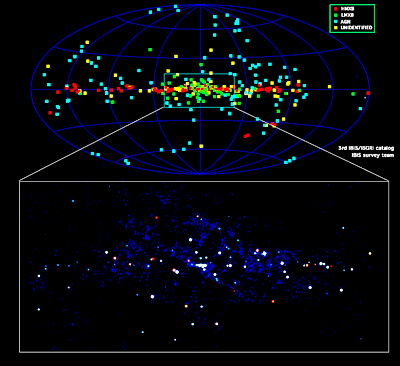
Integral's latest survey of the gamma-ray universe continues to change the way astronomers think of the high-energy cosmos. With over seventy percent of the sky now observed by Integral, astronomers have been able to construct the largest catalogue yet of individual gamma-ray-emitting celestial objects. And there is no end in sight for the discoveries.

Integral is the European Space Agency's latest orbiting gamma-ray observatory. Ever since Integral began scientific operations in 2003, the project team has been devoting a substantial proportion of its observing time to a survey of the gamma-ray universe.

In the first genome-wide search for the genetic roots of the most common form of amyotrophic lateral sclerosis (ALS), Johns Hopkins scientists have newly identified 34 unique variations in the human genetic code among 276 unrelated subjects with ALS.

The 34 so-called single nucleotide polymorphisms, or SNPs, represent good candidate genes predisposing people to the non-inherited form of the fatal neurodegenerative disease.

“Although we haven’t located the exact gene responsible for sporadic ALS, our results seriously narrow the search and bring us that much closer to finding what we need to start developing treatments for the disease,” says Bryan J. Traynor, M.D., of the Department of Neurology at The Johns Hopkins University School of Medicine.

How does life survive in the black depths of the ocean? At the surface, sunlight allows green plants to "fix" carbon from the air to build their bodies. Around hydrothermal vents deep in the ocean live communities of giant clams with no gut and no functional digestive system, depending on symbiotic bacteria to use energy locked up in hydrogen sulfide to replace sunlight.

The life cycles of many viruses include a self-assembly stage in which a powerful molecular motor must pack the DNA genome into the virus's preformed shell (the capsid). How it manages this intricate feat has been subject to debate, but we know that the DNA passes into the capsid shell through a channel formed by a structure called the connector.

How does the heart attain its characteristic shape? Shape may be sculpted by cell movement, cell division, or changes in cell size and shape, all of which can be influenced by the local environment. The heart appears as a simple tube early in development; later, the tube walls bulge outward to form the cardiac chambers.

In a new study published online in the open access journal PLoS Biology, Heidi Auman, Deborah Yelon, and colleagues found, by using transgenic zebrafish in which they can watch individual cardiac cells, that cells change size and shape, enlarging and elongating to form the bulges in the heart tube and eventually the chambers.

North American marine turtles are at risk if global warming occurs at predicted levels, according to scientists from the University of Exeter. An increase in temperatures of just one degree Celsius could completely eliminate the birth of male turtles from some beaches. A rise of three degrees Celsius would lead to extreme levels of infant mortality and declines in nesting beaches across the USA.


Marine turtle. Credit: Copyright Lucy Hawkes, MTRG

Here are the good ones. Read the entire piece here.

1. Engineering is done with numbers. Analysis without numbers is only an opinion.

5. Three points determine a curve.

6. Everything is linear if plotted log-log with a fat magic marker.

10. When in doubt, estimate. In an emergency, guess. But be sure to go back and clean up the mess when the real numbers come along.

16. The previous people who did a similar analysis did not have a direct pipeline to the wisdom of the ages. There is therefore no reason to believe their analysis over yours. There is especially no reason to present their analysis as yours.

19.

It was great to meet with a number of the top executives at GM prior to the Chicago Auto Show to learn about the Chevrolet Volt, the company commitment to developing battery technology and to really find out how committed this company is and will be in the area of cleaner automobiles.  However there is one interview that truly stands out that needs to be shared.

