


The CMS collaboration has released yesterday results of a search for Majorana neutrinos in dimuon data collected by the CMS detector in 8 TeV proton-proton collisions delivered by the LHC in 2012. If you are short of time and just need an executive summary, here it is: no such thing is seen, unfortunately, and limits are set on the production rate of heavy neutrinos N as a function of their mass. If you have five spare minutes, however, you might be interested in some more detail of the search and its results.

A team of scientists have shown that meltwater from the surface of an ice cap in northeastern Greenland can make its way beneath the ice and become trapped, refilling a subglacial lake. This meltwater provides heat to the bottom of the ice sheet.

The findings provide new information about atmospheric warming and its affect on the critical zone at the base of the ice. The warmth provided by the water could make the ice sheet move faster and alter how it responds to the changing climate.

Two new drug compounds - one of which has already proven useful in a mouse model of multiple sclerosis - appear to be effective in treating endometriosis, a disorder that, like MS, is driven by estrogen and inflammation, scientists report in Science Translational Medicine.

The researchers hope to eventually use the new compounds and others like them to treat a variety of disorders linked to estrogen signaling and inflammation: endometriosis, multiple sclerosis, inflammatory breast cancer, liver fibrosis, and cardiovascular and metabolic problems associated with obesity, for example.

People are more successful in taking up healthy habits if their partner makes positive changes too, according to research* published in JAMA Internal Medicine today (Monday).

Scientists at UCL funded by Cancer Research UK, the British Heart Foundation, and the National Institute on Aging looked at how likely people were to quit smoking, start being active, or lose weight in relation to what their partner did.**

They found that people were more successful in swapping bad habits for good ones if their partner made a change as well.

Racial disparities in tip size can't be explained by discriminatory service. Shutterstock

By Michael Lynn, Burton M. Sack '61 Professor in Food and Beverage Management at , Cornell University and Zachary Brewster, Assistant Professor of Sociology at Wayne State University

Carbon sequestration promises to address greenhouse-gas emissions by capturing carbon dioxide from the atmosphere and injecting it deep below the Earth's surface, where it would permanently solidify into rock. The U.S. Environmental Protection Agency estimates that current carbon-sequestration technologies may eliminate up to 90 percent of carbon dioxide emissions from coal-fired power plants.

While such technologies may successfully remove greenhouse gases from the atmosphere, researchers in the Department of Earth, Atmospheric and Planetary Sciences at MIT have found that once injected into the ground, less carbon dioxide is converted to rock than previously imagined.

Consumers usually look for the lowest price when shopping for a product. But can prices sometimes just feel right? According to a new study in the Journal of Consumer Research, consumers are drawn to prices with rounded numbers when a purchase is motivated by feelings.

"A rounded price ($100.00) encourages consumers to rely on feelings when evaluating products, while a non-rounded price ($98.76) encourages consumers to rely on reason. When a purchase is driven by feelings, rounded prices lead to a subjective experience of feeling right," write authors Monica Wadhwa (INSEAD, Singapore) and Kuangjie Zhang (Nanyang Technological University).

Researchers have revealed that the colonization of the gut of young mice by certain types of bacteria can lead to immune responses later in life that are linked to disease. Increases in the levels of segmented filamentous bacteria can trigger changes in the lymphoid tissue of the mouse gut that result in the production of antibodies that attack components of the cell nucleus. This type of damage is a hallmark of autoimmune diseases like systemic lupus erythematosus and systemic sclerosis where organs throughout the body are damaged by wayward immune responses. The findings are published in The EMBO Journal.


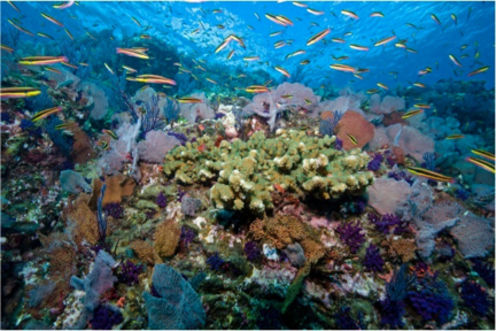
Looks healthy, but still lacks the big predatory fish... how would it rate on the Promonitor Index? AF Johnson, CC BY-NC-SA

By Andrew Frederick Johnson, University of California, San Diego

Glass looks like it is solid but telling a materials engineer that glass is a solid is like telling an aerospace engineer Bernoulli is why planes fly (or Newton, for that matter - whichever you say, they will argue the opposite).

Glass flows - but slowly. The question is does it ever really stop flowing? Researchers at the University of Bristol and Kyoto University used computer simulation and information theory to try and settle this long-standing bar bet in the physics community.

First, the premise: We know glass flows at high heat because we have all seen glass blowers shape swans and such. Once the glass has cooled down to room temperature though, it has become solid and we can pour wine in it or make window panes out of it.

