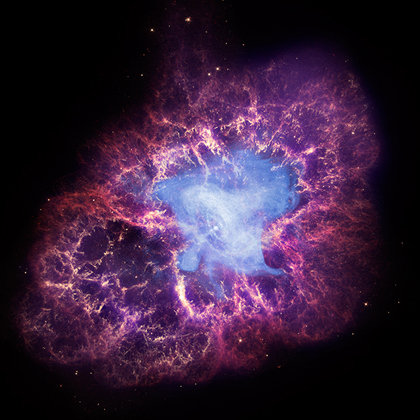


Astronomers tend to suffer from gigantomania; we relate to and prefer astronomical dimensions. Always. I, being not only an astronomer but also a sucker for celebrations, will not miss this opportunity to congratulate the American nation with its Independence Day 4th of July accordingly. With a celebration of astronomical proportions that, obviously, suits a superpower!

Here's a question. In many millions of years time, is it possible that future geologists - be they our distant descendants, or an alien race that has since conquered Earth - will be able to look at the sequence of rocks corresponding to the present period, and recognise the moment when humans became the dominant species on the planet? If so, what time will this horizon represent, and how will it be recognised?
The DZERO collaboration has just produced an update of their analysis of the dimuon charge asymmetry using 9.0 inverse femtobarns of proton-antiproton collisions. The new result confirms the previously reported effect, raising the discrepancy with the Standard Model prediction to over four standard deviations.
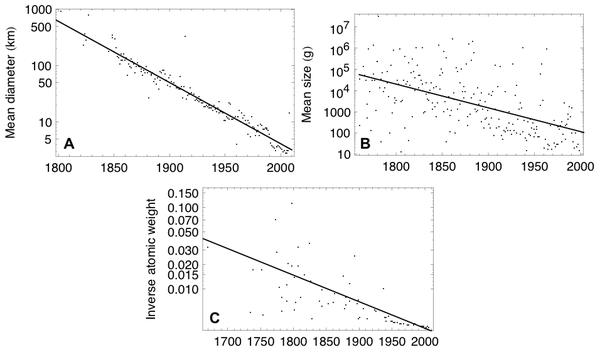
Studying science quantitavely has often taken the form of studying publications, such as citation counts, or identifying author networks. But now, Samuel Arbesman and Nicholas Christakis (2011) argue that there are two fairly recent developments that would enable a new approach to the study of scientific discoveries:

1) Vast computational resources and storage capacity, and

2) Automated science.

This new appraoch would offer potential for a new field that concerns itself with the study of scientific discoveries. In the words of the authors:
Superfund Me

Superfund Me

Jul 03 2011 | comment(s)

Scattered across Santa Clara County — home during our tenure at Stanford — are 23 parcels of land so polluted that they’ve been targeted for government intervention.

These “Superfund sites,”numbering more than 1,250 across the United States and its territories,are contaminated by heavy metals, organic solvents and petroleum residues. Some are at risk of contaminating the drinking water of hundreds of thousands of people; others already have. Some sites are sopolluted that their very soil must be scraped away; others will not befit for human habitation for generations.

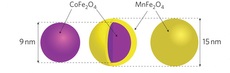
Cancer cells, like normal cells, begin to perish as soon as the temperature hits 43°C. So, the obvious challenge is to find out how cancer cells can be heated up without affecting the normal, healthy cells. One idea to deal with it, is known as magnetic hyperthermia. This involves injecting magnetic nanoparticles into the targeted tumors (For another nanoparticle approach to cancer, click here). Subsequently, the patient is put into a magnetic field that reverses direction several thousands of times each second. This excites the nanoparticles, heating them. Since the magnetic particles are only found in the tumors, the healthy tissue is exempt from the damaging heat.

Long before "Star Wars", science-fiction had talked of robot walkers.  In "War of the Worlds", even aliens from Mars had giant, mechanized tripeds and they got killed by a few germs.  

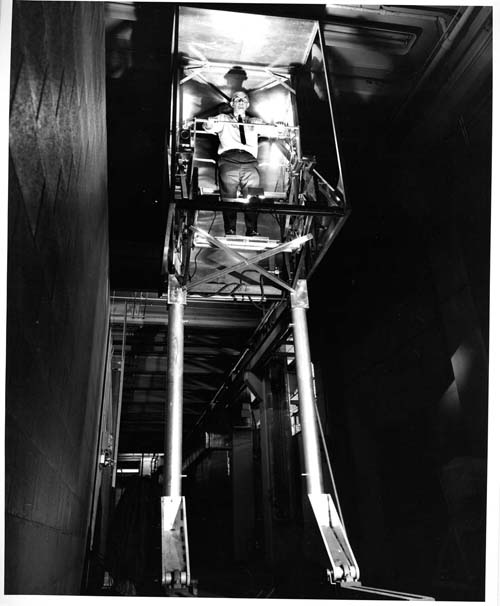
But the real world worked on them also.   Now on display at the US Army Transportation Musem at Fort Eustis is GE’s Pedipulator, or “Walking Truck", which was developed for the U.S. Army in the mid-‘60s.  This quadroped first lumbered through testing paces  Pittsfield, Massachusetts, circa 1962.

Botany: A Blooming History


And now we come to part three of this series

Joanna Dolgoff covers new research on how obesity spreads through social contact over at Huffington Post. I'm sure this comes as a huge surprise to those of us who have watched our waistlines spread along with the waistlines of our friends. Well, at least until we lose sight of our friends because they can no longer get out of their house and we can no longer get out of ours.

A recent BBC docu-drama called 'Atlantis' recreated the last days of the Bronze Age civilisation on the island of Thera (now known as Santorini), that I've meant to blog about for a while now.  This program, along with a more traditional 'Timewatch' documentary, argued that the eruption in roughly 1600 B.C.

