According to
Karl Popper, there are two contexts at work when trying to understand science. One is called 'the context of discovery', the other 'context of justification'. In many ways all human cognitive activities share similar divisions; art for instance also tends to fall apart in discussions on the intrinsic qualities, the skills, and mastery of the craft on one side, and discussions on the meaning, the purpose, and the place of art in society on the other. Philosophy (of science) itself knows many discussions on the issues related to discovery (e.g.
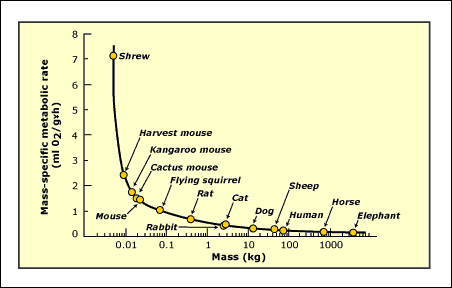
Recently, research has been conducted to see if certain life-history traits could be correlated with DNA mutation rates. By using whole-genome sequence data for 32 species of mammal, the researchers tested the hypothesis that DNA mutation rates are influenced by species-specific life-history traits. These mutation rates were estimated by looking at the rate of substitutions of neutrally evolving DNA segments.
This type of research could make it possible to infer life-history information of extinct species, providing that genomic data is present.
The research focused on three life-history traits.
1) Generation time
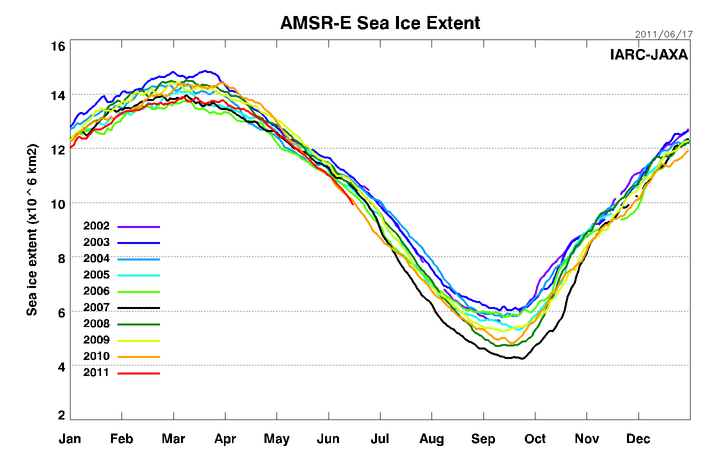
Arctic Ice June 2011
The sun is the main driver of climate and weather. The Arctic solar year could be plotted as a graph of the angle of the sun relative to the horizon, negative in winter and positive in summer. The graph would be a very neat waveform which varied little in amplitude or in frequency on decadal timescales. By way of contrast, any graph of any effect of the sun's relative angle will vary from year to year. Although the sun will warm the air, land, sea, snow and ice, it will never do so in exactly the same way during any two years.
When I was a teenager, my two scientific passions were astronomy and botany. However, at my school in the early 1960s, one could either do A-levels in Mathematics - Physics - Chemistry (Science A) or Chemistry – Botany - Zoology (Science B). I chose the former option, being very much put off by medicine which was more or less entailed with the latter. Botany still is a scientific passion – if I were time-transported back to the Jurassic I would be eager to investigate the flora, leaving others of the party to keep a watch-out for dinosaurs.
This is the extended abstract of an article you cannot read anywhere, which ensures that one can later claim “nobody could have possibly foreseen as the relevant literature clearly shows …” (here more on why). The article clarifies the singularity concept’s terminology and criticizes the concept itself, finishing with global suicide as the only expected annomality:
Singularity: Nothing Unusual Except For Global Suicide
I see a lot of talk on 'the future of science journalism'-- or science writing, or science funding, or science careers. I'm guilty of contributing to it myself, but the 'future of' debates miss one point. There isn't a single monolithic direction things are heading. There isn't one solution.
In fact, there's not even 'one starting point' we're all moving from.
Noah and Alexis Beery were diagnosed with cerebral palsy at age 2, but knowing that was only the first step on a journey to find an answer to the children's problems. Yet a determined mother determination and the high tech world of next-generation sequencing in the Baylor Human Genome Sequencing Center were able to solve the case.
Writing in Science Translational Medicine, Baylor College of Medicine researchers, along with experts in San Diego and at the University of Michigan in Ann Arbor, describe how the sequencing of the children's whole genome along with that of their older brother and their parents zeroed in on the gene that caused the children's genetic disorder, which enabled physicians to fine-tune the treatment of their disorder.
Now we've covered the relationships with postmodernity in the previous post, (I promise not to bring it up again, but I have recently been accused quite often to be 'almost postmodern', which -being an engineer myself- I find rather absurd) it is time to turn our attention to an Enlightenment favourite, namely rationality.
Methodological Stuff:
DNA codes for proteins, and, in doing so, is responsible for many processes that take place in our bodies. An important player in the processes that turn a DNA sequence into a functional protein (see figure 1), is messenger RNA, or mRNA. A recent study, published in Nature, has found a way to artificially modify this mRNA. This changes the ‘building instructions’ of the protein and results in a different protein than the one that was originally coded for.
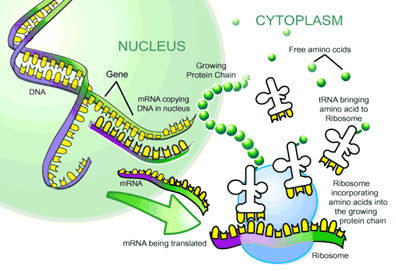
Figure 1: From DNA to protein.
(Source:
http://www.dna-sequencing-service.com/dna-sequencing/mrna-dna/)
Quantum physics has proven that the world cannot be described by local realism. Therefore, Many-Worlds Interpretations (MWI) are now in vogue.
 This is already wrong: Everett's is a relative state description, not necessarily a multiple worlds interpretation.