Mike Adams ought to have his library card revoked or limited to the children’s section as he obviously has a serious problem with reading comprehension. He takes Hawking’s The Grand Design and manages to butcher it and the ideas in it so badly that anyone having read Hawking’s book will wonder what Adams read in its place, or perhaps if Adams was tripping on one of his own products. Colloidal silver perhaps? Oh, if only he were a sickly shade of blue, all the better to stand out in a crowd.
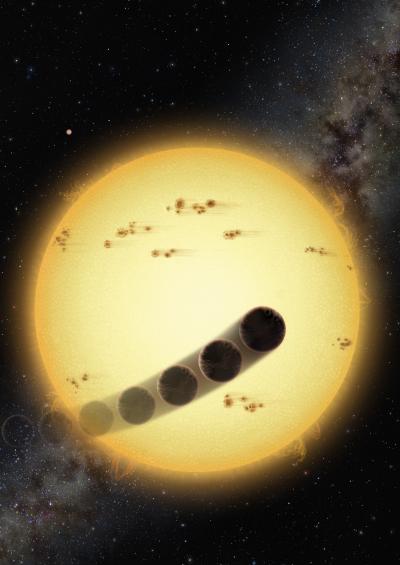
With the discovery of so many new extrasolar planets, astronomers have observed that in some of these systems the star is spinning one way but the planet, a 'hot Jupiter',
a huge Jupiter-like planet in very close proximity to the central star, orbits the star in the opposite direction.
The “vaccine injury” community has been buzzing over the press conference and release of Holland et al’s supposedly earth shattering “study” published in the Pace Environmental Law Review. Some of them proclaim triumphantly that they have proof the government has lied about the lack of a link between vaccines and autism. Now, here, they have the evidence. Some parents feel it’s time for a revolution, time to make the government pay for their lies. None of this rhetoric is new. Not even the information supposedly revealed in this non-scientific study published in a law review.
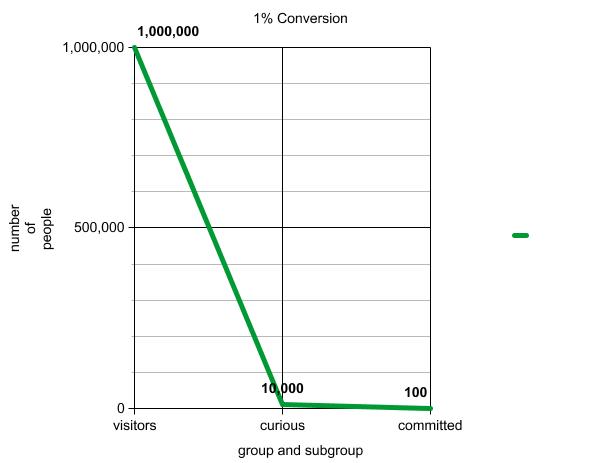
How much are 1 million visitors worth? In the midst of my
bake sale for science, I am verifying the 1% rule. Greg Stolze noted, why have 94 people 'liked' my fundraiser on Facebook, but only 30 people actually contributed? I am 3/4th through the time left on my fundraiser, with only 1/2 of my goal reached. Let's talk about how one million can become 100 very quickly.
Many people are confident that their dogs and cats can sense impending earthquakes. Could squid provide humans with the same service? Let's examine the "connections" that have been drawn between squid and earthquakes.
In La Jolla in 2009, a small stranding event occurred around the same time as an equally small earthquake. But the squid actually started stranding a few days before the earthquake, deflating the much-hyped idea that the earthquake caused the stranding.
This year in Japan,
I had a question posed to me last week; 'what was the first science experiment?'
Some books you read and forget about before you've even put it down. Some you cast aside midway through. Every now and then, though, you find a rare gift of a book that continues to move you days, weeks (and those really wonderful ones: years) later. Priscilla Gilman's book is certainly one of those rare ones with the power to move a person days and weeks later. It's too early to tell whether that will remain so, but I strongly suspect it will be one that remains a treasured book years from now for me. And sure, I'm biased: I sense a kindred spirit in Priscilla, a kindred love of words, of poets, of language in general, and for the majesty and transport that the specific melding of words by a skilled craftsman can bring a person.
You may suspect the beating of a dead horse by now, but the problem is actually that the animals in question are still alive. As was discussed, the alive cats expect to see something when the box opens.
If we interact with the Schrödinger cat superposition state inside the otherwise isolated box so that we will only have dead cats result, what do the alive cats see? There must be a place into which those cats can jump. However, it cannot be the room where the experimenter observes them, since the experimenter only observes dead cats after having applied the ‘rotation’.
This is a new title:
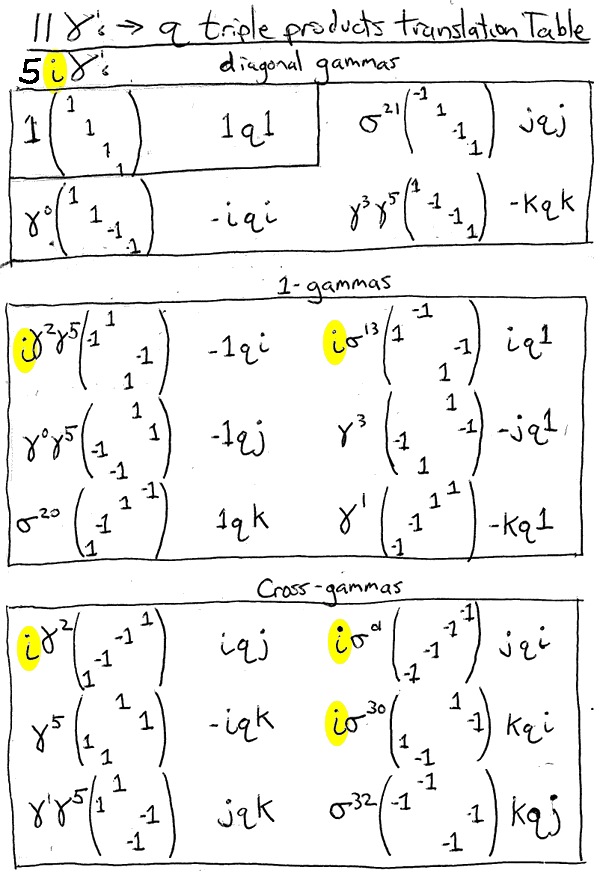
Gotta Get 11 Dirac Gamma Girls, Plus 5 Doing an Imaginary Twist
[Note: based on discussions below, I decided to alter the title from "Gotta Get 16 Gamma Girls". The core figure in the blog is not of the 16 gammas in the Dirac basis, but only 11 of them. 5 of them have an extra factor of i. I will have to consult a few articles on the subject to see how they handled this issue.]
I like to think I once led an eclectic, interesting life. I have bribed police in the mid-East, outrun the Bulgarian mafia while driving to get my picture taken with Albanian rebels in Macedonia and searched for the spark true conviction in ancient monasteries. I have generally thought there should be some type of D&D game about my life, or at least a TV movie of the week.
But I am not complete. For example, I have never owned a nightclub, been on any Vanity Fair 'fabulous' list, had a Haitian drug gang put out a hit on me or...died of a drug overdose. Drugs are nasty business, I am told, right after being told how awesome they are, and always by the same people.