A new poll by Nature and Scientific American, out in SA's October 2010 issue, notes that scientists have had a tough year - the "leaked 'Climategate' e-mails painted researchers as censorious," the H1N1 outbreak "led to charges that health officials exaggerated the danger to help Big Pharma sell more drugs," and the Harvard investigation that found holes in a professor's data. Nature and SA wanted to know - does the public1 still trust scientists?
The two polled readers using an internet survey on their Web sites, and more than 21,000 people responded.2 Here are the results:
How much do people trust what scientists say?
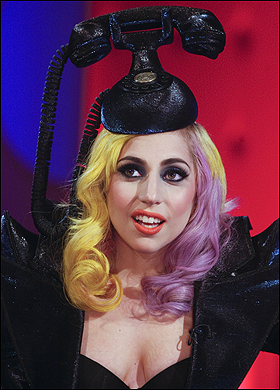
I have to be honest, if a casual question arose like 'who would you believe on science topics, Michael Shermer or Lady Gaga?' I would side with Shermer.
I know, I know, that is a vicious stereotype and I haven't read every single thing Lady Gaga has said regarding science, some of which might be correct, and then compared it to every speculation someone might have overheard Shermer say somewhere, which might have been incorrect - and because I have not been able to do that sort of comparison, some fringe pseudo-science apostates will claim it is entirely possible that Lady Gaga knows more about cell phones than Michael Shermer and therefore I am big ol' repressive science media if I do not give them equal time. So here I go.
UPDATE: This was written before the 22 February earthquake, and I realise that recent events show my arguments may be a little too simplistic. My heart goes out to all thouse affected.
In hindsight, comparing Christchurch and L'Aquila to other earthquakes like Haiti and Sichuan would have better illustrated my point about building codes saving lives.
I am spending a few pleasant days in Split for the conference "LHC Days". I will be representing the D0 and CDF collaborations here in a talk on top physics at the Tevatron; in the meantime, I am pleased to witness that talks are of high quality. This morning the most interesting to listen to (at least to me) was the one by Guido Altarelli, a distinguished theorist from the University of Roma III. Altarelli has given crucial contributions to the advancement of our understanding of Quantum Chromo-Dynamics in the seventies, and it is always a pleasure to listen to him (a previous report of a talk he gave in Perugia two years ago is
here).
Okay, in the past two days we've seen that our memories are malleable. We can easily be made to misremember, and easily be made to adopt memories of things that never happened. But what actually goes on in our brains as we code bad information? Can we see misinformation taking hold?
Researchers Yoko Okado and Craig Stark can.
They showed subjects slides (correct information), and then showed them another set of slides with details changed (incorrect information).
The Nobel Prize in Physiology or Medicine 2010 was awarded to Robert G. Edwards "for the development of in vitro fertilization".
Their reasoning seemed to be partly cultural - that Edwards battled societal and establishment resistance to his development of the in vitro fertilization procedure, which has so far led to the birth of around 4 million people.
Edwards, now 85 and professor emeritus at the University of Cambridge, began working on IVF in the 1950s and developed the technique with British gynecologist Patrick Steptoe, who died in 1988 - posthumous prizes are not allowed. In IVF, egg cells are removed from the mother and fertilized outside her body and then implanted into the womb.
The fake orgasm scene in "When Harry Met Sally" is likely the only good thing about that movie, and that's because it resonated with nearly everyone. To men, it seemed real, and women knew they could do a better job - and likely had. Recently, according to new data.
An Indiana University survey on sexual behavior covering a startling range (ages 14 to 94 - not sure which is creepier) said 85% of men believed their partners climaxed during the most recent sex act but only 64% of women affirmed that.
A group of researchers say receding glaciers due to global warming at the end of the last ice age, 20,000-100,000 years ago, resulted in the rampant biodiversity left behind in their wake.
Certainly it is true there is much less biodiversity at the poles, though likely there are limits in how hot we want the planet to be.
Investigating fossil clams and snails Steffen Kiel and Sven Nielsen at the Christian-Albrechts-Universität zu Kiel (CAU) say retreating glaciers created a mosaic landscape of countless islands, bays and fiords in which new species developed rapidly, geologically speaking.
Living in California now, I follow my third 'home' team in my life. Growing up in Vero Beach, FL I was (and remain) a Dodgers fan because they held spring training there for 60 years. As an adult living in Pittsburgh I was (and remain) a Pirates fan because they were the new home team.
Yesterday I posted about how Elizabeth Loftus is able to Jedi mind trick our interpretations of memories, but what about creating entirely new memories?
Oh yeah, baby. Actually, making a false memory is pretty easy. Loftus describes a father convincing his daughter she’d gotten lost in a mall when she was five years old. At first, the daughter denied any memory of the event, but as the father provided more fake details—“Don’t you remember that I told you we would meet at the Tug Boat”—the daughter began to “remember” and even provide details of her own. Eventually when her father said “I was so scared,” she responded “Not as scared as I was!”