Understanding Climate : #2 - Earth Air Water FireClimate science is a cross-disciplinary study.
I have listed some of the disciplines in
Understanding Climate : #1 - Components Of Climate and have hinted at others in
Mother Earth Cycles To Work.
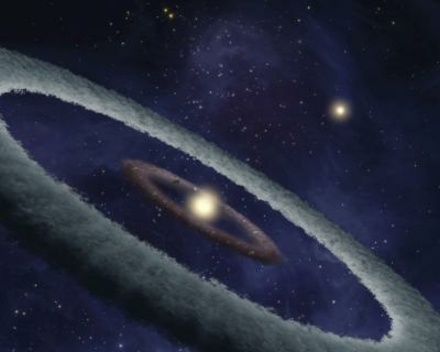
In this article I shall introduce some astronomical scale inputs to our global climate system. I shall be developing the ideas in what I hope will be easily digested chunks.
This is the first chunk of the astronomy section.
I had previously speculated on how electric and magnetic fields generated by individual neurons may be able to
transmit information to other neurons with which they are not in synaptic contact. From a purely physical point of view it strikes me as at least something to investigate. After all, we know that there are broad sweeps of electric fields that travel across the brain - whether alpha, beta, gamma, delta or theta waves. Such endogenous fields are both generated by the brain and feed back upon the brain. There must therefore be a mechanism by which such emergent fields are generated, sustained and propagated by the basic units of our brain: the neurons.
Have you ever seen a galaxy ?
I mean, not a picture of one. The real thing. A picture is a representation of reality, and as such it conveys to our senses only a pale suggestion of the stimulation that experiencing the real thing provides. In a world where images, still and in motion, have a dominant role in our lives, we tend to forget how different are some things when we experience them directly.
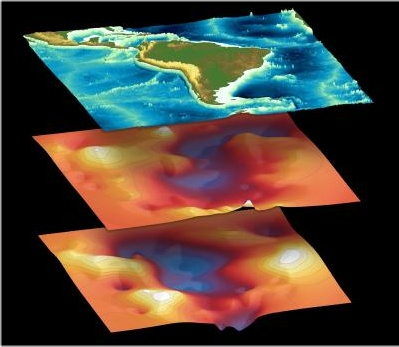
The high-magnitude earthquake that struck southern Central Chile last month closed one of the two remaining seismic gaps at the South American plate boundary. After the quake in Concepción, the remaining gap in the north of Chile now holds potential for a comparable strong quake and is, thus, moving more and more into the focus of attention.
The GFZ German Research Centre for Geosciences has been monitoring this gap with the Integrated Plate Boundary Observatory (IPOC) in Chile since 2006, and now the duties will be taken up the Universidad de Chile and the Universidad Catolica del Norte.
In a report published in the Proceedings of the National Academy of Sciences, researchers from The Wistar Institute suggest that mice that lack the p21 gene gain the ability to regenerate lost or damaged tissue.
The team says their findings provide solid evidence to link tissue regeneration to the control of cell division.
Unlike typical mammals, which heal wounds by forming a scar, these mice begin by forming a blastema, a structure associated with rapid cell growth and de-differentiation as seen in amphibians. The loss of p21 causes the cells of these mice to behave more like embryonic stem cells than adult mammalian cells
Until recently, it was thought that white dwarfs could not exceed what is known as the Chandrasekhar limit, a critical mass equaling about 1.4 times that of the Sun, before exploding in a supernova.
Since 2003, four supernovae have been discovered that were so bright, cosmologists wondered whether their white dwarfs had surpassed the Chandrasekhar limit, dubbed the "super-Chandrasekhar" supernovae.
Scientists have an emerging interest in lectins, naturally occurring chemicals in plants, because of their ability to halt the chain of reaction that leads to a variety of infections.
Now, researchers from the University of Michigan say they have found a potent inhibitor of HIV, derived from the lectin found in bananas that may open the door to new treatments to prevent sexual transmission of HIV.
In laboratory tests, BanLec, the lectin found in bananas, was as potent as two current anti-HIV drugs, T-20 and maraviroc, currently in clinical use. Based on the findings published in the Journal of Biological Chemistry, BanLec may become a less expensive new component of applied vaginal microbicides.
Writing in Nature Biotechnology, an international team of scientists say they have transferred broad spectrum resistance against some important plant diseases across different plant families.
The findings could provide a new biotechnological solution to engineering disease resistance and may help improve food security as a result.
Breeding programs for resistance generally rely on single resistance genes that recognize molecules specific to particular strain of pathogens. Hence this kind of resistance rarely confers broad-spectrum resistance and is often rapidly overcome by the pathogen evolving to avoid recognition by the plant.
New archaeological evidence recovered at Cova Gran de Santa Linya (Southeastern PrePyrenees, Catalunya, Spain) suggests that 'modern humans' first appeared on the Iberian Peninsula during the Middle/Upper Palaeolithic transition, according to researchers from the Universitat Autònoma de Barcelona.
The research, published in the Journal of Human Evolution, also supports the hypothesis that there was neither interaction nor coexistence between humans and Neanderthals during the period.
Cova Gran is a large shelter covering a total surface area of 2,500 meters squared,
Environmentally friendly products are everywhere, but consumers aren't purchasing them because they care about the environment, according to a new University of Minnesota study.
"Green purchases are often motivated by status," says Vladas Griskevicius, assistant professor of marketing at the University of Minnesota's Carlson School of Management. "People want to be seen as being altruistic. Nothing communicates that better than by buying green products that often cost more and are of lower quality but benefit the environment for everyone."