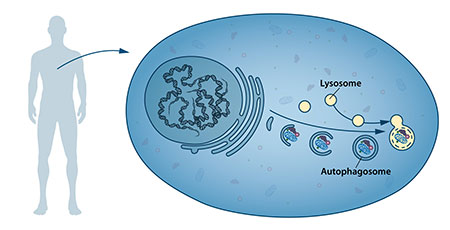


Yoshinori Ohsumi of the Tokyo Institute of Technology has been awarded the Nobel Prize in Physiology or Medicine 2016 "for his discoveries of mechanisms for autophagy", the body's recycling system. Autophagy can rapidly provide fuel for energy and building blocks for renewal of cellular components, and is therefore essential for the cellular response to starvation and other types of stress. 

Despite the bizarre claims of supernaturalists like Joe Mercola, D.O., or writers on Livestrong, the controlled digestion of damaged organelles within a cell are complex. Autophagy kills the cells

A type of immune antibody that can rapidly evolve to neutralize a wide array of influenza virus strains - including those the body hasn't yet encountered - suggests potential strategies for creating improved or even "universal" influenza vaccines.

The novel infection-fighting protein, named 3I14 mAb, is a "broadly neutralizing antibody," so-called because it can recognize and disable a diverse group of the 18 different strains of influenza virus that circulate around the globe.

According to the new report, the 3I14 antibody demonstrated it could neutralize the two main types of influenza A virus, group 1 and 2, and protected mice against lethal doses of the virus.

This is a news story that broke recently, on the idea that Elon Musk's plans would violate the Outer Space Treaty. The articles I've read so far focus on property rights and the  provisions in the OST that rule out ownership of territory. But that can be fixed with future legislation, especially since it's not really the land but the habitats that are of most value, and ownership of those is already covered in the OST . So far none of them have mentioned by far the toughest legal and practical obstacle, which is planetary protection of Mars from Earth microbes to preserve its science value for the future of mankind. That can't be fixed by passing new laws. Elon Musk says the mission would be dangerous, with colonists risking death, especially the first ones.

The INFN exam for nuclear and subnuclear physicists, to select 58 new researchers, took place on September 19th (first test) and 20th (second test) in Rome. Two different locations for the two tests were set up as the number of candidates who enrolled in the selection were 720, a too large number to manage in a single location.


 Microsporidia are typically found in the intestinal tracts of animals and humans, which are made up of millions of cells, which is why studying their mode of reproduction has been so difficult. Yet it's important. Microsporidia cause diarrhea, an illness called microsporidiosis, and even death in immune-compromised individuals.

In spite of those known widespread medical problems, scientists were uncertain about how these single-celled fungi reproduced in human or animal cells. In a study that employed transparent roundworms, biologists at the University of California San Diego succeeded in directly observing how these microorganisms replicate and spread. And what they saw surprised them.

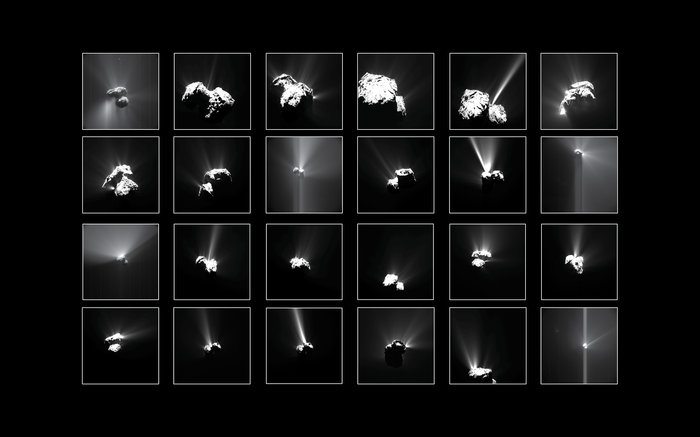
ESA’s Rosetta mission has concluded as planned, with the controlled impact onto the small lobe of Comet 67P/Churyumov–Gerasimenko, close to a region of active pits in the Ma’at region, which it had been investigating for more than two years.  

Confirmation of the end of the mission arrived at ESA’s control centre in Darmstadt, Germany at 11:19 GMT (13:19 CEST) with the loss of Rosetta’s signal upon impact, but the descent gave Rosetta the opportunity to study the comet’s gas, dust and plasma environment very close to its surface, as well as take very high-resolution images.  Pits are of particular interest because they play an important role in the comet’s activity. They also provide a unique window into its internal building blocks. 

Some loss of memory is often considered an inevitable part of aging, but new research reveals how some people appear to escape that fate. A study older adults whose memory performance is equivalent to that of younger individuals and finds that certain key areas of their brains resemble those of young people. 

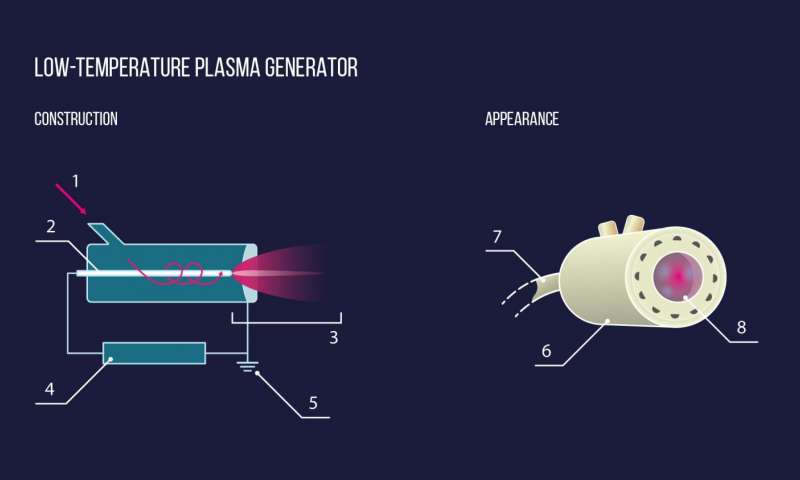
Russian scientists at the Moscow Institute of Physics and Technology (MIPT), the Joint Institute for High Temperatures of the Russian Academy of Sciences (JIHT RAS), and Gamaleya Research Centre of Epidemiology and Microbiology found that treating cells with cold plasma leads to their regeneration and rejuvenation. This result can be used to develop a plasma therapy program for patients with non-healing wounds. The paper has been published in the Journal of Physics D: Applied Physics.

Using experimental techniques, researchers have made the first ever direct observation of the elusive dewetting process, which takes place when a liquid film retracts to form a bead-shaped drop. The achievement could now spark a new line of research and lead to breakthroughs involving the use of liquids, such as better coatings and more effective self-cleaning surfaces.