







In the largest and longest study to date of weight loss maintenance strategies, researchers at Duke University Medical Center found that personal contact – and, to a lesser extent, a computer-based support system – were helpful in keeping weight off.

“The results of this study send a strong signal to those who seem to believe that obesity is such an intractable problem that nothing can be done about it,” says Dr. Laura Svetkey, professor of medicine at Duke and the lead author of the study. “Our research shows that is not true. A large majority of the participants in the Weight Loss Management study lost weight and kept weight off for two and one-half years.”

Rather than improving motorist safety, red-light cameras significantly increase crashes and are a ticket to higher auto insurance premiums, researchers at the University of South Florida College of Public Health conclude.

“The rigorous studies clearly show red-light cameras don’t work,” said lead author Barbara Langland-Orban, professor and chair of health policy and management at the USF College of Public Health. “Instead, they increase crashes and injuries as drivers attempt to abruptly stop at camera intersections. If used in Florida, cameras could potentially create even worse outcomes due to the state’s high percent of elderly who are more likely to be injured or killed when a crash occurs.”

Science has developed sophisticated models of the atmosphere and instruments can help make detailed weather forecasts but to truly understand global climate change, scientists need more than just a one-day forecast or a seven-day guess. They need a deeper understanding of the complex and interrelated forces that shape climate.

They need applied mathematics, says Brad Marston, professor of physics at Brown University. He is working on sets of equations that he says can be used to more accurately explain climate patterns.

“Climate is a statement about the statistics of weather, not the day-to-day or minute-by-minute fluctuations,” Marston said. “That’s really the driving concept. We know we can’t predict the weather more than a couple of weeks out.

Snakes don't eat fugu, the seafood delicacy prepared from blowfish meat and famed for its poisonous potential. However, should a common garter snake wander into a sushi restaurant, it could fearlessly order a fugu dinner.

The snakes have evolved resistance to the blowfish poison, tetrodotoxin (TTX), by preying on rough-skinned newts, which also secrete the toxin. Some newts are so poisonous that they harbor enough TTX to kill a roomful of adult humans.

Why would a small animal produce such an excessive amount of poison" The answer lies in the evolutionary back-and-forth between newts and garter snakes.

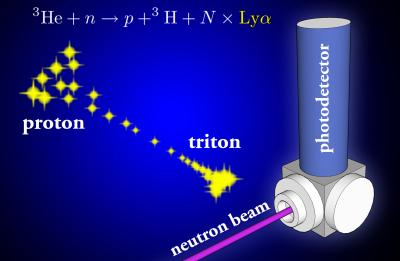
Researchers at the National Institute of Standards and Technology (NIST) and the University of Maryland have developed a new optical method that can detect individual neutrons and record them over a range of intensities at least a hundred times greater than existing detectors.

The new detector, described at the March Meeting of the American Physical Society by Charles Clark, a Fellow of the Joint Quantum Institute of NIST and the University of Maryland, promises to improve existing neutron measurements and enable tests of new phenomena beyond the Standard Model, the basic framework of particle physics.


Neutron absorption by 3He yields tens of Lyman alpha photons, which result from the most fundamental energy jump in the hydrogen atom. This schematic illustrates the operation of a prototype Lyman alpha neutron detector. Credit: NIST

A researcher at the National University in San Diego has taken a mathematical approach to a biological problem - how to design a portable DNA detector. Samuel Afuwape, Applied Engineering professor, describes a mathematical simulation to show how a new type of nanoscale transistor might be coupled to a DNA sensor system to produce a characteristic signal for specific DNA fragments in a sample.

Afuwape explains that a portable DNA sequencer could make life easier for environmental scientists testing contaminated sites. Clinicians and medical researchers too could use it to diagnose genetic disorders and study problems in genetics. Such a sensor might also be used to spot the weapons of the bioterrorist or in criminal forensic investigations.

The growth in China's carbon dioxide (CO2) emissions is far outpacing previous estimates, making the goal of stabilizing atmospheric greenhouse gases much more difficult, according to a new analysis by economists at the University of California, Berkeley, and UC San Diego.

Previous estimates, including those used by the Intergovernmental Panel on Climate Change, say the region that includes China will see a 2.5 to 5 percent annual increase in CO2 emissions, the largest contributor to atmospheric greenhouse gases, between 2004 and 2010. The new UC analysis puts that annual growth rate for China to at least 11 percent for the same time period.

An international group of researchers has found evidence for the earliest transport use of the donkey and the early phases of donkey domestication, suggesting the process of domestication may have been slower and less linear than previously thought.

Based on a study of 10 donkey skeletons from three graves dedicated to donkeys in the funerary complex of one of the first Pharaoh's at Abydos, Egypt, the team, led by Fiona Marshall, Ph.D., professor of Anthropology at Washington University in St. Louis, and Stine Rossel of the University of Copenhagen, found that donkeys around 5,000 years ago were in an early phase of domestication. They looked like wild animals but displayed joint wear that showed that they were used as domestic animals.

LONDON, March 11 /PRNewswire/ --

A quarter (23 per cent) of all smokers have cut down since the introduction of smoke-free legislation and millions more plan to quit altogether, new research suggests.

The study shows almost one in five smokers plans to stop tomorrow on No Smoking Day (12 March), with the ban proving a key factor in triggering quit attempts.

Conducted by YouGov to mark the 25th annual No Smoking Day event, the research indicates over 2.25 million people will take part, making it the biggest No Smoking Day for years.

At the end of "Back To The Future", Doc shows up wearing futuristic clothes and possessing a swanky new addition to his DeLorean - a "Mr. Fusion" device so that he no longer required the Plutonium that caused all of the problems with the terrorists. He just threw in potato peels and a beer can (pouring in the beer first, for reasons that were scientifically unclear) and off they went.

It may not be fusion, but it's possible to turn garbage into fuel, say University of Maryland researchers. They started with bacteria from the Chesapeake Bay and came up with a process that may be able to convert large volumes of all kinds of plant products, from leftover brewer’s mash to paper trash, into ethanol and other biofuel alternatives to gasoline.


