








A nationwide project to study the genetic causes of rare developmental disorders has found 12 causative genes that were unidentified before. The Deciphering Developmental Disorders (DDD) nationwide genome-wide diagnostic sequencing program sequenced DNA and compared the clinical characteristics of over a thousand children to find the genes responsible for conditions that include intellectual disabilities and congenital heart defects, among others. 

Bisphosphonates are medications commonly used to treat osteoporosis and other bone conditions but a new analysis suggests that women who use bisphosphonates also have about half the risk of developing endometrial cancer as women who don't use the drugs. 

Endometrial cancer, which arises in the lining of the uterus, accounts for nearly 50 percent of gynecologic cancers diagnosed in the United States, and it is the fourth most common malignancy in women and the eighth most common cause of cancer death.

While bisphosphonates are known to prevent bone loss, preclinical studies have shown that the medications also have antitumor effects, including the ability to keep tumor cells from multiplying and from invading normal tissues.

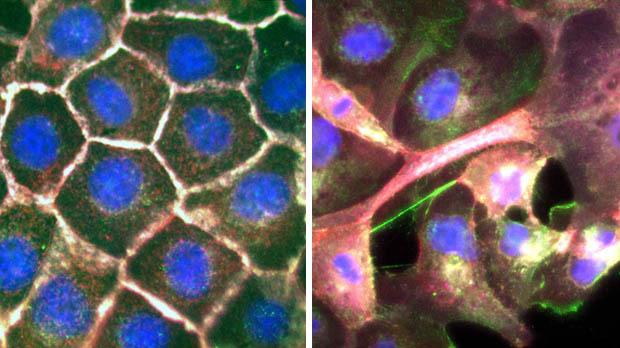
The researchers at the Cancer Research UK Manchester Institute discovered that the ties which lash cells together - controlled by a protein called TIAM1 - are chopped up when cell maintenance work goes wrong.

People who occupy the extreme ends of the political spectrum, be they liberals or conservatives, are less influenced by outside information bias than political moderates, according to psychologists.

The research used a simple estimation task and was conducted by psychologists Mark J. Brandt and Anthony Evans of Tilburg University and Jarret T. Crawford of The College of New Jersey. They hold that because political extremists see their own beliefs as superior to the beliefs of others, they are more resistant to so-called anchor bias, even for non-political information.


Extreme weather is more common than ever. EPA, CC BY-NC

By Mark Maslin, University College London

Climate change is one of the few scientific theories that makes us examine the whole basis of modern society.

It is a challenge that has politicians arguing, sets nations against each other, queries individual lifestyle choices, and ultimately asks questions about humanity’s relationship with the rest of the planet.

In the mid-1960s the Elizabethan morality play space western known as "Star Trek" debuted and series creator Gene Roddenberry was cagey about when exactly it took place (thus the reason to use 'star dates'), but it had to have been in the 23rd century if later writers were getting their information relayed correctly.  Regardless of the exact dates of their five year mission, the public was energized by the future - and the gadgets it contained.

Portable computers were completely believable and wireless communications already existed. A fax machine was clearly on the horizon, since the teletype had already existed since 1915 and a fax just required a phone line - but medical diagnosis was not even close to "Star Trek"'s future yet.

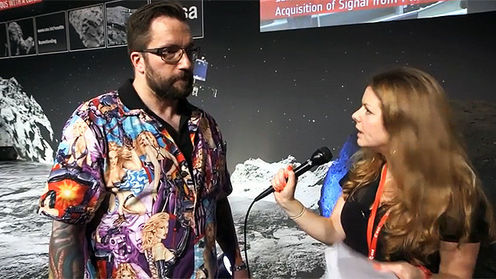
The shirt Matt Taylor wore while being interviewed about the Rosetta space mission set off a media and online shirtstorm. Youtube/ ESA

By Jamilla Rosdahl, University of the Sunshine Coast

According to some papers, human echolocation is another "sense," working in tandem with hearing and touch to deliver information to people with visual impairment.

A new paper adds evidence for the vision-like qualities of echolocation in blind echolocators - by wrongly judging how heavy objects of different sizes felt.

The experiment, conducted by psychologist Gavin Buckingham of Heriot-Watt University in Scotland and colleagues at the Brain and Mind Institute at Western University in Canada, demonstrated that echolocators experience a "size-weight illusion" when they use their echolocation to get a sense of how big objects are, in just the same way as sighted people do when using their normal vision.

By David Glance, University of Western Australia

People of the western world have been making resolutions for the new year for over 4,000 years.

The Babylonians, along with the Romans who later developed the idea further, made resolutions in the hope of favorable returns from the gods.

The "Basel-Gasfabrik" Celtic settlement, at the present day site of Novartis, was inhabited around 100 B.C. and is one of the most significant Celtic sites in Central Europe.

A team recently examined samples from the backfill of 2000 year-old storage and cellar pits from the Iron Age and found the durable eggs of intestinal parasites like roundworms (Ascaris sp.), whipworms, (Trichuris sp.) and liver flukes (Fasciola sp.).


