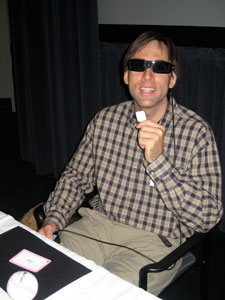
Erik Weihenmayer wears sunglasses often. He was wearing them to protect his eyes when he reached the summit of Mount Kilimanjaro in 1997. He had them on when he completed the 2003 Primal Quest, the world's toughest multi-sport adventure race. And, he put on a pair during a recent visit to the National Eye Institute (NEI).
But this last set is no ordinary pair of Oakley sunglasses.
Weihenmayer looks through them, peering down at a white note card on a table. He silently moves his head back and forth, up and down. After a few moments, he says, "Is that a 12?"
In 1988, Günter Wächtershäuser published a remarkable idea that excited tremendous interest, even being featured in a Scientific American article. It ran counter to prevailing ideas about the origin of life, and suggested new experimental approaches involving mineral interfaces. Wächtershäuser is a patent lawyer in Munich, Germany who enjoys fabricating intricate and novel approaches to the origin of life, then challenging others to test them. He is greatly influenced by the philosopher Karl Popper, who made the point that explanations are useless unless they are falsifiable.
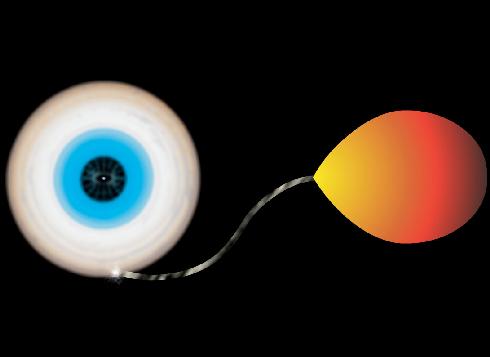
Pulsars are superdense neutron stars, the remnants left after massive stars have exploded as supernovae. Their powerful magnetic fields generate lighthouse-like beams of light and radio waves that sweep around as the star rotates. Most rotate a few to tens of times a second, slowing down over thousands of years.
The Mars rover, Opportunity, surveyed the rim and interior of Victoria Crater on the Red Planet from September 2006 through August 2008. Key findings from that work, reported in the May 22 edition of Science, reinforce and expand what researchers learned from Opportunity's exploration of two smaller craters after landing on Mars in 2004.
You're sitting in a room filled with a gazillion air molecules - how likely is it that most of those air molecules will spontaneously end up in the corner of the room opposite of where you're sitting?
Most likely you're not too concerned about this scenario, because something like that, a massive fluctuation in the distribution of air molecules in the room, is extremely unlikely, to put it mildly.
When you have zillions of air molecules bouncing around in a room (zillions here being on the order of 10^28 molecules of the various gases that make up air), the fluctuations away from the average distribution are miniscule.
If you own a computer you have probably gotten a 'virus' but there have been no major outbreaks of mobile phone viral infection despite the fact that over 80 percent of Americans now use these devices. A team headed by Albert-Laszlo Barabasi, director of the Center for Complex Network Research at Northeastern University, set out to explain why this is true.
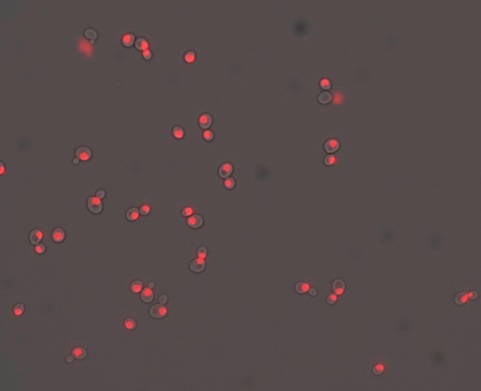
A class of drugs already approved as cancer treatments might also help to beat alcohol addiction. That's the conclusion of a discovery in flies of a gene, dubbed happyhour, that has an important and previously unknown role in controlling the insects' response to alcohol.
Animals with a mutant version of the gene grow increasingly resistant to alcohol's sedative effects, the research shows. The researchers report further evidence that the gene normally does its work by blocking the so-called Epidermal Growth Factor (EGF) pathway. That EGF pathway is best known for its role in cancer, and drugs designed to inhibit the EGF receptor, including erlotinib (trade name Tarceva) and gefitinib (trade name Iressa), are FDA-approved for the treatment of non-small cell lung cancer.
New research provides exciting genetic insight into a rare syndrome that first appeared in the medical literature in the mid 1800s with the case of Julia Pastrana, the world's most notorious bearded lady. The study, published by Cell Press in the May 21st issue of the American Journal of Human Genetics, reveals intriguing molecular clues about the pathogenesis of this mysterious condition that has captured the attention of the public since the Middle Ages.
Is there an advantage to being short? I think so, but I'm biased, being what the French call quite "petite." Good things come in small packages, I say.
But now at least one person with a presumably solid foundation in science backs me up. So when I hear yet another short joke (and I think I've heard 'em all), I can smile smugly to myself and know that all you leviathan, Brobdingnagian skyscrapers over 5' (or for the non-abnormal-American-measurementally inclined, 1.5 m) are actually at a disadvantage.
Later In Life

Like dolphins and unicorns, butterflies exist mostly to show artists what to draw on
Trapper Keepers. As such, you wouldn’t expect there to be a major difference between the genders. Natural selection should be working hard to keep all butterflies at maximum cuteness. Yet selection giving the males a slight advantage in the arms race to the Lisa Frank drawing board, and scientists want know why.