Practically every month in my Chemistry World there appears an article where a group of workers has synthesized some natural product with amazing ingenuity. But why, to use a Hogwartsian analogy, does one go to such great effort when the greenhouse is only a walk away from the potions department? So let us join Professor Sprout for a walk around the Hogwarts greenhouses.
Some plant families, such as the Cruciferae and the Labiatae are remarkably free from poisonous plants, whereas others such as the Araceae all seem to come with a toxic hazard warning sign.
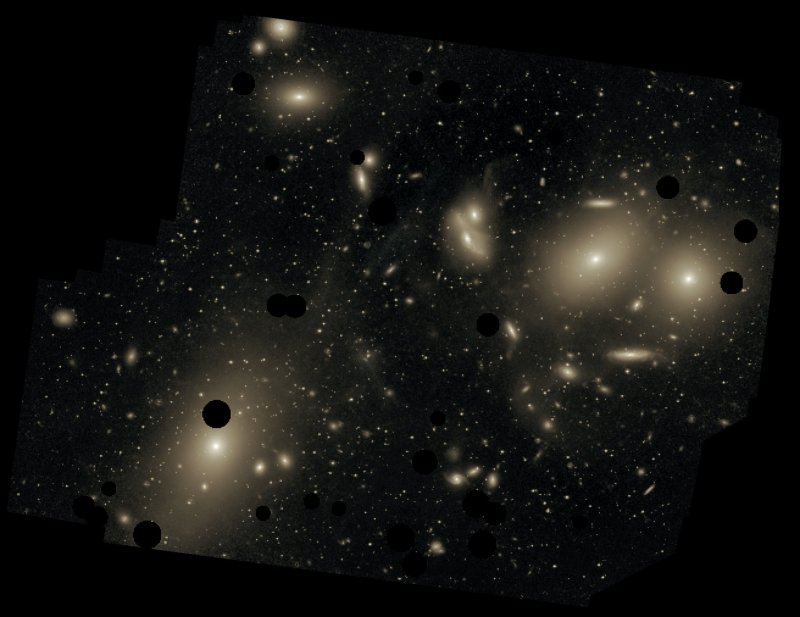
Using ESO's Very Large Telescope, astronomers have succeeded in measuring the size of giant galaxy Messier 87 - or what they thought there should be. It turns out that its outer parts have been stripped away - and no one is yet sure how. To add to its woes, the galaxy also appears to be on a collision course with another giant galaxy in this dynamic cluster.
Scientists sometimes regret when the terms they use in a scientific way get a colloquial meaning. In physics, Peter Higgs has to like his name recognition but might edit out references to a '
God particle' if he had it to do over again, and in biology a week doesn't go by that biologists won't complain that people misunderstand the term 'junk DNA.'
Well, 'junk' had a meaning before biology and everyone knew it - junk DNA in biology isn't garbage yet it dominates the genome and seems to lack specific functions. Why nature would force the genome to carry so much excess baggage is a puzzle still unsolved.
Cambridge University researchers have discovered that whether someone is a 'people-person' may depend on the structure of their brain: the greater the concentration of brain tissue in certain parts of the brain, the more likely they are to be a warm, sentimental person. Interestingly, the orbitofrontal cortex and ventral striatum have previously been shown to be important for the brain's processing of much simpler rewards like sweet tastes or sexual stimuli.
What happens when a guy married to an art historian who dislikes religion writes a book using science? "Angels&Demons", that's what. It's the book Dan Brown wrote that made even less sense than "The DaVinci Code", because it was written before that blockbuster hit, even though the new movie seems like a sequel.
Because it was written three years earlier, he had yet to refine his craft of jumbling vaguely non-specific pop social science with revisionist history - though he still knows he dislikes Catholics enough - and basically works in the expected conspiracy theory with some science as the weapon.
The politics of science is about more than just funding and science-based policy decisions: governments, and in particular the US Federal Government, are into science education in a big way, whether you like it or not. In fact, it's hard to see how the US government can avoid being in the science education business, even if it's not setting national standards for local schools: when people want to know about swine flu, they turn to the US Centers for Disease Control; the major science agencies, the NSF, NASA, NIH, DOE, are obligated (sometimes by law) to explain to the public how billions of dollars of research funds are being spent, and many of the US national parks have visitor centers that explain the science behind the parks' impressive natural wonders.
In the last few days I indulged in a rather technical description of the checks I made on DZERO's evaluation of the significance of their observation of Omega_b particles. In those occasions I did not discuss either what the Omega_b is, nor what is its relevance, nor the details of how DZERO collected a small but significant sample of events characterized by the production of that ephemeral particle.
"We have the habit, as humans, of only thinking that what we see is real", began Neil Tyson. Our job as astronomers is to 'turn something invisible and make it real'. His premise: space weather is important to study, but scientists also have to step up their game in communicating why this is important.
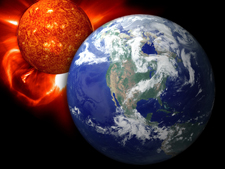
Dr. Neil deGrasse Tyson spoke at the 3rd Space Weather Enterprise Forum today. As an astrophysicist and director of the Hayden Planetarium, part of his job is "when the universe flinches and the reporters come to knock on my door" it's "because there is a hunger" for science.
Georg, over at
Lattice Points noted
a piece about open science in Physics World:
The adoption and growth of scientific journals has created a body of shared knowledge for our civilization, a collective long-term memory that is the basis for much of human progress. This system has changed surprisingly little in the last 300 years. Today, the Internet offers us the first major opportunity to improve this collective long-term memory, and to create a collective short-term working memory — a conversational commons for the rapid collaborative development of ideas.
In the previous post we introduced the idea that indifference was the primary action at work at the biochemical and cellular levels.
At this level, it would be hard to express any survival strategy beyond probabilistic, since reproduction is asexual with those cells that have the proper attributes, being able to dominate an environment in a short period of time. Similarly, it is also an environment that is subject to genetic “plagiarism” whereby novel combinations or sources of genetic information may be acquired directly through mechanisms like conjugation. The process of conjugation results in the transfer of genetic materials from a donor cell to that of the recipient.