




Show Me The Science Month Day 25 Installment 25


In nature, there is a sucker born every day. We humans may think that we're clever, but evolution has produced con games that would put Bernie Madoff to shame. One common natural swindle is mimicry, when one species tries to pass itself off as another. Orchids and cuckoos are classic examples of nature's swindlers, but mimicry isn't limited to plants and animals. A recent study has looked at how a fungus outsmarts a termite by dressing up as a termite egg.
The increasing frequency of bacterial resistance to antibiotics is alarming.  Researchers from the Albert Einstein College of Medicine of Yeshiva University believe they may have found a solution to this seemingly losing battle.  Professor Vern L. Schramm and team have developed antibiotic compounds that do not lead to microbial resistance over time.
A preliminary study on the application of thermo-microbiology and its relation to time of death has been released by Professor Isabel Corcobado and colleagues at the University of Granada.  The ultimate goal of this project is to use a microbiological indicator along with existing forensic techniques in order to determine time of death in forensics cases more accurately.
If the Higgs boson, whatever that will turn out to be, is hiding, wherever it may be found continues to shrink.

The latest analysis of data from the CDF and DZero collider experiments at Fermilab has now excluded a significant fraction of the allowed Higgs mass range established by earlier measurements. Those experiments predict that the Higgs particle should have a mass between 114 and 185 GeV/c2. Now the CDF and DZero results carve out a section in the middle of this range and establish that it cannot have a mass in between 160 and 170 GeV/c2.

It seems obvious; even in a noble profession like education, if you pay people more who are better at it, better people are incentivized to do it. Obviously a number of people do it despite the money, just like science and academia, and the overall quality of education has improved a lot this decade but America has a way to go if we are going to keep at the forefront of science and technology in the face of huge populations in China and India.

But there has been resistance to that from educational lobbyists and a hardline union that only votes Democrat, which has unfortunately made education a political football.

Nyiragongo, an active African volcano, possesses lava unlike any other in the world, which may point toward its source being a new mantle plume says a University of Rochester geochemist.

The lava composition indicates that a mantle plume—an upwelling of intense heat from near the core of the Earth—may be bubbling to life beneath the soil of the Democratic Republic of the Congo. The findings are presented in the current issue of the journal Chemical Geology.

Women with certain gene variations appear to be protected against cervical cancer, according to a study led by scientists at Albert Einstein College of Medicine of Yeshiva University and reported in Clinical Cancer Research. Knowing whether or not women have these genetic variants could help physicians to better tailor treatment strategies.

Virtually all cases of cervical cancer are caused by persistent infections from several of the human papillomaviruses (HPV) — a family of viruses that also cause common skin warts and genital warts. HPV is the most commonly sexually transmitted infection in young adults, yet only a small subset of these infections lead to cervical cancer.

A move from the big city to a small village is always a culture shock, but can it affect just more than your Friday night plans?

Now, I've lived in rural and urban locales. But either the local water utilities people put happy pills in the water supply here, or my overstimulation cup had overfloweth'd, because this latest move seemed more a stark contrast.

Show Me The Science Month Day 24 Installment 24


How do new genes arise? One common way is through gene duplication - the creation of a second copy of a gene when the DNA replication or repair machinery goes awry, followed by the the evolution of a new function for one copy. How genes are accidentally duplicated is reasonably well understood, but once a gene is duplicated, but how does the new copy acquire a new function?

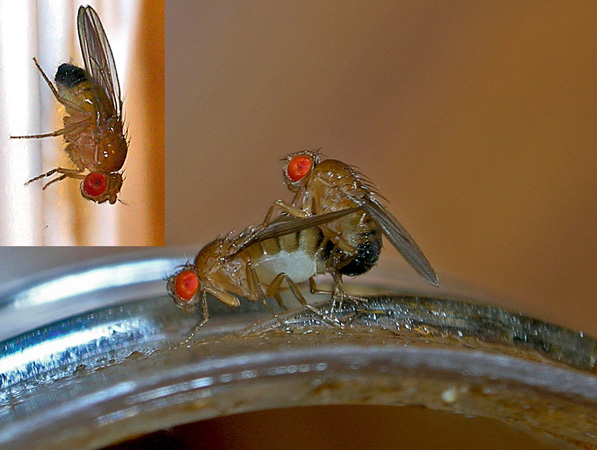
A pair of researchers in New York have looked at the role of a class of reproductive proteins in the mating behavior of different species of flies. One thing you can learn from this paper is that biologists will go to any length to learn about evolution - nobody watches fly sex for fun. Except for fly number three: (which was apparently put in by Photoshop):


But there are more lessons here. Mating behavior is in fact an excellent place to look for lessons about evolution, since reproduction is subject to strong evolutionary pressures.
While you're sipping that morning cup and looking for excuses to put off work, here's what's interesting in science around the web today (well, ok, not just today - I haven't done one of these in about a month):

Your tax money pays for the research, so shouldn't you be able to read that research without paying an arm and a leg? Biologist Michael Eisen defends the National Institute Health policy that scientists put copies of their manuscripts in a freely accessible, public repository, as Congress plans to revisit that policy at the behest of for-profit publishers. Eisen argues the policy doesn't hurt publishers, and thus there's no reason to scrap it:


