If you're happy and you know it, thank your friends—and their friends. And while you're at it, their friends' friends. But if you're sad, hold the blame. Researchers from Harvard Medical School and the University of California, San Diego have found that "happiness" is not the result solely of a cloistered journey filled with individually tailored self-help techniques. Happiness is also a collective phenomenon that spreads through social networks like an emotional contagion.
The decline of the Roman and Byzantine Empires in the Eastern Mediterranean more than 1,400 years ago may have been driven by unfavorable climate changes.
Based on chemical signatures in a piece of calcite from a cave near Jerusalem, a team of American and Israeli geologists pieced together a detailed record of the area's climate from roughly 200 B.C. to 1100 A.D. Their analysis, to be reported in an upcoming issue of the journal Quaternary Research, reveals increasingly dry weather from 100 A.D. to 700 A.D. that coincided with the fall of both Roman and Byzantine rule in the region.
As our knowledge of biology has increased exponentially, so has our potential to find new treatments and technologies to battle ailments previously incurable. However, many of these expansions of knowledge have faced stalling challenges and hurdles, halting practical applications. Gene therapy has been one of these dreams, touted as having endless potential, yet viable medical treatments were always yet to be developed. This is all about to change, as new laboratory research has seen unprecedented developments in gene therapy.
So if you are still unsure whether it's unsafe to drive while talking on a cell phone, come out of your cave. Multiple recent studies have supported that cell phone use endangers drivers. It seems that every week or so there's a new study out linking increased reaction times to the distraction caused by having a cell phone conversation, often comparing it to other types of impairments such as drinking or listening to the radio. As the research becomes more and more conclusive, scientists have attempted to find comparisons that are relevant than just a number in milliseconds.
How a bacterium overcomes a tomato plant's defenses and causes disease, by sneakily disabling the plant's intruder detection systems, is revealed in new research published in the December issue of Current Biology.
The new study focuses on a pathogen which causes bacterial speck disease in tomato plants. This bacterial invasion causes black lesions on leaves and fruit. Severe infection can cause extensive and costly damage to tomato crops, and researchers believe that understanding more about how this microbe works could lead to new ways of tackling it, and other plant diseases, without the need for pesticides.
Research carried out at MIT's Alcator C-Mod fusion reactor may have brought the promise of fusion as a future power source a bit closer to reality, though scientists caution that a practical fusion powerplant is still decades away.
Fusion, the reaction that produces the sun's energy, is thought to have enormous potential for future power generation because fusion plant operation produces no emissions, fuel sources are potentially abundant, and it produces relatively little (and short-lived) radioactive waste. But it still faces great hurdles.
"There's been a lot of progress," says physicist Earl Marmar, division head of the Alcator Project at the MIT Plasma Science and Fusion Center (PSFC). "We're learning a lot more about the details of how these things work."
Scientists at the Swedish medical university Karolinska Institutet have determined the first 3D structure of ZP3, a protein essential for the interaction between the mammalian egg coat and sperm. The findings, presented in Nature, gives a first glimpse into the molecular architecture of animal egg coats, with important implications for the future of human reproductive medicine and the possibility of developing novel contraceptives.
With up to half of a person's body mass consisting of skeletal muscle, chronic inflammation of those
muscles – which include those found in the limbs – can result in significant physical impairment.
According to University of Illinois kinesiology and community health professor Kimberly Huey, past research has demonstrated that the antioxidant properties of Vitamin E may be associated with reduced expression of certain pro-inflammatory cytokines, in vitro, in various types of cells. Cytokines are
The first robot that can jump like a grasshopper and roll like a ball could play a key role in future space exploration. The 'Jollbot' has been created by Rhodri Armour, a PhD student from the University of Bath. It's hoped his creation, which can jump over obstacles and roll over smoother terrain, could be used for space exploration or land survey work in the future.
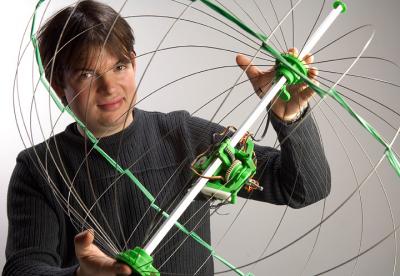
Rhodri Armour designed Jollbot as part of his Ph.D. thesis. Photo Credit: Nic Delves-Broughton, University of Bath)
Researchers using functional MRI (fMRI) have determined that the circuitry in the area of the brain responsible for suppressing memory is dysfunctional in patients suffering from stress-related psychiatric disorders. Results of the study will be presented today at the annual meeting of the Radiological Society of North America (RSNA).